
Key Takeaways
- Strength exercises help seniors maintain muscle mass and overall independence.
- Bodyweight workouts can effectively improve strength without any equipment.
- Regular exercise supports better balance, mobility, and coordination.
- Consistent strength training may help reduce the risk of falls and injuries.
- Simple home exercises make it easier for seniors to stay active and healthy.
Strength Exercises for Seniors Without Equipment, strength exercise make them healthy and fit for all day, it will help them in gaining their body muscle and improve bone density.
Getting stronger after 60 doesn’t require a gym membership, fancy machines, or any equipment at all. Your own body is the most reliable piece of fitness equipment you’ll ever own and it works just as well in your living room as it does in a facility. This guide walks you through safe, effective, and research-backed strength exercises for seniors without equipment, designed to protect your independence, prevent falls, and keep you thriving at every age.
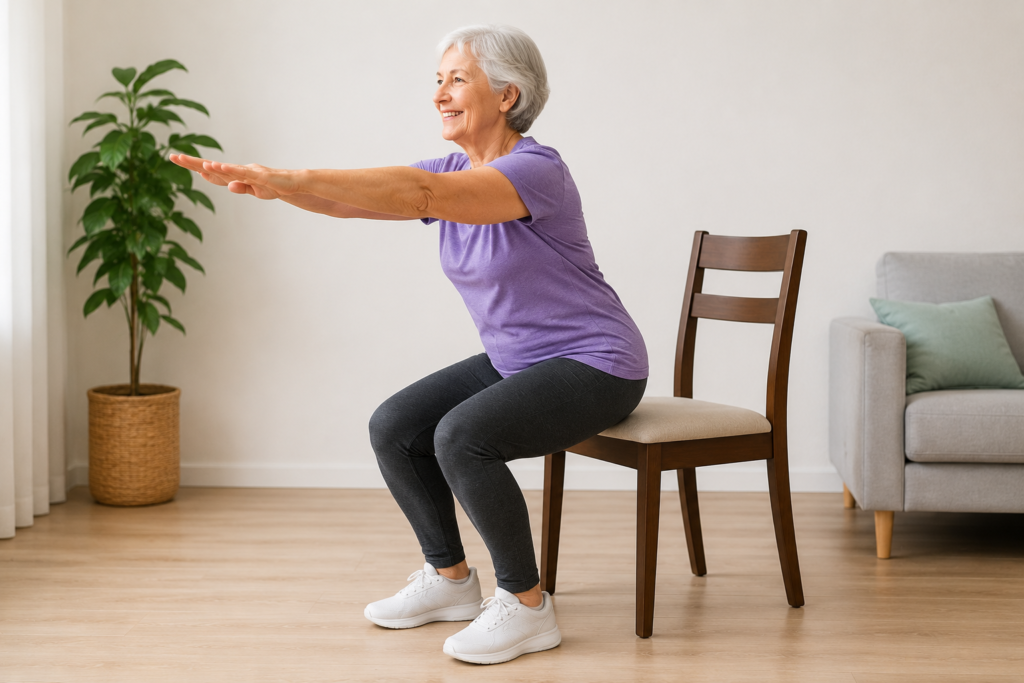
Senior Bodyweight Training Different from Regular Workouts
For most younger adults, fitness is about pushing limits. For seniors, the goal shifts toward movement quality, joint safety, and consistency over intensity. Senior bodyweight training prioritizes controlled motion, proper breathing, and adequate recovery time between sessions.
The American College of Sports Medicine recommends that older adults perform muscle-strengthening activities at least two days per week, targeting all major muscle groups. Low-impact strength exercises for seniors check this box without putting unnecessary strain on aging joints.
Age-friendly workouts also take into account common conditions like arthritis, osteoporosis, and balance concerns which is why every exercise in this guide is either standing, seated, or close to the floor with an easy exit.
Best Strength Exercises for Seniors Without Equipment
Here are the most effective, evidence-backed no-equipment exercises for seniors, organized by muscle group and difficulty level. Start with what feels manageable, not what looks impressive.
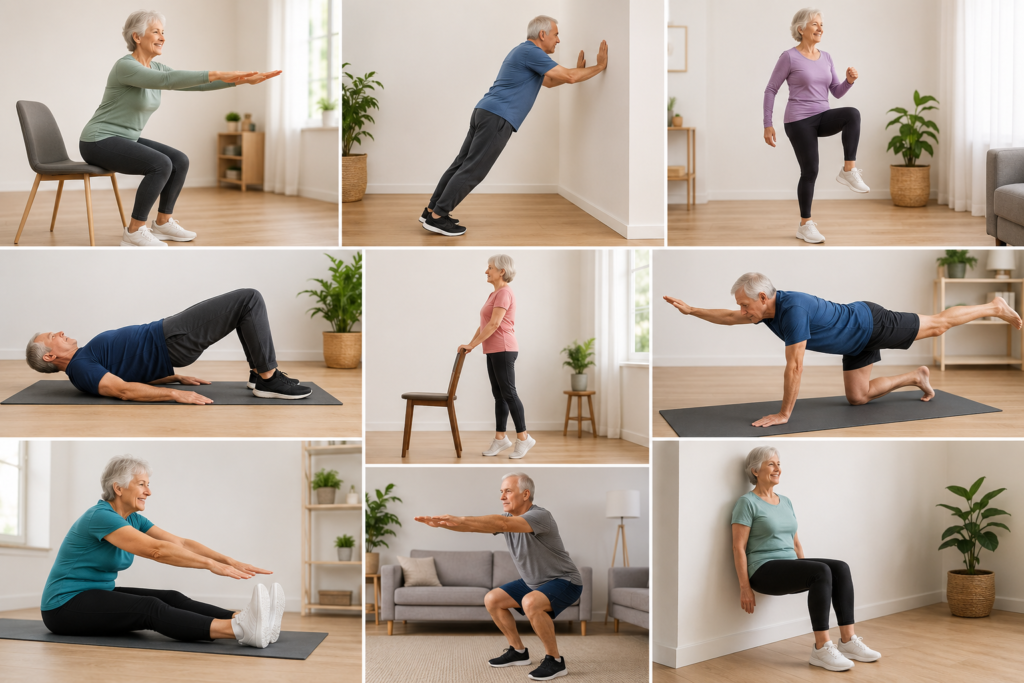
1. Chair Squats
Why it works: Sitting and standing is one of the most important daily movements. This exercise trains exactly that. Chair strength exercises for seniors don’t get more fundamental than this one.
How to do it:
- Stand in front of a sturdy chair with your feet shoulder-width apart.
- Slowly lower your hips as if you’re going to sit but stop just before you touch the seat.
- Push through your heels to stand back up.
- Aim for 8–12 repetitions, 2–3 sets.
Pro tip: Hold your arms out in front for balance. If 12 reps feels too easy, try doing it on one leg (with the chair nearby for support).
2. Wall Push-Ups
Why it works: Traditional push-ups can be hard on wrists and shoulders for older adults. Wall push-ups deliver the same chest, shoulder, and triceps benefits with zero floor contact and significantly reduced joint strain.
How to do it:
- Stand arm’s length from a wall, placing both palms flat against it at shoulder height.
- Slowly bend your elbows and lower your chest toward the wall.
- Push back to the start position.
- Perform 10–15 reps per set.
This is one of the most beginner-friendly senior strength training at home options, and it translates directly to real-life pushing movements like opening heavy doors or pushing a grocery cart.
3. Standing Calf
Why it works: Weak ankles and calves are a leading contributor to falls in older adults. According to the CDC, falls are the leading cause of fatal and nonfatal injuries among Americans aged 65 and older with 36 million falls reported each year.
How to do it:
- Stand behind a chair, lightly holding the back for support.
- Rise up onto your toes as high as you can.
- Hold for 2 seconds, then slowly lower.
- Do 12–15 reps per set.
This simple move dramatically improves balance and strength training connection, improves proprioception (your body’s sense of position), and strengthens the lower leg muscles that keep you upright.
4. Seated Leg
Why it works: On days when standing feels like too much, seated strength work still delivers real results. This chair exercise targets the hip flexors, lower abs, and quads all essential for walking stability.
How to do it:
- Sit upright in a firm chair (not a recliner) with feet flat on the floor.
- Slowly lift one leg until it’s straight and parallel to the floor.
- Hold for 3–5 seconds. Lower slowly.
- Alternate legs for 10–12 reps each.
Chair strength exercises for seniors like this one are ideal for those managing knee pain, recent surgeries, or early mobility limitations. They’re also a great starting point for strength training over 80.
5. Glute Bridges
Why it works: The glutes are the largest and most powerful muscles in the body and they’re often the most underused in sedentary older adults. Weak glutes contribute to back pain, poor posture, and unstable gait.
How to do it:
- Lie on your back with knees bent and feet flat on the floor, hip-width apart.
- Press through your heels and lift your hips toward the ceiling until your body forms a straight line from knees to shoulders.
- Squeeze at the top for 2 seconds. Lower slowly.
- Do 10–12 reps per set.
This is one of the most effective muscle strengthening exercises for seniors that requires zero equipment and puts almost no stress on the spine when performed correctly.
6. Bird Dog
Why it works: Balance and strength training must work together. The bird dog exercise trains your body to stabilize while moving which is exactly what walking, reaching, and turning require.
How to do it:
- Start on all fours (hands under shoulders, knees under hips).
- Slowly extend your right arm forward and left leg back simultaneously.
- Hold for 3–5 seconds. Return and repeat on the other side.
- Perform 8–10 reps per side.
If getting on the floor is uncomfortable, a modified version can be done standing lift one foot slightly off the ground while extending the opposite arm forward, using a wall for support.
7. Standing Hip
Why it works: Most people train forward-and-backward movements. But falling sideways tripping over a curb or stepping off an uneven surface is what injures most seniors. Hip abduction trains the muscles that prevent sideways collapse.
How to do it:
- Stand behind a chair, holding the back lightly.
- Keeping your leg straight, lift one leg out to the side (about 12–18 inches).
- Hold for 2 seconds. Lower slowly.
- Do 10–12 reps per side, 2 sets.
This move directly targets the hip abductors and glute medius the muscles most responsible for lateral stability during daily walking and stair climbing.
8. Shoulder Blade
Why it works: Rounded shoulders and forward head posture are common in seniors, largely due to decades of sitting. This simple mobility exercise for older adults counteracts that pattern and keeps the upper back strong.
How to do it:
- Sit or stand tall.
- Pull your shoulder blades together as if you’re trying to hold a pencil between them.
- Hold for 5–7 seconds. Release.
- Repeat 12–15 times.
No movement. No strain. Just pure upper back muscle activation. This is one of the most underrated resistance-free workouts for improving daily posture and reducing chronic upper back discomfort.
How Should Seniors Structure a Weekly Fitness Routine?
The World Health Organization (WHO) recommends that older adults get at least 150–300 minutes of moderate-intensity activity per week, including muscle-strengthening exercises on 2 or more days. Here’s what an effective daily exercise routine for seniors might look like:
| Day | Focus |
|---|---|
| Monday | Lower body strength (squats, calf raises, hip abductions) |
| Tuesday | Gentle walking or stretching |
| Wednesday | Upper body + core (wall push-ups, bird dog, shoulder squeezes) |
| Thursday | Rest or light mobility work |
| Friday | Full-body circuit (mix of all exercises above) |
| Saturday | Balance training + flexibility |
| Sunday | Rest |
This active aging fitness routine keeps rest days built in, avoids overtraining, and ensures every major muscle group gets attention at least twice per week.
Is It Safe to Start Strength Training Over 70 or Over 80?
Absolutely with sensible modifications and a doctor’s clearance if needed.
Research published in JAMA Internal Medicine confirmed that progressive resistance training is safe and beneficial for adults well into their 80s and 90s. In fact, the evidence suggests that the older you are, the more you benefit from starting, because muscle loss accelerates with age and each year of inactivity compounds the deficit.
For strength training over 70, the key is starting lighter (fewer reps, slower speed) and progressing gradually. For strength training over 80, chair-based or supported exercises are often the best starting point, with standing work introduced over time.
Signs you’re progressing well:
- Exercises that felt hard now feel manageable.
- You can complete daily tasks more easily.
- Your balance feels more confident.
- Fatigue after normal activities decreases.
What Role Does Nutrition Play in Maintaining Muscle Mass with Age?
Exercise without adequate protein is like building a house without cement the structure won’t hold.
According to a 2019 consensus paper from the Society for Sarcopenia, Cachexia and Wasting Disease, older adults need approximately 1.0-1.2 grams of protein per kilogram of body weight per day to maintain muscle mass higher than the standard dietary recommendation for younger adults.
Good protein sources that support maintaining muscle mass with age include eggs, legumes, lean poultry, Greek yogurt, tofu, and fish. Pairing these with your senior wellness workouts creates the biological environment muscles need to repair and grow stronger.
Vitamin D also plays a crucial role it supports both muscle function and bone strength. The NIH recommends adults over 70 get at least 800 IU of Vitamin D daily, ideally from sunlight exposure combined with dietary sources or supplementation.
What Are the Most Common Mistakes Seniors Make When Starting a Fitness Routine?
Starting too fast, skipping warmups, and expecting overnight results are the big three.
Mistake 1 Doing too much too soon.
Beginner strength training for seniors should feel mildly challenging not exhausting. If you’re gasping for breath or in significant pain, you’ve gone too far.
Mistake 2 Skipping the warmup.
Cold muscles and stiff joints don’t respond well to sudden exertion. Spend 5 minutes walking in place, rolling your ankles, and doing gentle arm circles before any workout.
Mistake 3 Ignoring rest days
. Muscles grow stronger during recovery, not during exercise. Skipping rest actually slows your progress.
Mistake 4 Exercising through pain.
Mild muscle soreness 24–48 hours after a workout is normal. Sharp, joint-level pain during exercise is a signal to stop.
Home fitness for elderly adults works best when approached as a long-term lifestyle habit, not a short-term fix.
The science is remarkably consistent:
regular strength training for older adults reduces fall risk, improves bone density, slows muscle loss, boosts mood, and supports cognitive function all without expensive equipment or gym memberships. Easy strength exercises for seniors, done consistently in your own home, deliver compounding benefits that medication can’t replicate.

Hi, I’m Salem Nasir, founder of Fiturely. I research and write evidence-based articles on fitness, nutrition, weight loss, and healthy living. My mission is to make reliable health information simple, practical, and easy to understand so readers can build healthier habits with confidence
Pingback: 7 Best Low Impact Exercises for Seniors to Improve Balance, Strength & Mobility (2026 )
Pingback: Arm Workout for Women: 10 Moves for Toned, Strong Arms - fiturely.com
Pingback: Metabolic Workout Guide: Burn More Fat in Less Time (Backed by Real Science) - fiturely.com
Pingback: 15 Best Posture Exercises for Women to Fix Slouching and Ease Back Pain - fiturely.com