
Key Takeaways
- Tai Chi for seniors is a gentle, low-impact exercise that improves balance, flexibility, strength, and coordination while reducing the risk of falls.
- Just 10-20 minutes of daily Tai Chi can support better mobility, posture, and joint health for older adults.
- Slow, controlled movements combined with deep breathing help reduce stress, improve focus, and promote overall well-being.
- Beginners can safely practice Tai Chi at home without special equipment by starting with simple, easy-to-learn movements.
- Consistent Tai Chi practice supports healthy aging, helping seniors stay active, independent, and confident in everyday activities.
Tai chi for seniors is a slow, low impact mind body exercise that improves balance, flexibility, and joint health without straining the body. It’s widely recommended for fall prevention, arthritis relief, and healthy aging, and it can be practiced standing or seated, indoors or outside, with no equipment needed. Just 10 minutes a day can build strength, stability, and calm over time.
This guide breaks down everything you need to know, including the benefits, common mistakes to avoid, safety tips, and a simple routine you can start today.
 What Exactly Is Tai Chi?
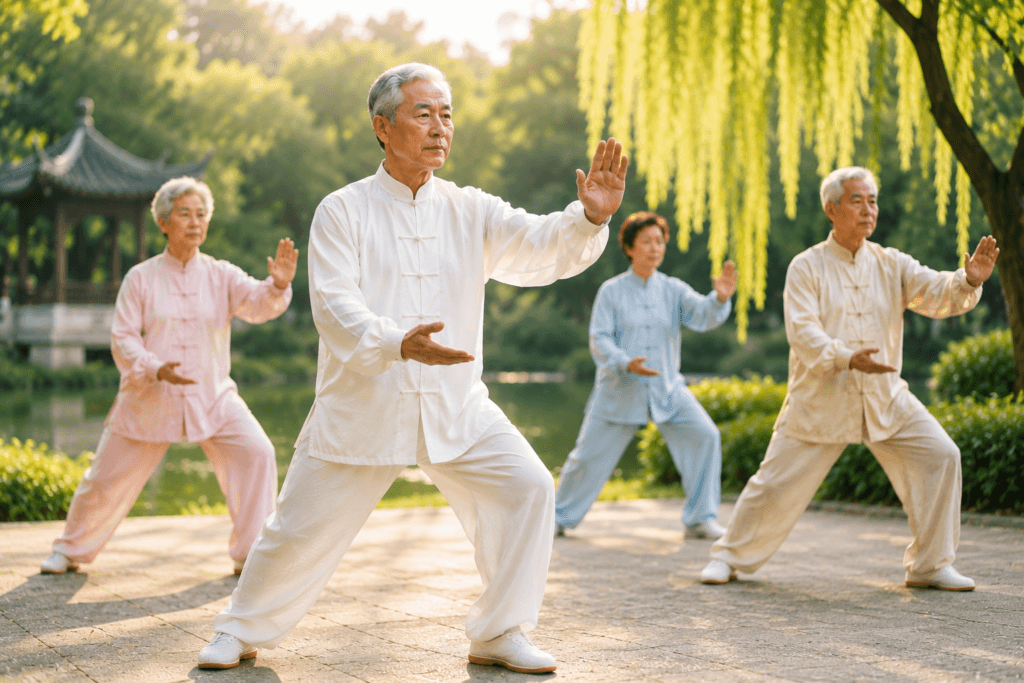 What Exactly Is Tai Chi?
Tai chi is a mind body exercise that started centuries ago as a Chinese martial art. Today, most people practice it purely for health. It combines slow, flowing movements with deep breathing and focused attention.
Unlike man of tai chi style choreography you might see in movies, real-life practice for older adults is calm, controlled, and never rushed. There are no jumps, no sprints, no high impact moves. Just steady, deliberate motion.
Health organizations like the CDC and Harvard Health Publishing have recognized tai chi as an evidence-based low impact exercise for improving balance and reducing falls in older adults. That’s not marketing talk. It’s backed by decades of research in geriatric and rehabilitation medicine.
Why Tai Chi Works So Well for Older Adults
Most exercise programs ask a lot from your joints. Tai chi asks very little, yet it gives a lot back. Here’s why it fits so naturally into senior wellness routines.
It builds balance training into every single movement. Each shift of weight from one leg to the other trains your body to stay stable, which directly supports tai chi for balance and stability.
It also strengthens muscles without strain. Holding a slightly bent knee for a slow moving posture works your legs harder than you’d expect, contributing to muscle strength and core stability over time.
And because every movement is guided by breath, tai chi doubles as one of the most accessible breathing exercises and relaxation techniques available to older adults.
If you’re also working on strength elsewhere, pairing tai chi with Strength Exercises can round out a well balanced weekly routine.
Tai Chi for Balance and Fall Prevention
Falls are one of the biggest threats to independence in later life. This is where tai chi genuinely shines.
Tai chi for fall prevention works because it trains your nervous system, not just your muscles. Slow weight shifts teach your brain and body to react faster when you stumble on uneven ground.
Studies in geriatric medicine journals have repeatedly linked regular tai chi practice with improved postural control in adults over 60. That’s why tai chi exercises to prevent falls in older adults are now recommended by many physical therapists as a standalone falls prevention program, not just a supplement to other exercise.
Combine this with mobility exercises and coordination exercises, and you get a body that moves with more confidence, indoors and out.
Tai Chi for Joint Health, Arthritis, and Pain Relief
Joint pain shouldn’t mean giving up on movement entirely. In fact, gentle motion often helps more than rest does.
Tai chi for arthritis relief is one of the most researched applications of this practice. The Arthritis Foundation has highlighted tai chi as a suitable movement therapy because it takes joints through their full range without jarring impact.
For tai chi for knee pain, the slow bending and straightening motions improve circulation around the joint without the pounding of walking or jogging. Many people notice their knees feel looser, not stiffer, after a session.
Similarly, tai chi for back pain works by strengthening the muscles that support your spine. And because it emphasizes upright posture throughout every movement, it naturally supports tai chi for better posture.
For those managing bone density concerns, tai chi for osteoporosis offers weight bearing benefits without the risk of high impact stress on fragile bones, always in consultation with your doctor, of course.
If joint pain is more localized, pairing your routine with Leg Strength Exercises can add targeted support around the knees and hips.
Flexibility, Mobility, and Everyday Function
Stiffness sneaks up on all of us. One day you’re touching your toes, the next you’re groaning just tying your shoes.
Tai chi for flexibility gently stretches muscles and connective tissue through repeated, slow motion. Unlike static stretching, it keeps your body warm throughout, which many physical therapists consider safer for older joints.
Tai chi for joint mobility also improves how well your hips, shoulders, and ankles move through daily tasks, whether that’s reaching for a shelf, stepping over a curb, or turning to check behind you while driving.
This is where functional fitness and body awareness come together. You’re not training for a sport. You’re training for real life.
How to Start Tai Chi for Seniors
Wondering how to start tai chi for seniors without feeling overwhelmed? Good news: you don’t need a gym membership, fancy shoes, or a mat.
Here’s a simple starting checklist:
- Wear comfortable, flat shoes with good grip.
- Choose a quiet space with enough room to stretch your arms fully.
- Start with 10 minutes and build up gradually.
- Focus on breathing slowly through your nose.
- Never push through sharp pain; mild effort is enough.
This is genuinely beginner tai chi for seniors advice, not an intimidating fitness plan. You’re not competing with anyone, including your younger self.
For those also building general strength alongside balance work, Resistance Band Exercises offer a similarly low impact way to add gentle resistance.
Easy Tai Chi Movements You Can Try Today
You don’t need years of training to feel the benefits. These simple tai chi movements for seniors are a great place to begin. Below is exactly how to do each one, plus what it does for your body.
1. Cloud Hands
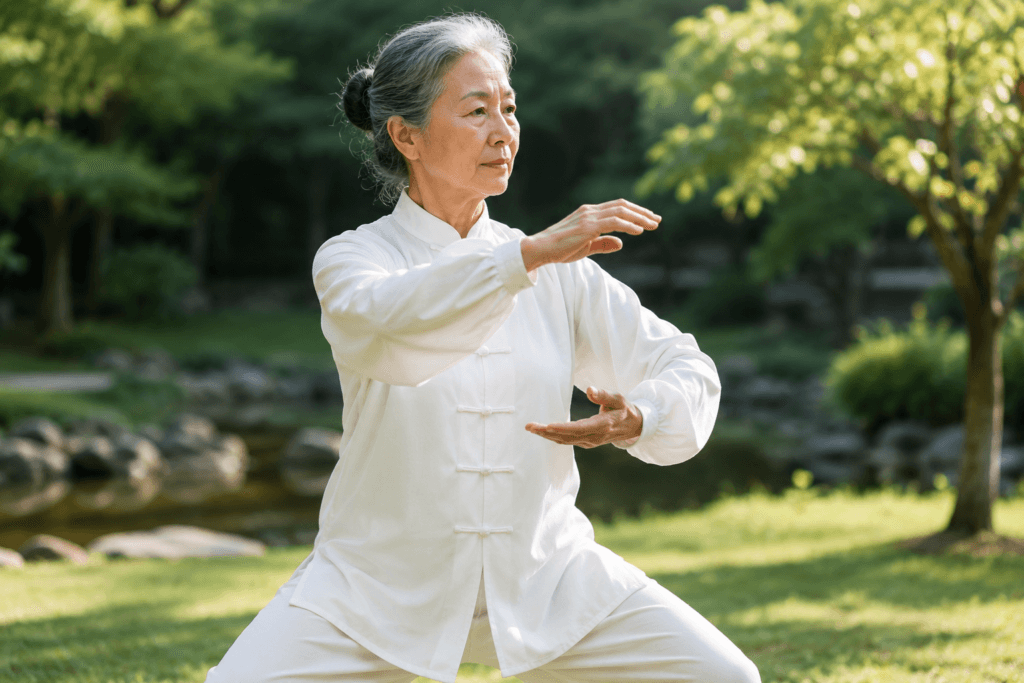
How to do it:
- Stand with your feet shoulder-width apart, knees slightly bent.
- Raise one hand to chest height and the other near your waist.
- Slowly circle both hands in front of your body, as if pushing a cloud from side to side.
- Shift your weight from one foot to the other as your hands move.
- Repeat for 8 to 10 slow rounds.
Benefits: This move builds shoulder mobility and trains balance training through the constant weight shift. It also sharpens coordination, since your arms and legs move on slightly different rhythms.
2. Brush Knee and Push
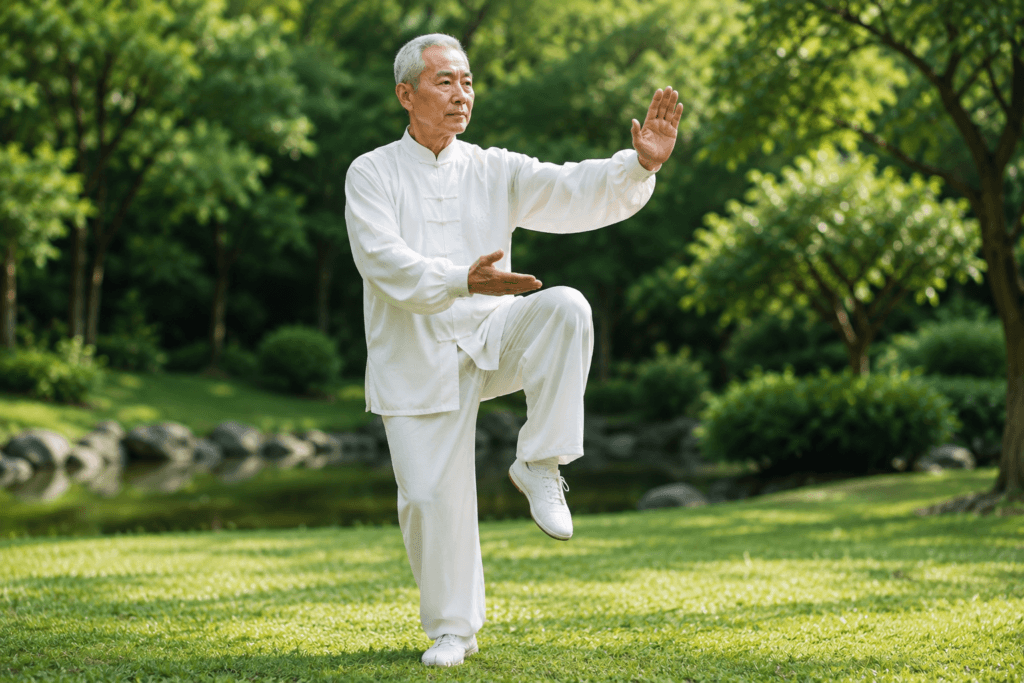
How to do it:
- Stand with one foot forward and one foot back, weight mostly on the back leg.
- Sweep the front hand past your knee in a gentle brushing motion.
- At the same time, push the other hand forward slowly, as if pressing against light resistance.
- Shift your weight onto the front leg as you push.
- Repeat 6 to 8 times on each side.
Benefits: This is one of the best leg strength exercises built into tai chi. It strengthens the quads and hips while reinforcing core stability, and it directly supports fall risk reduction since it mimics the balance shift your body makes when catching a stumble.
3. Tai Chi Walking
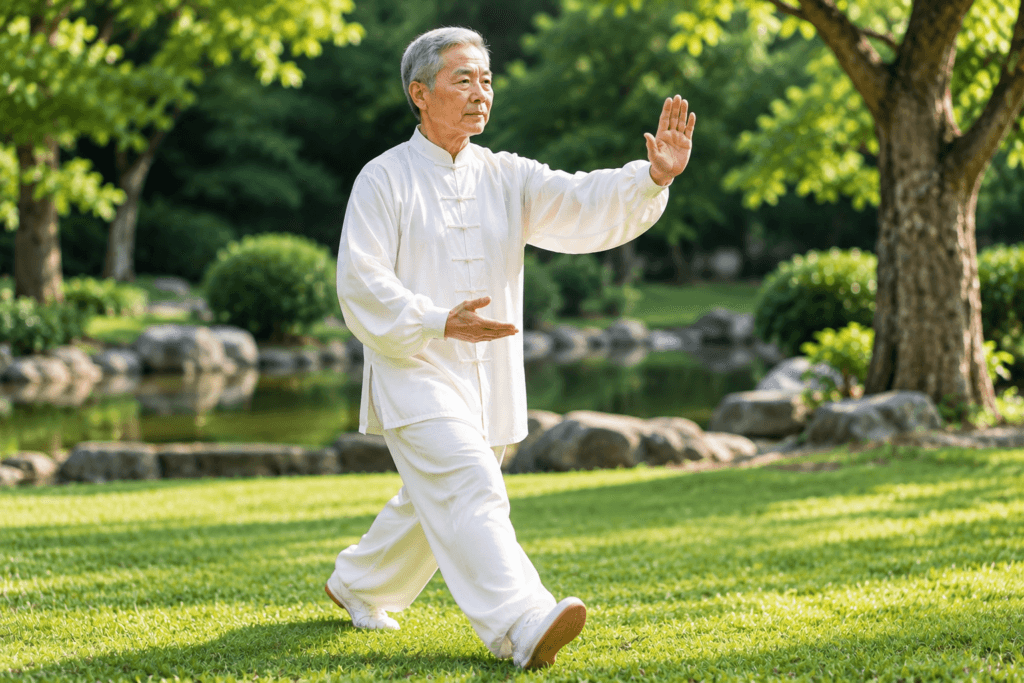
How to do it:
- Stand at one end of a clear, open space.
- Lift one foot slowly and place it down heel first, then roll onto the full foot.
- Gradually shift your weight onto that foot before lifting the other.
- Keep your attention fully on each step, without rushing.
- Walk 10 to 15 slow steps forward, then return.
Benefits: Tai chi walking improves gait and builds real confidence on uneven ground. It’s considered one of the most practical mobility exercises because it trains the exact movement pattern you use every day.
4. Breathing Warm-Up
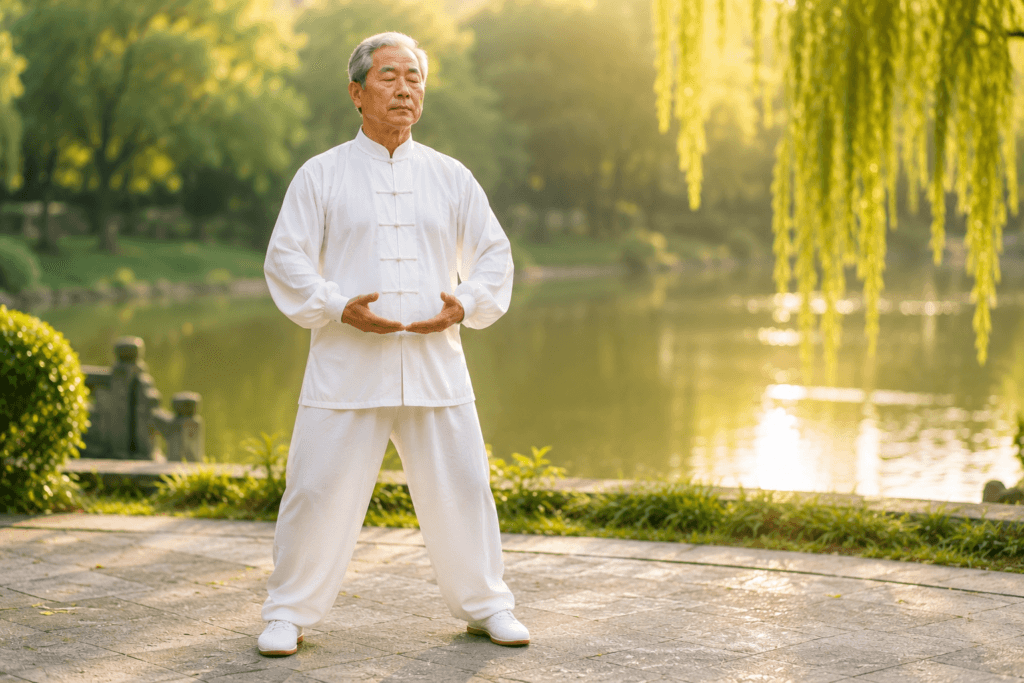
How to do it:
- Stand or sit comfortably with your arms relaxed at your sides.
- Inhale slowly through your nose for a count of four.
- Pause briefly, then exhale through your mouth for a count of six.
- Keep your shoulders down and your jaw loose.
- Continue for 1 to 2 minutes before or after your session.
Benefits: This is one of the simplest breathing exercises available, and it calms the nervous system, helps stabilize blood pressure, and sets a focused, mindful movement tone for the rest of your practice.
These moves form the backbone of most easy tai chi for seniors routines taught in community centers and senior wellness programs.
Seated and Standing Tai Chi: Which One Is Right for You?
Not everyone can stand comfortably for a full session, and that’s completely fine.
Seated tai chi for seniors adapts the same slow arm and breathing patterns to a chair based format. It’s ideal for tai chi for seniors with limited mobility, or anyone recovering from surgery or illness.
Standing tai chi for seniors offers more balance and leg strengthening benefits, since it engages the lower body through weight shifts.
Many people mix both, standing when energy allows and sitting on lower energy days. If chair based movement appeals to you, Chair Yoga for Seniors makes an excellent companion practice with a similar gentle philosophy.
A Simple 10-Minute Tai Chi Routine for Seniors
Short on time? This 10 minute tai chi routine for seniors covers the basics without demanding a huge time commitment.
- Minute 1 to 2: Standing breathing warm-up. Inhale through the nose, exhale slowly.
- Minute 3 to 4: Cloud Hands, repeated slowly on both sides.
- Minute 5 to 6: Brush Knee and Push, alternating legs.
- Minute 7 to 8: Tai Chi Walking across the room, slow and mindful.
- Minute 9 to 10: Cool down breathing, arms relaxed at your sides.
This forms a complete tai chi workout for beginners over 60, and it fits easily into a morning coffee break or before dinner.
Building a Daily Habit
Consistency matters more than intensity here. Daily tai chi for seniors doesn’t need to mean an hour long session; even ten focused minutes builds momentum.
Many people prefer morning tai chi exercises because the slow movements wake up the body gently, without the jolt of caffeine or a rushed commute. Starting the day this way often sets a calmer tone for everything that follows.
Think of it as a tai chi routine for older adults you can return to daily, rain or shine, indoors or out.
Practicing Tai Chi at Home Without Equipment
One of the best things about this practice is how little it demands from you.
Tai chi for seniors at home requires no mats, weights, or resistance bands. Tai chi for seniors at home without equipment is entirely possible in a living room, hallway, or backyard patio.
All you really need is enough space to extend your arms and shift your weight, plus a few quiet minutes. That accessibility is a big reason tai chi has become such a staple of active aging and physical activity for seniors programs across the country.
If you’d like to build a fuller home routine, Core Exercises and Mobility Exercises both pair naturally with tai chi’s gentle philosophy.
Best Tai Chi Practices for Seniors Over 60
For those specifically looking at the best tai chi exercises for seniors over 60, the priority should always be control over speed. Slower movement, done correctly, builds more strength and balance than rushing through a sequence.
Gentle tai chi exercises should never leave you out of breath or in pain. A little muscle fatigue is normal; sharp discomfort is not.
Tai chi for seniors with arthritis in particular benefits from shorter, more frequent sessions rather than one long workout. Five minutes, three times a day, can be more sustainable than a single 20 minute block.
Common Mistakes Seniors Make With Tai Chi:
Even a gentle practice like tai chi comes with a few pitfalls. Avoiding these early on makes the entire experience safer and more effective.
Rushing through the movements. Tai chi is meant to be slow. Moving too quickly turns it into a shallow arm workout and strips away the balance and focus benefits.
Locking the knees. Straight, locked knees put unnecessary stress on the joints. Keeping a soft bend protects the knees and improves stability at the same time.
Holding the breath. Many beginners focus so hard on the movement that they forget to breathe naturally. This defeats one of tai chi’s biggest benefits: calming the nervous system.
Skipping warm-ups. Jumping straight into movement without a short breathing warm-up increases the chance of stiffness or minor strain.
Practicing on unstable or cluttered surfaces. A rug that slides or a cramped space increases fall risk. Choose flat, open flooring with nothing to trip over.
Comparing progress to others. Tai chi is not a race. Progress looks different for everyone, and comparing your pace to someone else’s only adds unnecessary pressure.
Ignoring pain signals. Mild muscle fatigue is normal. Sharp or lasting pain is not, and it should never be pushed through.
A Few Safety Notes Worth Remembering:
Tai chi is gentle, but it’s still exercise. A quick check with your doctor is wise if you have a heart condition, recent surgery, or significant balance issues.
Keep a chair or wall nearby during standing practice until you feel confident. And always listen to your body. Tai chi rewards patience, not pushing through pain.
Frequently Asked Questions
Is tai chi safe for seniors with balance problems?
Yes. Tai chi is often recommended specifically for people with balance concerns because its slow, controlled movements gradually retrain stability without high risk of falling.
How often should seniors practice tai chi for the best results?
Most physical therapists suggest 3 to 5 sessions per week, even if each session is only 10 to 15 minutes. Consistency matters more than duration.
Can tai chi help with arthritis pain?
Many seniors with arthritis report reduced stiffness and improved joint comfort after consistent practice, since the movements take joints through their full range without impact.
Do I need any equipment to start tai chi at home?
No equipment is required. Comfortable clothing, supportive flat shoes, and a small clear space are enough to begin.
Is seated tai chi as effective as standing tai chi?
Seated tai chi still delivers real benefits for breathing, upper body mobility, and relaxation, though standing versions add more balance and leg strengthening work.
How long does it take to see results from tai chi?
Many people notice improved balance and reduced stiffness within 4 to 8 weeks of regular practice, though individual results vary.
Can beginners over 60 really learn tai chi without a teacher?
Yes, especially with simple movements like Cloud Hands or Tai Chi Walking. That said, joining a local class or following guided videos can help refine form early on.
The Bottom Line:
Tai chi for seniors offers something rare in the fitness world: a workout that’s genuinely gentle on the body while still delivering measurable benefits for balance, strength, flexibility, and mental calm.
Whether you’re doing seated tai chi for seniors from a chair or working through a full standing tai chi for seniors sequence, the goal stays the same: steady, mindful movement that supports healthy aging at your own pace.
Start small, breathe deeply, and give it a few weeks. Your knees, your balance, and probably your mood will thank you.
Sources:
- Harvard Health Publishing, “The Health Benefits of Tai Chi”: https://www.health.harvard.edu/exercise-and-fitness/the-health-benefits-of-tai-chi
- National Center for Complementary and Integrative Health (NIH NCCIH), “Tai Chi: What You Need To Know”: https://www.nccih.nih.gov/health/tai-chi-what-you-need-to-know
Note: Please verify these links and citations directly before publishing, as source URLs and page content can change over time.

Hi, I’m Salem Nasir, founder of Fiturely. I research and write evidence-based articles on fitness, nutrition, weight loss, and healthy living. My mission is to make reliable health information simple, practical, and easy to understand so readers can build healthier habits with confidence
Pingback: Stretching Exercises for Seniors: 10 Simple Moves for Daily Relief and Flexibility - fiturely.com
Pingback: Tai Chi Walking for Weight Loss: Does This Gentle Exercise Actually Work? - fiturely.com