
Key Takeaways
- A strong core improves more than your abs. It helps seniors maintain better balance, posture, mobility, and independence in everyday life.
- Choose safe, low-impact exercises. Standing, seated, and floor-based core movements can strengthen your muscles without putting excessive stress on your joints.
- Consistency beats intensity. A 10-15 minute core workout, performed 3-5 times per week, can lead to noticeable improvements in strength and stability.
- Core training helps reduce fall risk. Stronger abdominal, back, and hip muscles improve stability and support safer movement during daily activities.
- Always prioritize proper form. Start with beginner-friendly exercises, use a chair or wall for support if needed, and stop if you experience pain or dizziness.
If you’ve spent the winter on the couch and now feel a little wobblier getting out of a chair, you’re not alone, and your core is probably trying to tell you something. Core exercises for seniors aren’t about six-pack abs. They’re about walking to the mailbox without gripping the railing like it owes you money. A strong core means better balance, less back pain, and more independence as you age. This guide breaks down exactly which moves work, how to do them safely, and when to do them, no gym membership required.
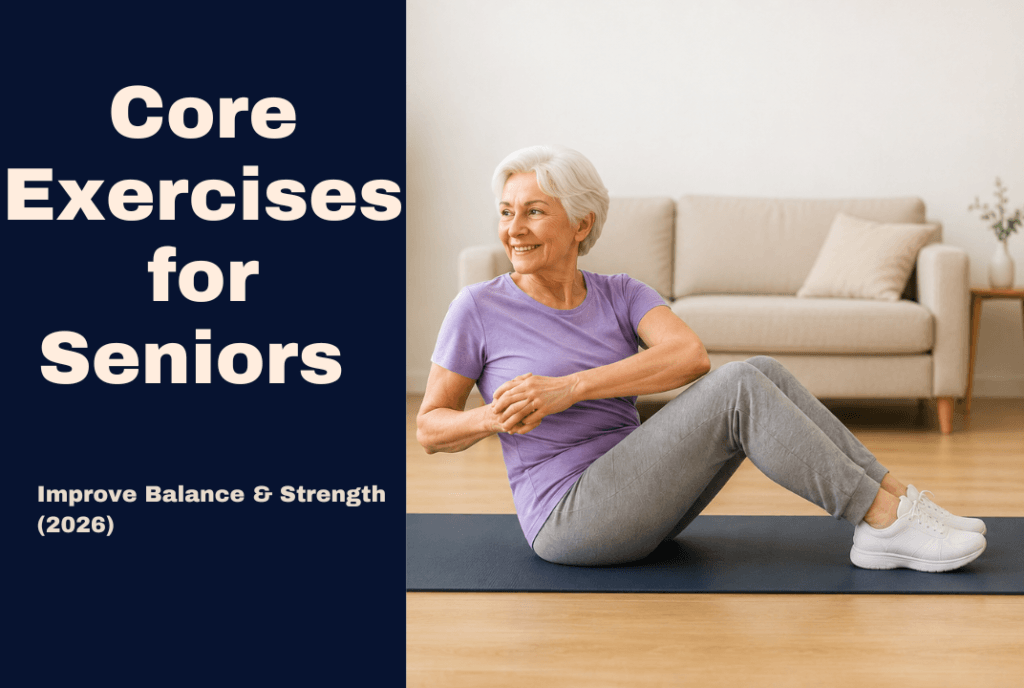
What Are Core Exercises for Seniors and Why Do They Matter?
Core exercises for seniors are movements that train the muscles wrapping your trunk (abs, obliques, lower back, and hips) so you can stand, bend, twist, and balance without strain. They matter because your core is the anchor for almost every movement you make, from lifting a grocery bag to catching yourself on an uneven sidewalk. Weak trunk muscles are strongly linked to poor posture, back pain, and a higher fall risk. Strengthening them is one of the highest-return investments you can make in your health after 60.
According to the CDC, more than 1 in 4 older adults in the U.S. fall each year, and falls are the leading cause of injury among people 65 and older (CDC, National Center for Injury Prevention and Control). Fall prevention starts largely in the core; it’s what keeps your center of gravity stable when the ground surprises you. The National Institute on Aging also recommends muscle-strengthening activity, including the core, at least two days a week as part of healthy aging guidelines.
Do Core Exercises Help Prevent Falls?
Yes. A strong core directly supports balance training and reduces fall risk. Your core muscles control your center of gravity, so when they’re weak, small trips are more likely to turn into full falls. Research summarized by the CDC and physical therapy studies consistently shows that combining core work with balance and strength training lowers fall incidence in older adults. That’s why balance and core exercises for seniors are often paired together in fall-prevention programs, not treated as separate routines.
If you’re also working on general strength, pairing this routine with Strength Exercises for Seniors rounds out a well-balanced weekly plan. And if standing balance feels shaky right now, easing in with Chair Yoga for Seniors is a gentle way to build confidence before adding standing core work.
Beginner Core Exercises for Seniors at Home
The best starting point for beginner core exercises for seniors is isometric holds, exercises where you hold a position instead of repeating fast movements. These are gentler on joints and easier to control. Core exercises for seniors at home don’t need equipment; a chair, a wall, and a bit of floor space are enough. Start with 2 to 3 sessions a week and build from there.
How to do a modified bridge:
- Lie on your back, knees bent, feet flat and hip-width apart.
- Tighten your buttocks and lift your hips until your body forms a straight line from shoulders to knees.
- Hold for 5 to 10 seconds, then lower slowly.
- Repeat 8 to 10 times.
Benefits: Strengthens glutes, lower back, and deep abdominal muscles that support lower back support and posture.
When to do it: Anytime, ideally after a short warm-up like marching in place for 2 to 3 minutes.
Beginner Core Workout for Seniors at Home
A simple beginner core workout for seniors at home combines a bridge, a seated march, and gentle side bends: three moves, ten minutes, no floor time required if joints are sensitive. Consistency beats intensity here. Doing a short, easy routine four times a week builds more real-world strength than one exhausting session that leaves you sore for a week. This is also the safest entry point if you haven’t exercised your core “on purpose” in years.
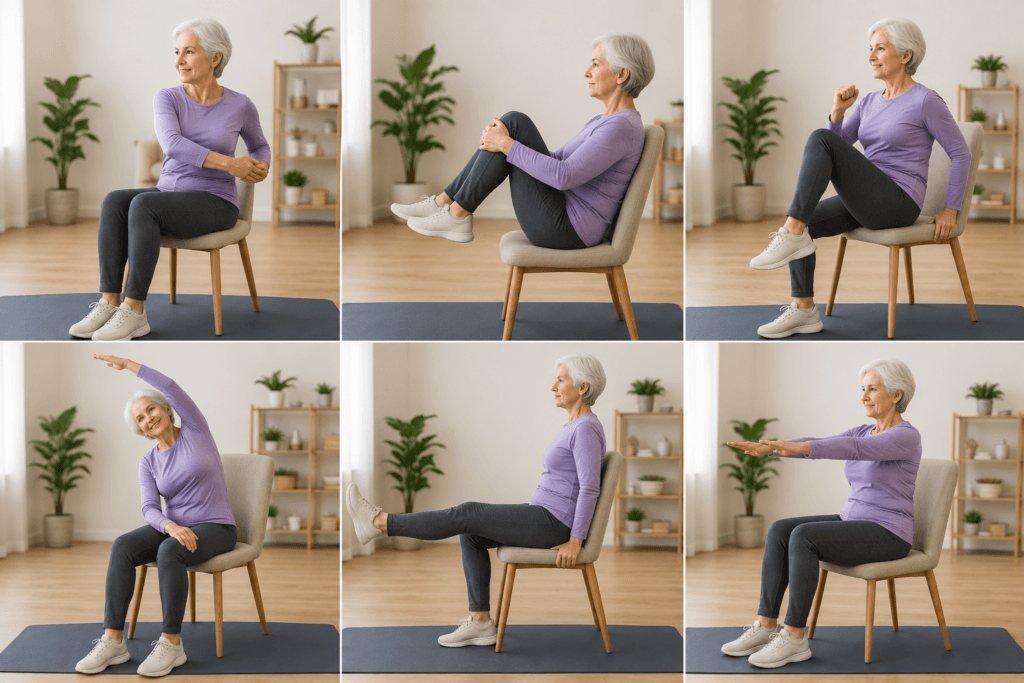
Seated Core Exercises for Seniors
Seated core exercises for seniors are ideal for anyone with balance concerns, joint pain, or recent hip or knee surgery, since a chair provides constant support. They still activate the abdominals, obliques, and hip flexors effectively, while removing the fall risk almost entirely. This category overlaps heavily with chair core exercises for seniors, and both are backed by physical therapists as safe, low-barrier options.
How to do seated knee lifts:
- Sit tall in a sturdy chair with a back support.
- Engage your core and slowly lift one knee toward your chest.
- Lower with control, then switch legs.
- Repeat 10 times per side.
Benefits: Builds abdominal strength and hip flexor control while protecting the lower back.
When to do it: Great as a daily warm-up or a stand-alone routine on rest days from standing exercise.
Pairing seated core work with light resistance is also effective. See Resistance Band Exercises for an easy way to add gentle load without straining joints.
How to do the seated tabletop press:
- Sit in front of a table, arms straight, palms facing down just above the surface.
- Push your hands down into the table as hard as comfortably possible.
- Squeeze your abdominal muscles as you press.
- Hold for 5 seconds, release, repeat 8 to 10 times.
Benefits: Activates the rectus abdominis without any spinal movement, making it one of the more ideal safe abdominal exercises for seniors for those with disc or joint issues.
 Standing Core Exercises for Seniors
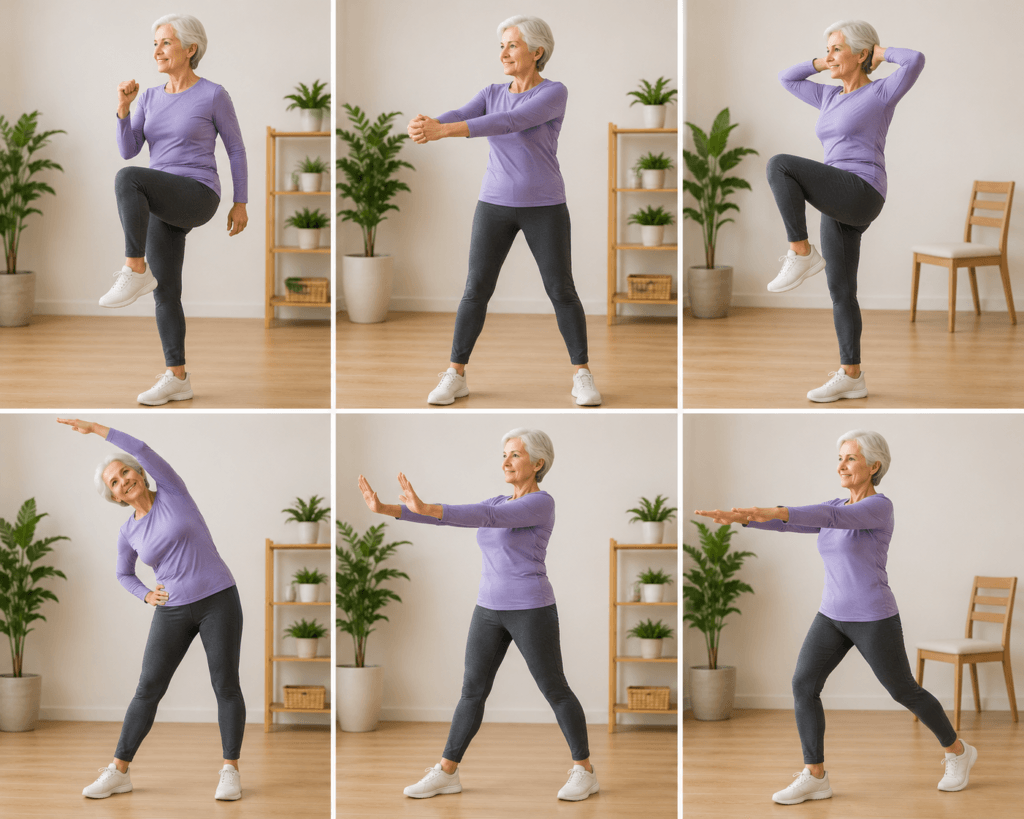 Standing Core Exercises for Seniors
Standing core exercises for seniors build the kind of “functional” strength you actually use, the strength that stops you from stumbling when you reach for a high shelf or twist to grab a dish towel. These fall under functional core exercises for seniors because they mimic real daily movements rather than isolated gym moves.
How to do standing marching:
- Stand tall, holding a countertop or chair back if needed.
- Lift one knee at a time as if marching in place.
- Keep your abs gently engaged throughout.
- Continue for 30 to 60 seconds.
Benefits: Improves mobility exercises carryover, endurance, and hip-core coordination.
When to do it: As a warm-up before other exercises, or as a light daily movement snack.
Standing Ab Workout for Seniors
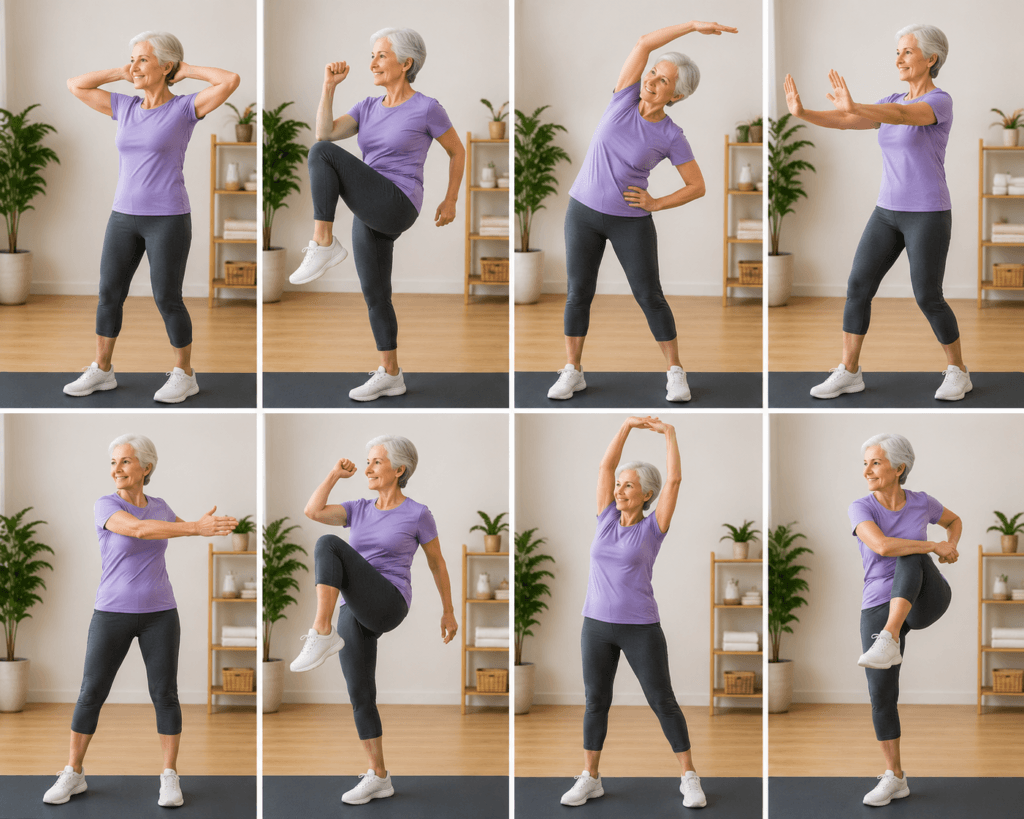 Standing Ab Workout for Seniors
A complete standing ab workout for seniors might include marching, standing side bends, and a wall-supported plank, all done without ever getting on the floor. This is especially useful for people who find getting up and down from the ground difficult, which is common but rarely talked about openly. If getting up off the floor is a genuine concern, standing-only routines let you build real strength without that added stress.
For extra cardio support alongside standing core work, many seniors also enjoy a low-impact Exercise Bike for Seniors session. It’s easy on the knees and complements standing balance training well.
Senior Core Strengthening Exercises:
Below is a quick comparison so you can pick the right starting point based on your comfort, balance, and current mobility level.
| Exercise Type | Best For | Equipment Needed | Difficulty | Balance Risk |
|---|---|---|---|---|
| Seated core exercises for seniors | Beginners, post-surgery, limited balance | Sturdy chair | Easy | Very Low |
| Chair core exercises for seniors (chair plank) | Building full-body core strength safely | Chair | Moderate | Low |
| Standing core exercises for seniors | Functional daily-life strength | Wall or counter | Moderate | Low to Medium |
| Floor exercises (bridge, bird dog) | Intermediate strength building | Mat | Moderate | Low (lying down) |
| Low impact core exercises for seniors (Pallof press) | Rotational strength, golf/pickleball players | Wall | Easy to Moderate | Very Low |
Core Exercises for Seniors Over 60, 70, and 80:
There’s no single cutoff age, but intensity and support should scale with balance and joint health, not just birthdays. Core exercises for seniors over 60 can often include floor-based moves like bridges and modified planks. Core exercises for seniors over 70 may lean more on seated and wall-supported versions. Core exercises for seniors over 80 typically prioritize seated and standing isometric holds with full support nearby.
How to Strengthen Your Core After 60
The honest answer is consistency over intensity. How to strengthen your core after 60 really comes down to picking 3 to 4 moves you can do with good form, doing them most days of the week, and gradually adding hold time or repetitions rather than jumping straight to advanced moves. Senior core strengthening exercises work best when progression is slow and steady, think monthly improvement, not weekly.
Best Ab Exercises for Seniors with Bad Knees
If knees are an issue, the best ab exercises for seniors with bad knees are ones that avoid kneeling or deep bending. Seated knee lifts, standing marches, wall planks, and seated tabletop presses all keep pressure off the knees entirely. Skip floor-based bird dogs or kneeling planks unless a mat and cushioning make kneeling comfortable.
To build strength in the rest of the body without stressing joints, Resistance Band Exercises again make a great companion routine, since bands let you control resistance precisely.
Benefits of Core Exercises for Seniors:
Regular core work delivers benefits far beyond appearance, directly supporting independence. Here’s what consistent practice actually improves, based on physical therapy research and clinical guidance:
- Improved posture and reduced slouching, which eases neck and upper back strain.
- Better spinal stability, reducing the load on discs and joints during daily movement.
- Stronger pelvic floor strength, which supports bladder control and core coordination together.
- Reduced lower back support issues, since a strong core takes pressure off the spine.
- Better balance training outcomes, lowering fall risk.
- Greater functional fitness, making grocery carrying, gardening, and playing with grandchildren easier.
- Support for healthy aging overall, since core strength correlates with maintained independence in later decades.
A strong core is also one of the pillars of overall senior fitness, working hand in hand with cardio and strength training rather than replacing them.
When Should Seniors Do Core Exercises?
Timing matters less than consistency, but a few guidelines help. Morning sessions work well because core activation can improve posture for the rest of the day. Avoid doing intense core work right after a heavy meal. Most physical therapists recommend spacing sessions across the week rather than doing them all in one day, since the core, unlike some muscle groups, tolerates daily light activity well.
How Long Should Seniors Do Core Exercises?
Fifteen to twenty minutes, three to five times a week, is a reasonable target for most seniors, according to physical therapy guidance summarized by Harvard Health and Hinge Health clinicians. Daily core exercises for seniors are fine as long as intensity stays moderate, since the core recovers faster than larger muscle groups like the legs or back. Beginners should start with 10 minutes and build gradually rather than jumping straight to 20.
Are Chair Core Exercises Effective for Seniors?
Yes, chair-based moves are genuinely effective, not just a “consolation prize” for people who can’t get on the floor. Physical therapists note that chair core exercises for seniors, like the chair plank and seated tabletop press, activate the same muscle groups as floor exercises while removing fall risk almost entirely. For many seniors, especially those newer to exercise, chair-based training is actually the smarter starting point.
Common Mistakes Seniors Make with Core Exercises:
Most core-training setbacks come from a handful of avoidable habits, not from the exercises themselves. Knowing these upfront saves weeks of frustration or, worse, an injury that sidelines you completely. Here are the mistakes physical therapists see most often in older adults starting a core routine.
- Doing sit-ups and crunches instead of isometric holds.These pull on the neck and mostly train the hip flexors, not the deeper core stability muscles, and can aggravate the lower back.
- Holding your breath during a hold.Straining your breath spikes blood pressure unnecessarily. Breathe normally and count out loud if it helps you stay relaxed.
- Skipping the warm-up.Jumping straight into a plank or bridge with cold muscles raises injury risk; 2 to 3 minutes of marching or arm circles fixes this.
- Progressing too fast.Adding too many reps or seconds per week, rather than one small increase at a time, is the top reason seniors quit or get hurt early on.
- oring form for the sake of repsIgn.A shaky, poorly held bridge or plank trains bad movement patterns; slow and controlled always beats fast and sloppy.
- Training core in isolation.Core work pays off most when paired with general strength exercises and balance training, not done as the only form of exercise.
- Not using support when needed.Skipping a chair or wall for balance “to make it harder” often just increases fall risk without adding real benefit
Safety Tips Before You Start:
A few precautions make a real difference in avoiding injury and building confidence.
- Check with your doctor before starting, especially with existing back, hip, or heart conditions.
- Warm up for 2 to 3 minutes with marching or arm circles.
- Use a chair, wall, or countertop for support until balance feels solid.
- Stop if you feel sharp pain. Mild muscle fatigue is normal, pain is not.
- Progress slowly; adding one rep or one extra second of hold per week is plenty.
Alongside core work, many seniors also build in short daily movement habits. See Exercises to Do Everyday for Seniors for a simple daily framework that complements this routine.
Fueling Recovery: Nutrition Matters Too
Strength training, including core work, works best alongside decent protein intake and good nutrition, since muscle repair depends on it. A few easy additions: Best High Protein Drinks for convenient protein after a workout, Steamed Broccoli Nutrition for a fiber and vitamin rich side, and Paneer Nutrition Facts for a vegetarian-friendly protein source that’s easy to digest. None of this replaces the exercise itself, but good nutrition helps muscles actually recover and grow stronger between sessions.
Keep the Rest of You Strong Too:
Core strength works best as part of a bigger picture. Once your core routine feels comfortable, consider layering in Brain Exercises for Seniors to keep cognitive health sharp alongside physical health. The two are more connected than most people realize, since balance and coordination rely on both muscle and brain signaling working together.
FAQs:
What is the best core exercise for a senior beginner?
Seated knee lifts or a modified bridge are both low-risk, effective, and require no equipment, making them the easiest starting point for anyone new to core training.
Can core exercises really help with fall prevention?
Yes, a stable core directly supports balance and reduces fall risk, according to CDC and physical therapy research linking weak trunk muscles to higher fall rates in older adults.
Is it okay to do core exercises every day?
Generally yes, in moderation. The core recovers faster than larger muscle groups, so light daily work is usually safe, as long as intensity stays gentle and controlled.
How soon will I notice results from core exercises?
Most seniors notice better balance and easier movement within 4 to 6 weeks of consistent practice, three to five times a week, though everyone progresses at a different pace.
Do I need special equipment to start?
No. A sturdy chair, a wall, and a small patch of floor are enough for almost every exercise in this guide, so cost or equipment should never be a barrier to starting.
What’s the difference between seated and standing core exercises?
Seated exercises remove almost all balance risk and are ideal for beginners, while standing exercises build more functional, real-life strength once balance and confidence improve.
Can core exercises help with back pain?
Yes, a stronger core reduces strain on the spine and lower back, and physical therapists commonly recommend core training as part of managing and preventing chronic back pain.
Should seniors avoid sit-ups and crunches?
Many physical therapists now advise against traditional sit-ups and crunches for older adults, since they strain the neck and overwork the hip flexors instead of the deeper core muscles.
Final Thoughts:
Simple core workouts for seniors don’t need to be complicated, painful, or time-consuming to work. A handful of seated, standing, or gentle floor exercises, done consistently three to five times a week, can meaningfully improve balance, posture, and independence. Start small, use support when you need it, and let progress be slow and steady. That’s really the whole secret.
Related Reads Chair Yoga for Seniors, Resistance Band Exercises, Exercise Bike for Seniors, Brain Exercises for Seniors, Strength Exercises for Seniors, Exercises to Do Everyday for Seniors, Steamed Broccoli Nutrition, Best High Protein Drinks, Paneer Nutrition Facts
Sources checked: This article is based on CDC fall-prevention data, National Institute on Aging exercise guidelines, and clinical insights from Harvard Health and Hinge Health physical therapists. Full references are listed at the end.
References:
This article draws on guidance from the CDC’s National Center for Injury Prevention and Control on older-adult falls, the National Institute on Aging’s physical activity recommendations, and clinical insights from physical therapists at Harvard-affiliated Brigham and Women’s Hospital and Hinge Health. Always consult your doctor before starting a new exercise program.

Hi, I’m Salem Nasir, founder of Fiturely. I research and write evidence-based articles on fitness, nutrition, weight loss, and healthy living. My mission is to make reliable health information simple, practical, and easy to understand so readers can build healthier habits with confidence
Pingback: 7 Best Mobility Exercises for Seniors to Improve Flexibility & Balance (2026)