
Key Takeaways
- Daily mobility exercises help seniors improve flexibility, balance, and joint movement for easier everyday activities.
- Just 10-15 minutes a day can reduce stiffness and support healthy aging.
- Gentle mobility movements may lower the risk of falls by improving stability and coordination.
- Most senior mobility exercises require no equipment and can be done safely at home.
- Consistency matters more than intensity regular practice delivers the best long-term results.
Getting older doesn’t mean getting stiffer, not if you know what to do about it. Mobility exercises for seniors are short, low-risk movements that keep joints loose, muscles engaged, and daily life easier. This guide gives you real, science-backed senior mobility exercises, a weekly plan, and honest answers to the questions people actually search for.
No fluff, no fake statistics, just what works, explained the way a good physical therapist would explain it over coffee.
 What Are Mobility Exercises for Seniors?
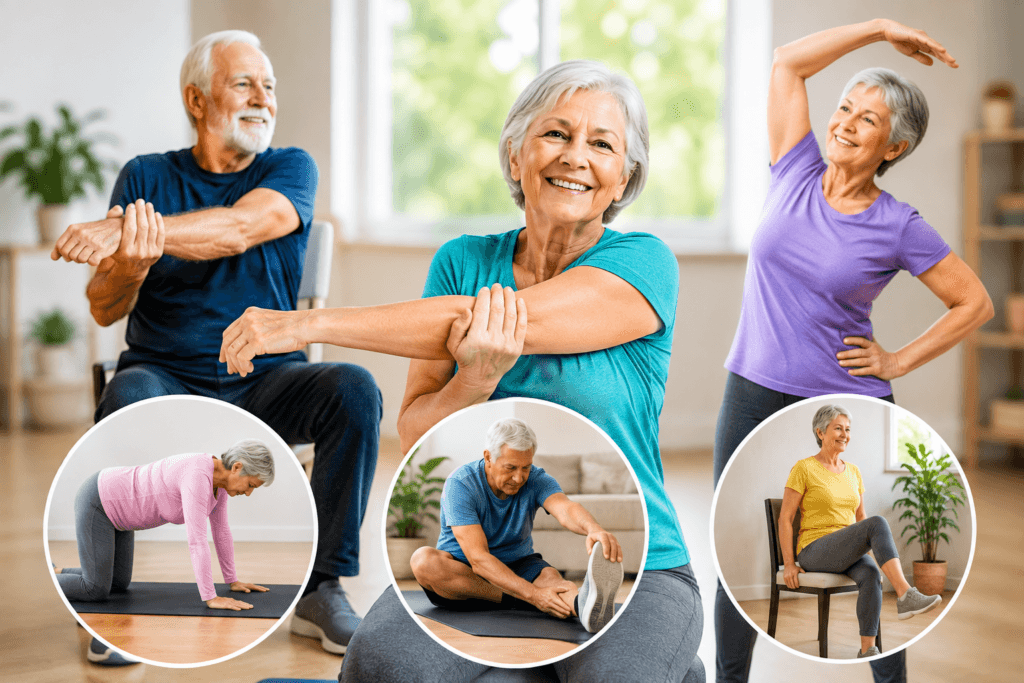 What Are Mobility Exercises for Seniors?
Mobility exercises are controlled movements that take a joint through its full, natural range of motion. They’re different from stretching alone, they combine flexibility exercises for seniors with strength and control. The goal is simple: keep the body doing what it’s supposed to do, for as long as possible.
Here’s why this matters more with age. According to the CDC, one in four Americans aged 65+ falls each year, and falls are the leading cause of injury death in that age group (CDC, 2023). Weak joints and poor balance are two of the biggest contributors.
The World Health Organization recommends that older adults do muscle-strengthening and balance activities at least twice a week, alongside regular movement, to maintain functional mobility exercises and reduce fall risk (WHO, 2020). That’s not a suggestion, it’s a public health guideline.
A short daily habit built around joint mobility exercises can mean the difference between climbing stairs confidently at 75 and avoiding them altogether. Start with the Core Exercises, they form the foundation for everything else in this guide.
How Often Should Seniors Do Mobility Exercises?
Short answer: most seniors benefit from 10-15 minutes daily, plus 2–3 dedicated sessions weekly for strength and balance. Consistency beats intensity every single time. You don’t need an hour, you need a habit.
The National Institute on Aging (NIA) recommends older adults aim for some form of movement most days of the week, mixing balance, strength, and flexibility work rather than doing the same thing every day (NIA, 2022).
A daily mobility routine for seniors doesn’t need to be long. Five to ten minutes in the morning to “wake up” the joints, followed by a slightly longer session 2–3 times a week, covers most of what the body needs.
Think of it like brushing your teeth, skipping one day won’t hurt, but skipping it for months will. The same logic applies to mobility training for elderly adults: small, repeated effort compounds into real independence over time.
If you’re managing joint pain, pair this with Resistance Band Exercises, which add gentle resistance without straining the joints.
What Are the Best Mobility Exercises for Seniors at Home?
You don’t need a gym. These beginner mobility exercises use bodyweight only, take under 20 minutes total, and can be done in a living room. Below are 7 exercises, with a suggested weekly build-up, one of the most searched setups for best mobility exercises for seniors at home.
1. Neck rotations (shoulder mobility warm-up)

The neck holds tension overnight and after long periods of sitting. This simple movement is often the first thing physical therapists recommend before any other exercise.
How to do it:
- Sit or stand tall with shoulders relaxed.
- Slowly turn your head to look over one shoulder.
- Hold for 2 seconds.
- Turn to the other side and hold again.
- Repeat 5 times per direction.
Benefits: Loosens the neck and upper spine, reduces tension headaches, and prepares the body for further movement.
2. Shoulder mobility circles
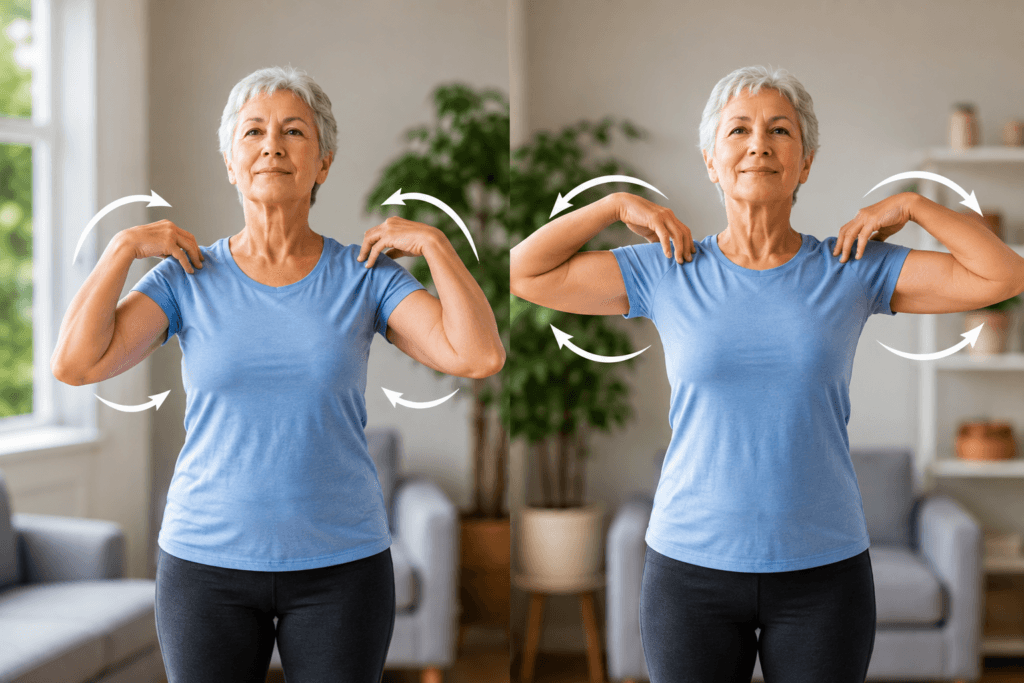
Rounded shoulders from sitting too long are one of the most common posture complaints in older adults. This move reverses that pattern in under a minute.
How to do it:
- Stand or sit tall with arms relaxed at your sides.
- Roll both shoulders forward in a slow circular motion.
- Repeat 10 times forward.
- Reverse direction and roll backward 10 times.
Benefits: One of the simplest standing mobility exercises for seniors for upper-body stiffness, and it also improves circulation to the shoulder joint.
3. Seated marches (hip mobility)
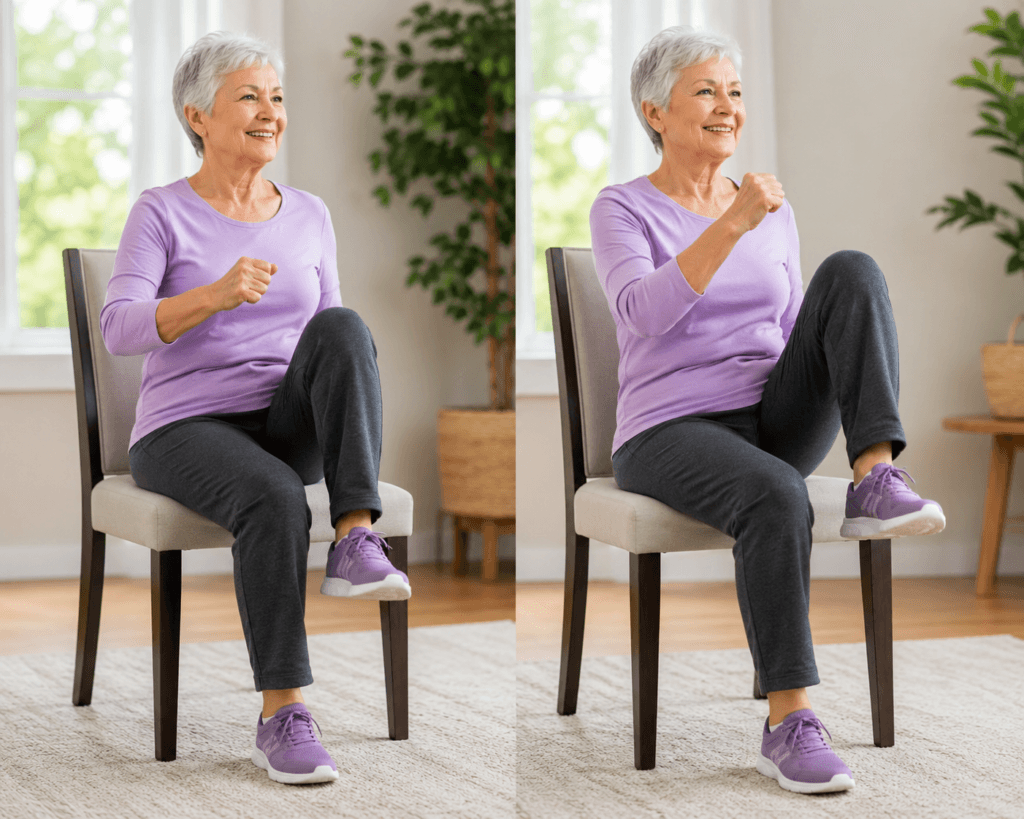
This looks easy but works the hip flexors, which weaken faster than most other muscle groups with age. It’s ideal for anyone nervous about standing exercises.
How to do it:
- Sit tall in a sturdy chair with feet flat on the floor.
- Lift one knee toward your chest.
- Lower it back down with control.
- Alternate legs like a slow march.
- Do 10–15 reps per leg.
Benefits: A staple among seated mobility exercises, it strengthens hip flexors and improves circulation without any balance risk.
4. Ankle circles and pumps
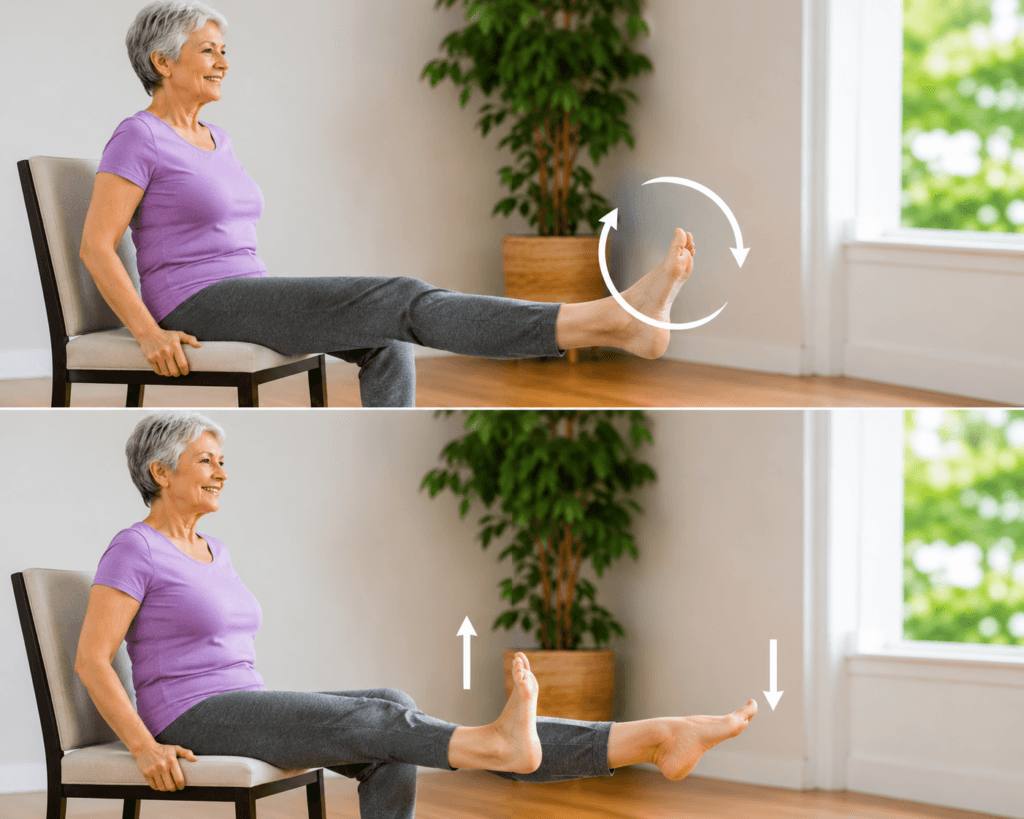
Ankles are easy to ignore, but they’re the foundation of every step you take. Weak or stiff ankles are directly linked to unsteady walking.
How to do it:
- Sit with one leg extended in front of you.
- Rotate the ankle clockwise 10 times.
- Rotate the ankle counterclockwise 10 times.
- Repeat both directions on the other leg.
- Finish with 10 up-and-down ankle pumps per foot.
Benefits: Directly supports ankle mobility, which affects walking stability and balance more than most people realize.
5. Cat-cow stretch (spinal mobility)
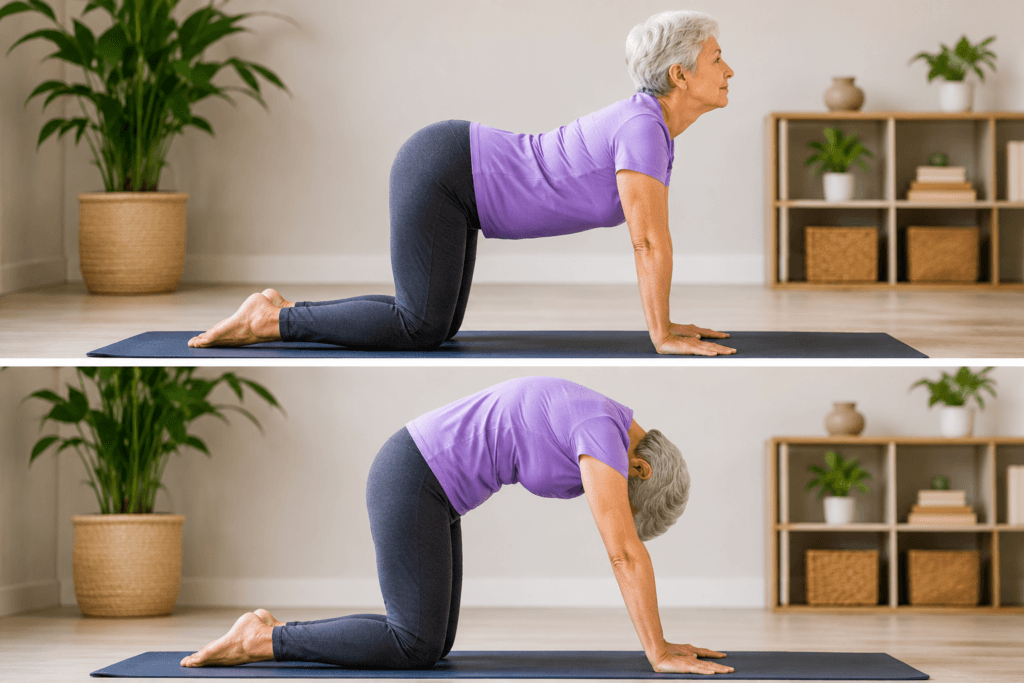
This yoga-based movement is one of the best ways to relieve stiffness along the entire spine, and it can be done on all fours or seated in a chair.
How to do it:
- Get on hands and knees, or sit with hands resting on your knees.
- Arch your back and lift your chest upward (cow position).
- Hold for a moment, then round your spine and tuck your chin toward your chest (cat position).
- Move slowly between the two positions.
- Repeat 8–10 times.
Benefits: Excellent for posture improvement, spinal flexibility, and easing lower back stiffness that builds up through the day.
6. Standing hip circles
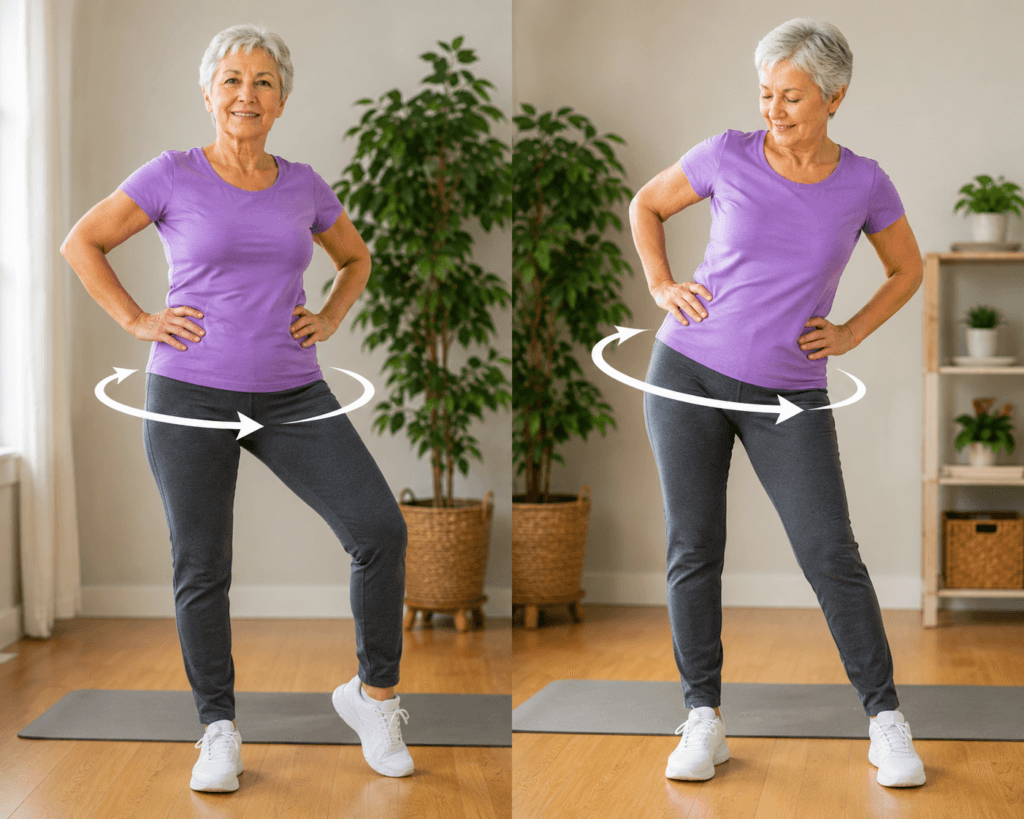
Hip stiffness is one of the biggest hidden causes of a shortened, unsteady walking stride in older adults. This move restores natural hip rotation.
How to do it:
- Hold onto a chair or counter for support.
- Lift one knee slightly off the ground.
- Circle the knee outward 8 times.
- Reverse direction and circle inward 8 times.
- Switch legs and repeat.
Benefits: Builds hip mobility and coordination together, and helps maintain a longer, more confident walking stride.
7. Wall shoulder slides
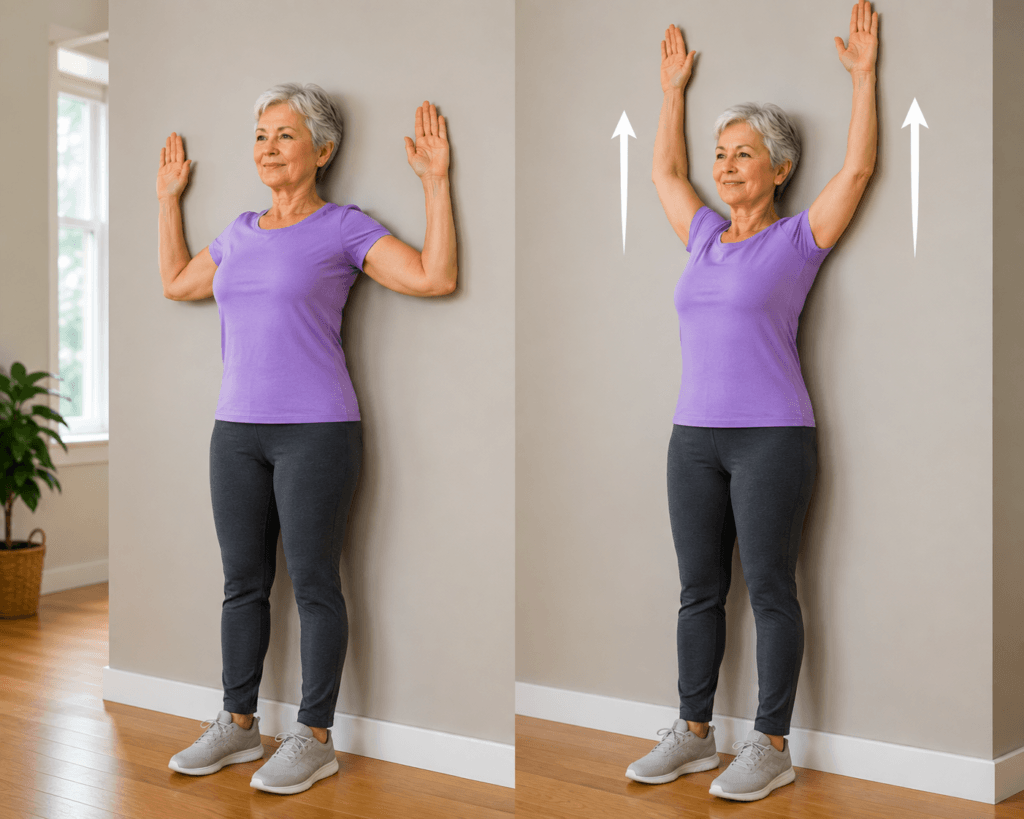
This finishing move combines shoulder mobility with posture correction, making it a satisfying way to end a routine.
How to do it:
- Stand with your back flat against a wall.
- Bend your arms at 90 degrees, elbows and hands touching the wall.
- Slowly slide your arms up overhead, keeping contact with the wall.
- Slide back down to the starting position, like a slow-motion snow angel.
- Repeat 8 times.
Benefits: A great full body mobility exercises finisher that also improves posture and opens up the chest after sitting.
Suggested weekly plan for daily mobility exercises for seniors over 60:
| Week | Exercises Included | Frequency | Focus |
|---|---|---|---|
| Week 1-2 | Exercises 1–4 (neck, shoulders, seated marches, ankles) | Once daily | Form and comfort, works well as easy mobility exercises for elderly beginners |
| Week 3-4 | Add exercises 5–6 (cat-cow, standing hip circles) | 5 days a week | Slightly higher reps, building control |
| Week 5-6 | Full set of 7 (add wall shoulder slides) | 5–6 days a week, 2 rest days | Now a proper full body mobility workout for seniors |
| Week 7 onward | Full set of 7, optionally longer holds or added reps | 5–6 days a week | Maintenance and gradual progression |
For a done-for-you plan you can follow along with, check Exercises to Do Everyday.
How Do Chair and Seated Mobility Exercises Help Less Mobile Seniors?
Seated routines aren’t a “lesser” version of exercise, they’re a legitimate, effective option for people with limited standing balance. Chair mobility exercises for seniors protect against falls while still building strength and range of motion.
Harvard Health notes that chair-based exercise programs can improve flexibility, circulation, and even mood in older adults with mobility limitations, without requiring standing balance at all (Harvard Health Publishing, 2021).
Seated mobility exercises like ankle pumps, seated torso twists, and arm raises target the same muscle groups as standing versions, just with more support and less fall risk. This makes them ideal gentle mobility exercises for seniors at home.
This is especially useful for anyone doing mobility exercises for seniors over 80, or recovering from a fall, surgery, or long illness. Starting seated and progressing to standing mobility exercises for seniors is a smart, medically sound approach, not a shortcut.
Pair seated routines with Chair Yoga for Seniors for a gentler, breath-focused variation that also improves flexibility and calm.
Mobility vs. Flexibility vs. Strength Training: What’s the Real Difference?
People use these terms interchangeably, but they’re not the same thing. Mobility is about usable range of motion, flexibility training is about how far a muscle can stretch, and strength is about force production. All three work together for real functional movement.
| Type | What It Does | Example | Best For |
|---|---|---|---|
| Mobility | Controlled movement through a joint’s full range | Hip circles, ankle rotations | Daily function, fall prevention |
| Flexibility | Passive lengthening of muscles | Hamstring stretch, seated forward bend | Reducing stiffness |
| Strength | Building muscle force | Sit-to-stands, resistance bands | Independence, bone health |
| Balance | Controlling body position | Standing on one leg (supported) | Fall prevention |
Notice that mobility and balance overlap heavily, you can’t have good stability without some balance control, and vice versa. That’s why a well-rounded routine touches all four categories, not just one.
If strength is your focus this month, Strength Exercises breaks down safe progressions specifically for older adults building healthy joints over time.
How Can Seniors with Arthritis Safely Improve Mobility?
Yes, people with arthritis should still move, the right way. Mobility exercises for arthritis reduce stiffness and pain over time, according to the Arthritis Foundation, which recommends low-impact movement as a core part of arthritis management, not something to avoid (Arthritis Foundation, 2023).
The key is choosing low impact mobility exercises that don’t jar the joints, think seated leg extensions, water-based movement, or slow range-of-motion work rather than high-impact cardio.
Gentle mobility exercises done consistently can actually reduce muscle stiffness and improve joint flexibility more than rest does. Movement lubricates joints through synovial fluid circulation, staying still tends to make arthritis pain worse, not better. This applies directly to mobility exercises for seniors with arthritis looking for daily relief.
Always stop if you feel sharp pain (not just mild discomfort), and check with a doctor before starting if arthritis is severe. Safe exercises for seniors with joint conditions are about pacing, not avoidance.
What Does a Morning Mobility Routine for Seniors Look Like?
A good morning mobility routine for seniors takes 5–8 minutes and targets the areas that stiffen most overnight: neck, shoulders, hips, and ankles. Think of it as defrosting the body before it goes to work.
Start with warm-up exercises like neck rotations and shoulder rolls, move into hip and ankle circles, then finish with a gentle standing stretch. This sequence supports exercises to improve mobility for seniors without demanding much energy first thing in the morning.
Doing this before breakfast, even in pajamas, sets a physical tone for the whole day. It’s one of the simplest ways to build healthy aging exercises into a routine that already exists, you’re just adding 5 minutes to it, and it doubles as mobility exercises to reduce stiffness for the rest of the day.
End the day the same way it started, cool-down stretches in the evening help reduce next-morning stiffness and support better sleep quality.
How Do Mobility Exercises Prevent Falls and Support Independence?
This is the real payoff: mobility work directly supports fall prevention and independence in daily activities. Better balance and mobility exercises, stronger joints, and improved coordination mean fewer falls and more confidence doing everyday tasks, reaching a shelf, getting up from a chair, walking on uneven ground.
The National Council on Aging reports that falls result in over 3 million emergency room visits annually among older adults in the U.S., and that most falls are preventable through strength and balance training (NCOA, 2023). This is why mobility exercises to improve balance are recommended alongside strength work, not instead of it.
Range of motion exercises for seniors also protect against the slow decline that comes from inactivity, what doctors sometimes call “disuse atrophy.” The joints and muscles you use, you keep. The ones you don’t, you lose faster than expected, which is why body movement should stay a daily habit, not a weekend project.
This is really the heart of senior wellness and active aging, not chasing fitness goals, but protecting the freedom to move through daily life without fear or assistance. For seniors over 70, the same logic applies with even more emphasis on caution and consistency, mobility exercises for seniors over 70 should always prioritize control over speed.
What Common Mistakes Should Seniors Avoid When Starting Mobility Exercises?
Most setbacks don’t come from the exercises themselves, they come from small, avoidable habits around them. Knowing these mistakes upfront saves weeks of frustration and reduces injury risk.
- Skipping the warm-up and jumping straight into bigger movements like standing hip circles.
- Doing too much too soon, going from zero activity to daily full-body routines in week one.
- Holding your breath during stretches instead of breathing slowly and steadily.
- Ignoring pain signals and pushing through sharp discomfort instead of stopping.
- Practicing on unstable surfaces or without support when balance is still shaky.
- Comparing progress to younger routines instead of tracking your own baseline.
- Skipping rest days, which are just as important as the exercise days themselves.
Avoiding these mistakes matters more than doing every exercise perfectly. Safe exercises for seniors are defined as much by what you don’t do as by what you do.
Frequently Asked Questions
Do mobility exercises really help stiff joints?
Yes. Regular, gentle movement increases blood flow and joint lubrication, which directly targets exercises for stiff joints and reduces morning stiffness over weeks of consistency.
Can I improve flexibility after 60?
Absolutely. Research on stretching and mobility consistently shows measurable gains in range of motion within 8–12 weeks of regular practice, regardless of starting point (Harvard Health, 2021), proof that improve flexibility after 60 is a realistic, achievable goal.
Are mobility exercises without equipment effective?
Yes, mobility exercises without equipment using just bodyweight and a sturdy chair are enough for most seniors to see real improvement. Equipment adds variety, not necessity, and works well for any mobility workout at home.
What’s a good starting point for someone who’s never exercised?
Start with seated versions of the 7 exercises above, once daily, for two weeks before progressing. Slow and steady beats fast and abandoned, this is the safest route into mobility workouts for older adults of any fitness level.
How long does it take to see results from mobility exercises?
Most seniors notice less morning stiffness within 2–3 weeks, and clearer improvements in balance and range of motion by 8–12 weeks of consistent practice (Harvard Health, 2021). Results build gradually, not overnight.
Can mobility exercises help with knee pain?
Yes, when done correctly. Gentle range-of-motion work around the knee, like seated leg extensions and ankle pumps, can reduce stiffness and support the muscles around the joint, though sharp or worsening pain should always be checked by a doctor first.
Is it safe to do mobility exercises every day?
For most seniors, yes. These are low-impact movements, not intense workouts, so daily practice is generally safe and even encouraged. Just listen to your body and rest if a joint feels inflamed or unusually sore.
What time of day is best for mobility exercises?
Morning works well for reducing overnight stiffness, but any consistent time works. The best time is simply the one you’ll actually stick to, consistency matters more than timing.
Do I need a doctor’s approval before starting?
If you’re generally healthy and the exercises are low-impact, most seniors can start safely on their own. However, anyone with arthritis, recent surgery, heart conditions, or balance disorders should check with a doctor first, per general CDC and NIA guidance on starting new exercise routines.
Movement doesn’t need to be complicated to work. A few honest minutes a day, done consistently, protects independence far better than any single “miracle” routine ever could.
References
- Centers for Disease Control and Prevention (CDC), Older Adult Fall Prevention: https://www.cdc.gov/falls/index.html
- World Health Organization (WHO), Physical Activity Guidelines for Older Adults: https://www.who.int/news-room/fact-sheets/detail/physical-activity
- National Institute on Aging (NIA), Exercise and Physical Activity: https://www.nia.nih.gov/health/exercise-and-physical-activity
- Harvard Health Publishing, The Importance of Stretching: https://www.health.harvard.edu/staying-healthy/the-importance-of-stretching
- Arthritis Foundation, Exercise and Arthritis: https://www.arthritis.org/health-wellness/healthy-living/physical-activity/getting-started/exercise-benefits
- National Council on Aging (NCOA), Falls Prevention Facts: https://www.ncoa.org/article/get-the-facts-on-falls-prevention

Hi, I’m Salem Nasir, founder of Fiturely. I research and write evidence-based articles on fitness, nutrition, weight loss, and healthy living. My mission is to make reliable health information simple, practical, and easy to understand so readers can build healthier habits with confidence
Pingback: Leg Strength Exercises for Seniors: 11 Safe Moves to Improve Balance, Walking & Independence (2026)
Pingback: 15-Minute Workout for Seniors: A Simple Daily Routine for Strength, Balance, and Mobility - fiturely.com
Pingback: 10-Minute Workout for Seniors: Easy Daily Exercises at Home - fiturely.com