
What are the best kettlebell exercises in a Joe Rogan-style workout? The core kettlebell exercises are swings, goblet squats, deadlifts, clean and press, snatches, rows, lunges, farmer carries, halos, and the Turkish get up. Together they train your legs, glutes, back, shoulders, and core. They also build strength, conditioning, and grip with a single piece of equipment.
Why Everyone Searches for the Joe Rogan Kettlebell Workout
Joe Rogan talks about training almost as much as he talks about everything else. That’s a lot.
He’s a longtime martial artist, a UFC commentator, and a podcast host who has spent years discussing fitness with coaches and athletes. So it’s no surprise that people want to copy his gym habits.
One clarification first. Rogan has not published an official, fixed kettlebell program. This guide uses the exercises he’s known to discuss and combines them with well-established kettlebell training principles. Think of it as a Joe Rogan kettlebell routine inspired by his style, not a leaked secret document.
Does Joe Rogan Use Kettlebells?
Yes. Rogan has mentioned kettlebells on his podcast and shown them in workout clips on social media. He has also hosted kettlebell educators, including Pavel Tsatsouline, who helped popularize the tool in the United States.
Rogan has also been tied to Onnit, a fitness brand known for its kettlebells. Onnit was acquired by Unilever in 2021.
His training style is a mix, though. He blends weights, bodyweight work, and martial arts. That makes kettlebells a natural fit, because one bell can train strength, conditioning, and cardio in the same session.
Why Kettlebell Training Works
A kettlebell is a cast-iron ball with a handle. Its weight sits away from the handle, which makes it harder to control than a dumbbell. That’s the point.
Here’s what the research says:
- Calorie burn: An American Council on Exercise (ACE) study of kettlebell snatches measured an average of about 20 calories per minute. The study was small, so treat it as a rough guide, not a promise.
- Explosive strength: A 2012 study in the Journal of Strength and Conditioning Research found that kettlebell swing training improved maximal and explosive strength.
- Back and shoulder comfort: A 2011 workplace study in the Scandinavian Journal of Work, Environment & Health reported reduced neck and shoulder pain and low back pain in participants after kettlebell training.
In short, kettlebells are efficient. You get power, endurance, and grip work without a gym full of machines.
Joe Rogan Kettlebell Exercises:
These are the staple moves behind most Joe Rogan kettlebell training. Learn them in this order.
1. Kettlebell Swings
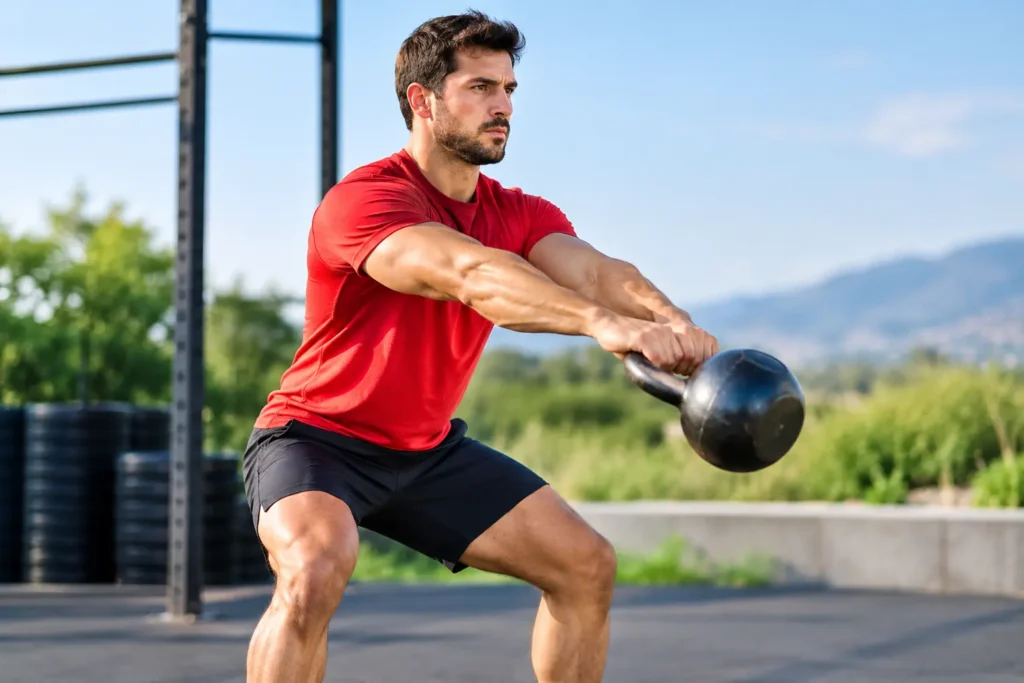
How to do it:
- Stand with feet slightly wider than shoulders. Place the bell about a foot in front of you.
- Hinge at the hips, push your butt back, and grab the handle with both hands.
- Hike the bell back between your legs.
- Snap your hips forward and stand tall. The bell floats up to chest height.
- Let it fall back, hinge again, and repeat.
Benefits: Swings work your glutes, hamstrings, and back. They build power and explosive strength, and they raise your heart rate fast. A 2012 study in the Journal of Strength and Conditioning Research linked swing training to better maximal and explosive strength.
Tip: The arms guide the bell. The hips throw it.
2. Kettlebell Goblet Squats
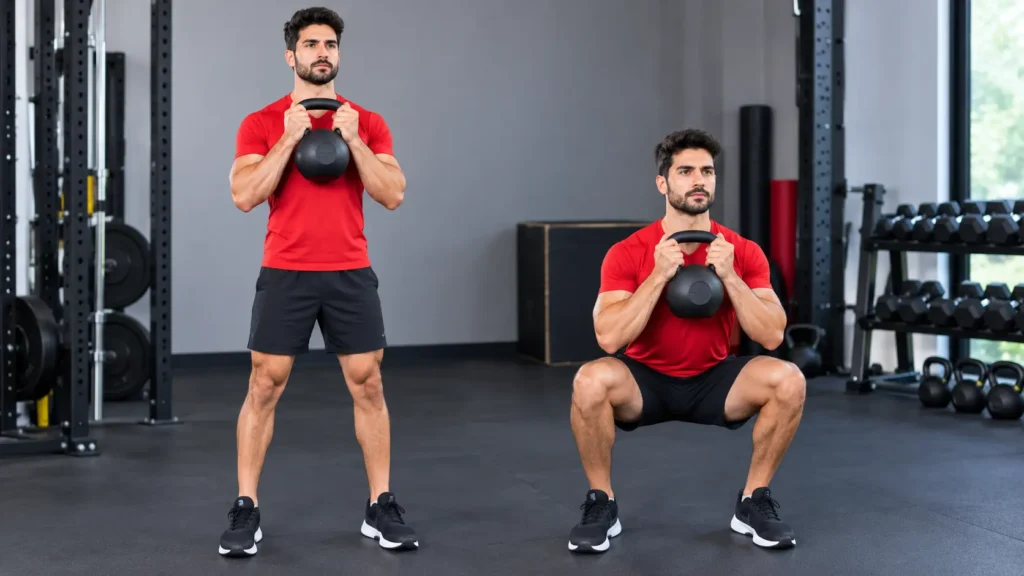
How to do it:
- Hold the bell by the horns at chest height, elbows pointing down.
- Stand with feet shoulder-width apart, toes slightly out.
- Sit down between your knees while keeping your chest tall.
- Go as deep as you can with good form.
- Drive through your heels to stand.
Benefits: This move builds the quads, glutes, and core. The front-loaded weight helps you stay upright, so it teaches good squat form. It’s one of the best picks for beginners.
3. Kettlebell Deadlifts
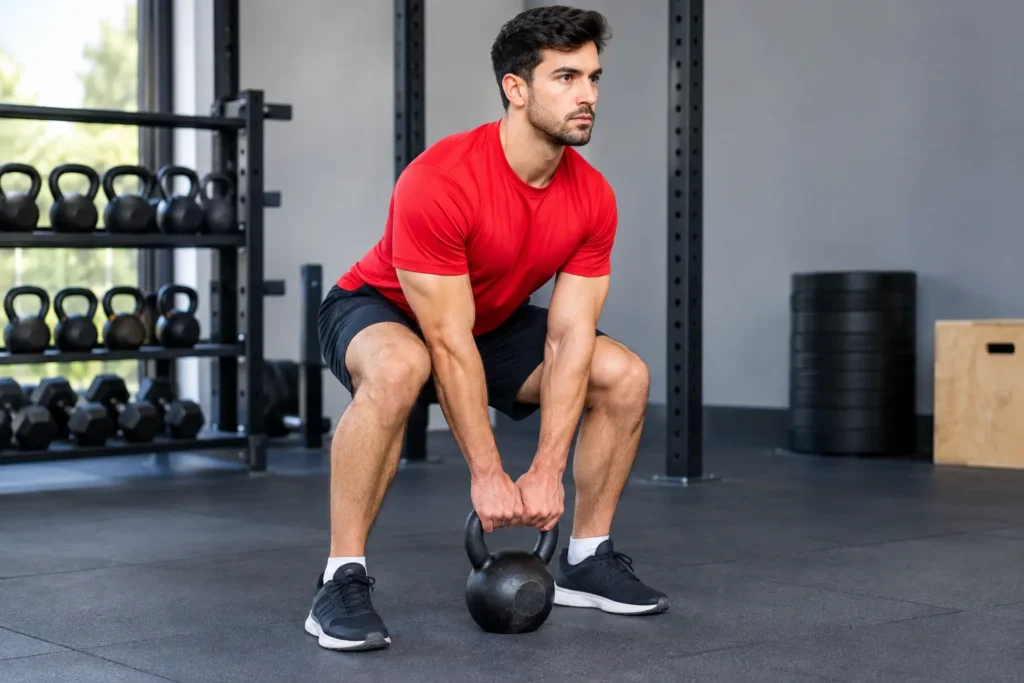
How to do it:
- Place the bell between your feet, in line with your ankles.
- Hinge back, keep your back flat, and grip the handle.
- Push the floor away and stand up straight.
- Squeeze your glutes at the top.
- Hinge back down and set the bell on the floor.
Benefits: Deadlifts train the hamstrings, glutes, and lower back. They teach the hip hinge, which is the base for swings, cleans, and snatches. They’re also a good low impact option.
4. Kettlebell Clean and Press
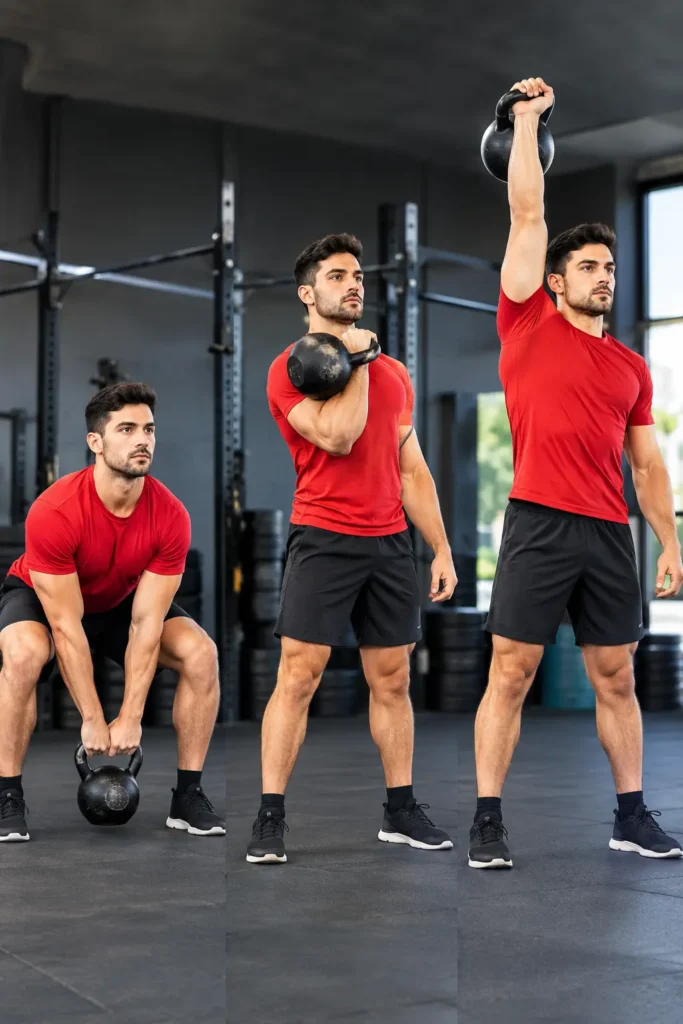
How to do it:
- Start with the bell on the floor, hinge, and grab it with one hand.
- Pull it up close to your body and flip it so it rests at your shoulder (the “rack” position).
- Brace your core and squeeze your glutes.
- Press the bell straight overhead until your arm locks out.
- Lower it back to the rack, then to the floor.
Benefits: You use your legs, back, shoulders, and arms in one move. It builds shoulder strength and coordination. It also trains the core to resist leaning.
5. Kettlebell Snatches
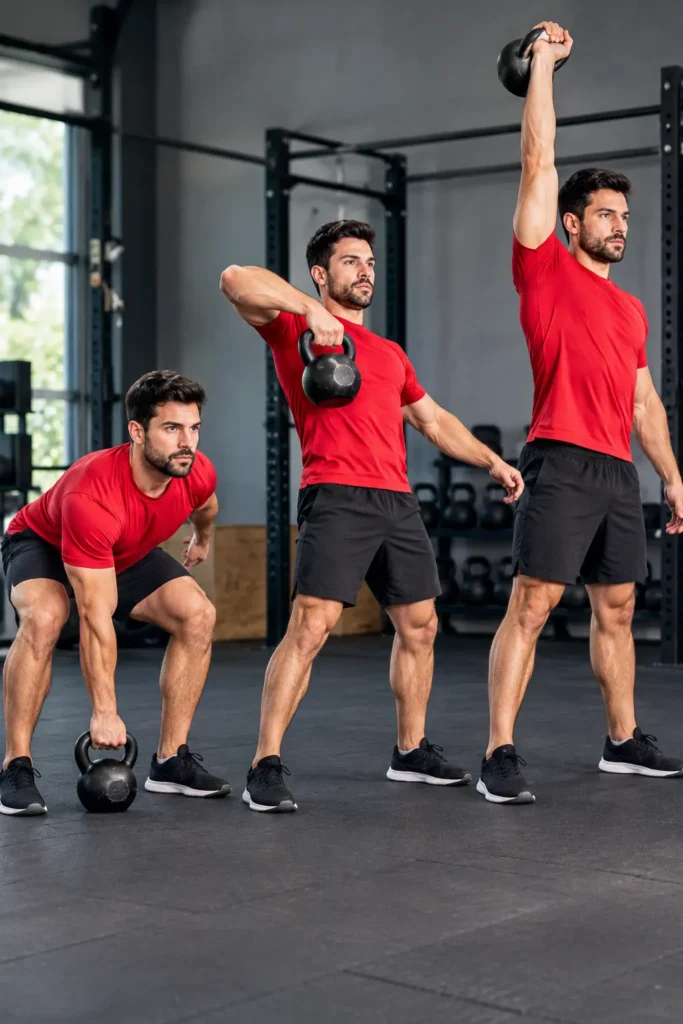
How to do it:
- Start like a swing, with the bell between your legs.
- Drive your hips forward and pull the bell upward in a straight line.
- As it rises, punch your hand through to catch it overhead.
- Lock out the arm, then let the bell fall back to the swing path.
Benefits: Snatches build power, endurance, and shoulder stability. An ACE-sponsored study found snatches burned about 20 calories per minute on average, though the sample was small. This is an advanced move, so learn swings and cleans first.
6. Kettlebell Rows
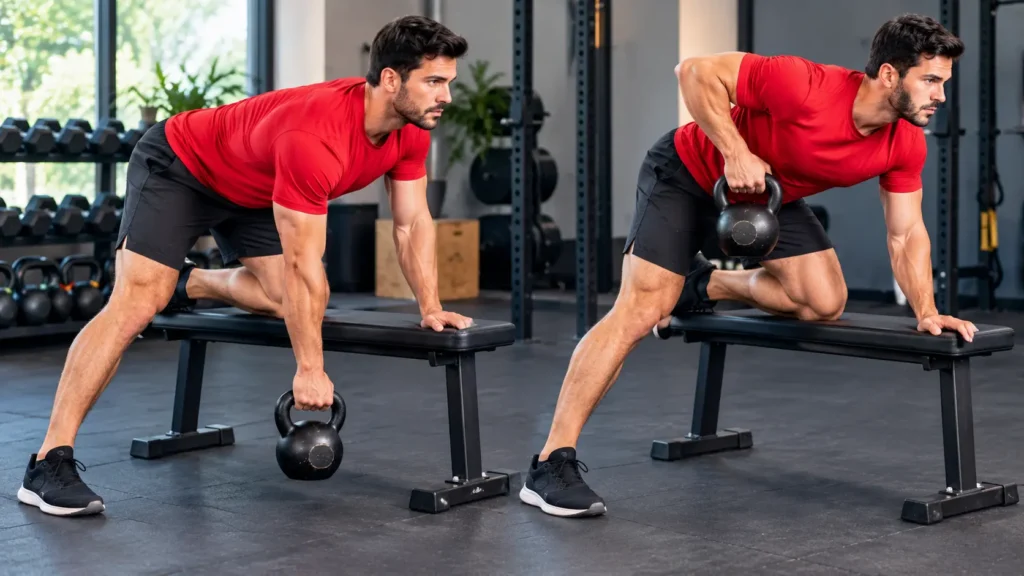
How to do it:
- Hinge forward with a flat back. Place one hand on a bench or your thigh for support.
- Let the bell hang from the other hand.
- Pull the bell toward your hip, keeping your elbow close.
- Squeeze your shoulder blade back, then lower with control.
Benefits: Rows train the back, rear shoulders, and arms. They balance all the pushing moves in this routine, which supports good posture.
7. Kettlebell Lunges
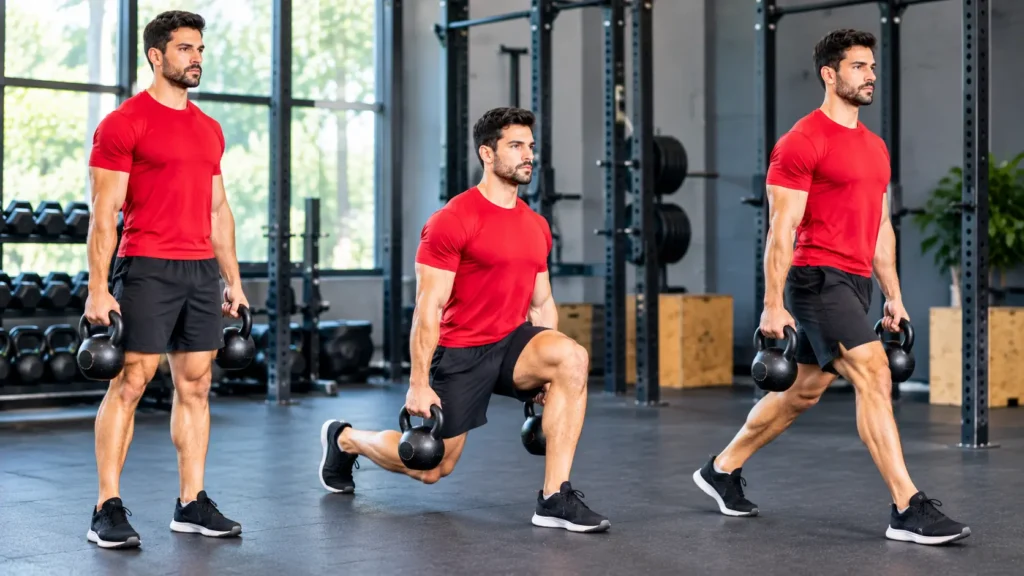
How to do it:
- Hold the bell at your chest (goblet style).
- Step forward with one leg.
- Lower until both knees bend to about 90 degrees.
- Push through the front foot to return.
- Switch legs.
Benefits: Lunges build the quads, glutes, and hamstrings, one leg at a time. This helps spot and fix side-to-side strength gaps. It’s a strong lower body exercise that also challenges balance.
8. Kettlebell Farmer Carries
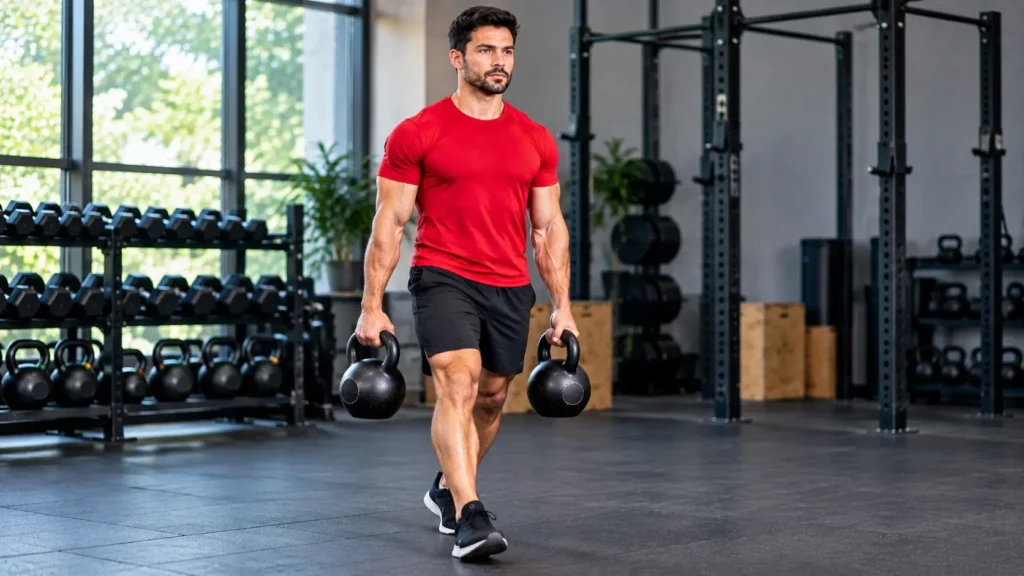
How to do it:
- Pick up a heavy bell in one hand (or two bells, one in each hand).
- Stand tall, shoulders back, and ribs down.
- Walk with steady steps for 20 to 40 seconds.
- Set the bell down with control.
Benefits: Carries build grip, posture, and core stability. They’re simple, hard, and useful in daily life, such as carrying groceries.
9. Kettlebell Halos
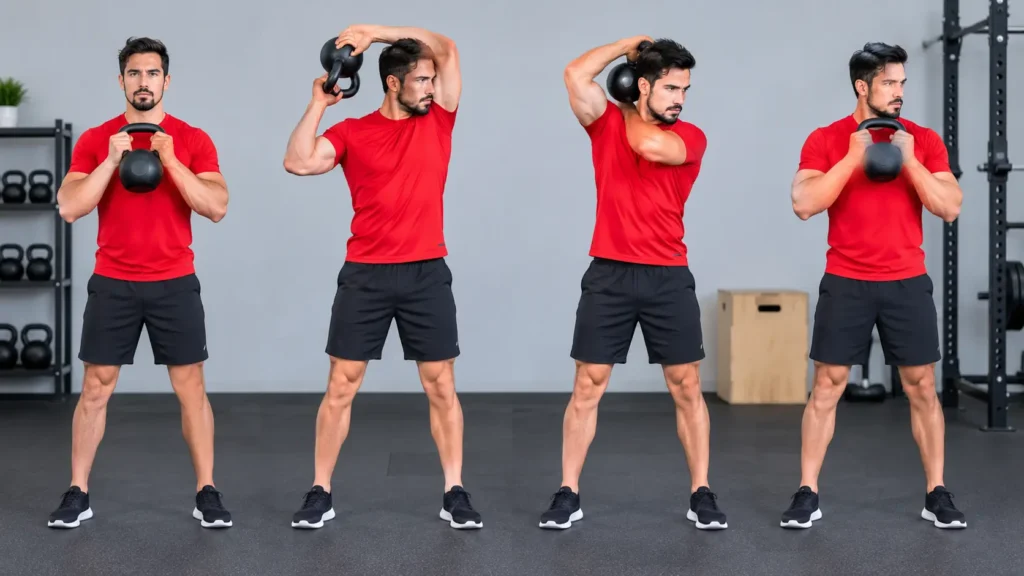
How to do it:
- Hold the bell upside down by the horns at chest level.
- Circle it around your head slowly, keeping it close.
- Keep your ribs down and hips still.
- Do 5 circles one way, then 5 the other way.
Benefits: Halos improve shoulder and upper back mobility. They make a good warm-up and work the core as a bonus.
10. Kettlebell Turkish Get Up
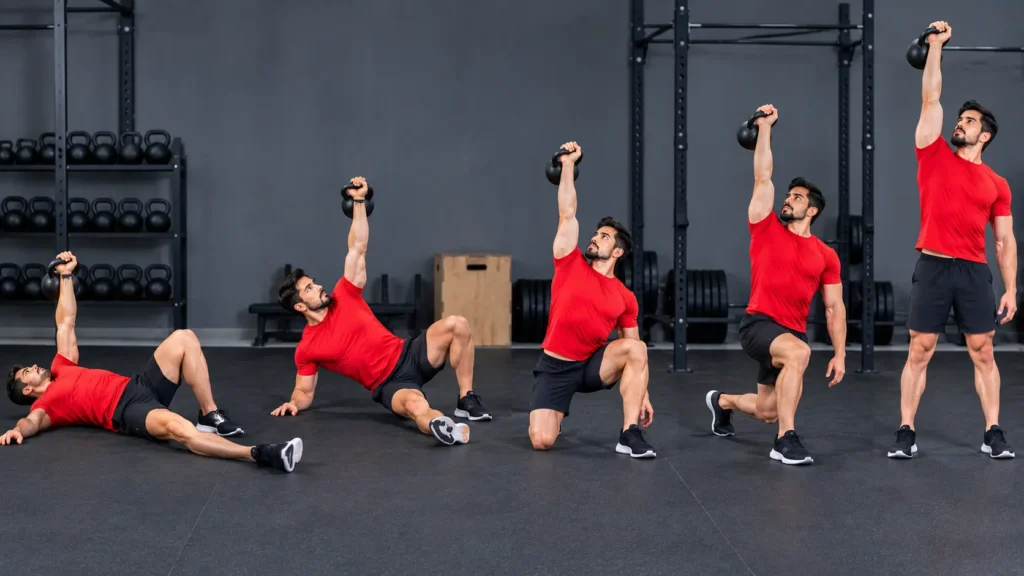
How to do it:
- Lie on your back. Hold the bell in your right hand with the arm straight up, and bend your right knee.
- Roll onto your left elbow, then your left hand.
- Lift your hips, sweep your left leg back, and come to a kneeling position.
- Stand up while keeping the bell overhead.
- Reverse each step to lie back down.
Benefits: The Turkish get up builds shoulder stability, core strength, and body control. It moves you through several positions slowly, which makes it a great skill drill. Start with no weight or a light bell.
Joe Rogan Kettlebell Workout Routine for Beginners
This is a Joe Rogan kettlebell routine for beginners that fits in a living room. It’s a full body kettlebell workout, so you only need one bell and some floor space.
Many coaches suggest starting with 8 kg (about 18 lb) for women and 12 kg (about 26 lb) for men. Go lighter if form feels shaky. Your ego will recover.
Warm-up (5 minutes)
- Kettlebell halos: 5 each direction
- Bodyweight squats: 10
- Hip hinges: 10
Main circuit (4 rounds, rest 60 seconds between rounds)
- Kettlebell swings: 15 reps
- Kettlebell goblet squats: 10 reps
- Kettlebell rows: 8 reps per arm
- Kettlebell clean and press: 5 reps per arm
- Kettlebell farmer carry: 30 seconds
Cool-down (5 minutes)
- Hamstring stretch, chest stretch, deep breathing
This Metabolic Workout style keeps your heart rate up while you build muscle. The whole thing takes about 30 minutes.
Train three days per week with a rest day between sessions. The World Health Organization recommends adults get 150 to 300 minutes of moderate aerobic activity weekly, plus muscle-strengthening work on two or more days. This routine covers both ideas.
Adjust the Workout for Your Goal
The same bell can serve different goals. Change the reps, sets, and rest times.
Strength. Use a heavier bell. Do 3 to 5 sets of 5 reps on presses, squats, and deadlifts. Rest 90 seconds or more.
Conditioning. Use a moderate bell. Do 20 seconds of work and 10 seconds of rest across swings, goblet squats, and snatches. This kettlebell conditioning workout will test your stamina.
Fat loss. Fat loss starts in the kitchen. Training supports it by raising your weekly calorie burn. A kettlebell workout for fat loss works best as a circuit with short rests, done three or four times a week. No exercise burns fat from one spot, so the belly-fat claims you see online are marketing.
Muscle. Slow down and add weight over time. A kettlebell workout for muscle needs progressive overload, which means doing a little more each week.
How Many Kettlebell Swings Should You Do?
There is no magic number, and anyone who gives you one is guessing. Start with 3 sets of 10 to 15 clean swings. Add reps once your form stays crisp.
Stop when your hips stop driving the bell. Sloppy swings turn into back pain. Quality beats quantity every time.
Pair Kettlebells With Bodyweight Work
Rogan is known for mixing styles, so you can too. Military Calisthenics such as push-ups, pull-ups, and planks pair well with kettlebells. They add pulling and pushing volume without more equipment.
Need Low Impact options? Swap swings for deadlifts, and replace lunges with slow goblet squats. You still get Core Exercises and leg work without pounding your joints.
Add one calisthenics block at the end of a session. Ten push-ups and a 30-second plank is plenty.
Recovery, Flexibility, and Common Mistakes
Training breaks you down. Recovery builds you up.
- Sleep seven to nine hours when you can.
- Stretch your hips, hamstrings, and shoulders after each session.
- Eat enough protein to support muscle repair.
- Rest at least one full day between hard sessions.
Avoid these common mistakes:
- Squatting the swing instead of hinging.
- Lifting the bell with your arms instead of your hips.
- Using a bell that’s too heavy too soon.
- Skipping the warm-up.
If you have a medical condition or an injury, check with a doctor or a qualified coach before you start.
Frequently Asked Questions
What kettlebell exercises does Joe Rogan do?
Rogan has not released a complete list. Moves commonly linked to his style include swings, cleans, presses, and snatches. This article’s core moves match those foundations.
What is Joe Rogan’s kettlebell workout?
There’s no single official version. The routine above is a Joe Rogan kettlebell workout routine built from common kettlebell staples, not a copy of his private sessions.
How often does Joe Rogan train with kettlebells?
He hasn’t published a fixed schedule. For you, three sessions per week is a smart start.
Is Joe Rogan’s kettlebell workout good for beginners?
A beginner version is. Use a light bell, learn the hip hinge first, and build slowly. Advanced moves like snatches can wait.
Can kettlebell workouts build muscle?
Yes. Kettlebell training can build muscle when you load the movements and progress over time. Heavier weights and more reps each month help.
Can kettlebells help burn belly fat?
Kettlebells raise your energy use, which helps with overall fat loss. They can’t target belly fat alone. Diet and consistency do the heavy lifting.
Is kettlebell training good for cardio?
Yes. High-rep swings and snatches raise your heart rate quickly. The ACE study mentioned above supports this, though its sample was small.
Can you get fit with only a kettlebell?
Yes. One bell covers squats, hinges, presses, pulls, and carries. That’s a complete functional toolkit for home training.
Final Thoughts
You don’t need Rogan’s schedule, his gym, or his podcast budget to train like a strong, athletic person. You need a kettlebell, 30 minutes, and patience.
Start light and learn the hinge. Build the habit first and the numbers will follow. Your future self will thank you, and your couch will survive without you.
Sources
- American Council on Exercise (ACE): “ACE-Sponsored Research: Kettlebells Kick Butt” (Porcari et al., University of Wisconsin–La Crosse, 2010)
- Lake, J. P., & Lauder, M. A. (2012). “Kettlebell swing training improves maximal and explosive strength.” Journal of Strength and Conditioning Research
- Jay, K. et al. (2011). “Kettlebell training for musculoskeletal and cardiovascular health.” Scandinavian Journal of Work, Environment & Health
- World Health Organization: Guidelines on Physical Activity and Sedentary Behaviour (2020)
- Joe Rogan Experience podcast episode pages (for his statements on kettlebells)

Hi, I’m Salem Nasir, founder of Fiturely. I research and write evidence-based articles on fitness, nutrition, weight loss, and healthy living. My mission is to make reliable health information simple, practical, and easy to understand so readers can build healthier habits with confidence