
Eggs are cheap, quick, and almost suspiciously good for you. Yet they have also been blamed for everything from high cholesterol to Monday morning grumpiness (okay, we made that last one up).
This guide gives you the egg nutrition facts straight from USDA data, with no fluff and no invented numbers. Use it to compare cooking methods, settle the yolk debate, and decide how many eggs fit your day.
What Are the Nutrition Facts for One Large Egg?
That is the short version of nutrition facts for one egg. Here is the full breakdown.
One Large Egg Nutrition at a Glance (Raw or Boiled, Without Shell)
| Nutrient | Amount per large egg (50 g) |
|---|---|
| Calories | ~72 kcal |
| Protein | ~6.3 g |
| Total fat | ~4.8 g |
| Saturated fat | ~1.6 g |
| Carbohydrates | ~0.4 g |
| Cholesterol | ~186 mg |
| Choline | ~147 mg |
| Selenium | ~16 mcg |
| Vitamin B12 | ~0.5 mcg |
Notice how much nutrition fits into about 72 calories. Few foods pack that much into so little.
How Many Calories Are in One Large Egg?
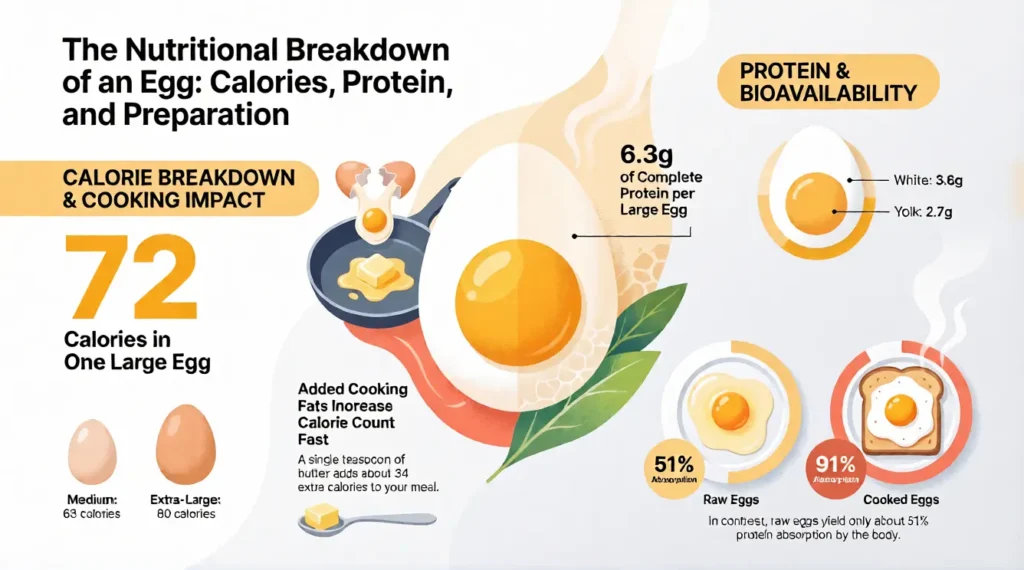
- Calories in one egg: about 72 for a large egg.
- A medium egg has roughly 63 calories, and an extra-large has about 80.
- Cooking fat, not the egg, usually adds the extra calories.
- Two large eggs come to about 144 calories.
The egg itself stays steady. What changes the count is the butter, oil, or cream you add. A teaspoon of butter adds about 34 calories, so your breakfast math can shift fast.
The USDA classifies a large egg as weighing at least 2 ounces (about 57 g) in the shell. Once you crack it open and drop the shell, the edible part is around 50 g. That is why you may see slightly different numbers on different websites.
How Much Protein Does One Egg Contain?
- Protein in one egg: about 6.3 g (large).
- The egg protein content is split between white and yolk.
- The white has about 3.6 g, and the yolk has about 2.7 g.
- Eggs contain all nine essential amino acids.
So, are eggs high in protein? Yes, especially for the calories. Eggs are a “complete” protein, which means your body gets every essential amino acid it cannot make on its own.
Cooking also helps. A well-known human study (Evenepoel et al., 1998, Journal of Nutrition) found the body absorbs about 91% of protein from cooked eggs, compared with about 51% from raw eggs. We recommend you verify the study details yourself, since we cannot search live databases here.
For anyone focused on fitness, that is a strong reason to cook your eggs rather than drink them raw like a movie boxer.
What Are the Egg Nutritional Value and Nutrition per 100g?
- Egg nutrition per 100g (raw, whole) is about 143 calories.
- It has about 12.6 g of protein and 9.5 g of fat.
- It has roughly 0.7 g of carbs and 372 mg of cholesterol.
- Two large eggs are close to 100 g.
The 100 g number is handy when you track food on a scale. Since a large egg weighs about 50 g, doubling the single-egg numbers gives you a close match.
In everyday terms, the egg nutritional value is high in protein and healthy fats, very low in carbs, and rich in micronutrients. That combination is why eggs show up in nearly every diet plan, from keto to bodybuilding to hospital meal trays.
What Nutrients Are Found in Eggs? (Egg Vitamins and Minerals)
These egg micronutrients are where eggs really shine. Here are the standouts:
- Choline: Supports brain function and liver health. The NIH recommends 425 mg per day for adult women and 550 mg for adult men, and one egg gives you about a quarter of that.
- Vitamin B12: Needed for nerve function and red blood cell formation. So, are eggs a good source of vitamin B12? Yes. One egg gives roughly 20% of the Daily Value.
- Selenium: A trace mineral that supports thyroid function and acts as an antioxidant. One egg covers about 30% of the Daily Value.
- Vitamin D: Eggs are among the few natural food sources, with about 40 IU per large egg.
- Lutein and zeaxanthin: Carotenoids in the yolk linked to eye health.
Here is a fun fact about color. The shade of a yolk, from pale yellow to deep orange, depends mostly on what the hen eats. A darker yolk does not automatically mean more nutrition, though it can signal more carotenoids in the feed.
Egg Yolk vs Egg White: Which Has More Nutrition?
This is the classic egg white vs whole egg nutrition debate, and the honest answer is that each has a job.
| Nutrient | Egg white (large, ~33 g) | Egg yolk (large, ~17 g) | Whole egg (large, ~50 g) |
|---|---|---|---|
| Calories | ~17 | ~55 | ~72 |
| Protein | ~3.6 g | ~2.7 g | ~6.3 g |
| Fat | ~0.1 g | ~4.5 g | ~4.8 g |
| Carbs | ~0.2 g | ~0.6 g | ~0.4 g |
| Cholesterol | 0 mg | ~184 mg | ~186 mg |
This also answers calories in egg white vs egg yolk. The yolk has about three times the calories, but it also holds nearly all the vitamin A, D, E, choline, and B12.
Is egg yolk healthy to eat? For most healthy people, yes. The yolk is where much of the whole egg nutrition lives. If you want to save calories, you can use one whole egg plus two whites for a lighter, high-protein scramble.
Boiled vs Fried vs Scrambled vs Raw: How Does Cooking Change Egg Nutrition?
Here is the cooking comparison for one large egg, based on USDA data.
| Cooking method | Calories | Protein | Fat | Carbs |
|---|---|---|---|---|
| Raw | ~72 | ~6.3 g | ~4.8 g | ~0.4 g |
| Boiled (hard) | ~78 | ~6.3 g | ~5.3 g | ~0.6 g |
| Fried (in oil) | ~90 | ~6.3 g | ~6.8 g | ~0.4 g |
| Scrambled (with milk and fat) | ~91 | ~6.1 g | ~6.7 g | ~1.0 g |
Boiled Egg Nutrition Facts
A boiled egg is the simplest option. It has about 78 calories, 6.3 g of protein, and 5.3 g of fat, with no added oil. How many calories are in 2 boiled eggs? About 155 calories, with roughly 12.6 g of protein.
Fried Egg Nutrition Facts
Fried egg nutrition facts run higher in fat because of the cooking oil. You get around 90 calories and 6.8 g of fat. That is still modest, as long as you do not fry it in half a stick of butter.
Scrambled Egg Nutrition
How many calories are in scrambled eggs? About 91 calories per large egg when made with a little milk and fat. A restaurant-style French omelette or soft scramble made with extra butter or cream can climb higher.
Raw Egg Nutrition Facts
Raw egg nutrition facts match the first table above. The catch is safety. The CDC and FDA warn that raw eggs can carry Salmonella, so pregnant people, young children, older adults, and anyone with a weak immune system should avoid them.
Boiled Egg vs Fried Egg Nutrition
In the boiled egg vs fried egg nutrition matchup, boiled wins on calories and fat. Fried wins on flavor, and nobody is judging you for that.
Best way to cook eggs for nutrition: poached or boiled. They keep calories low and avoid extra fat. Cooking until the whites are firm and the yolk begins to thicken also improves protein digestion and safety.
How Many Carbs and How Much Fat Are in an Egg?
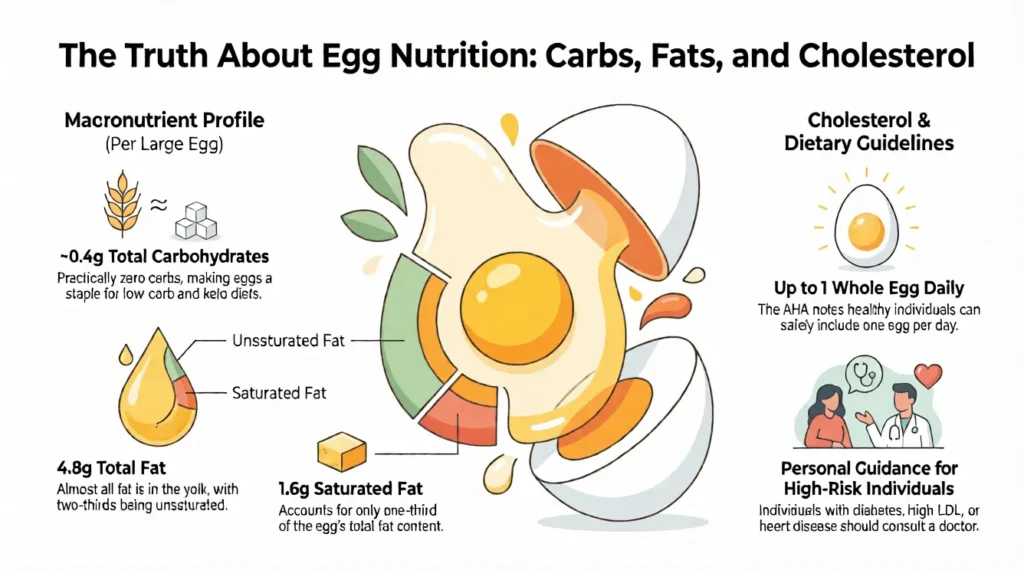
- Carbs in eggs: about 0.4 g per large egg, which is nearly zero.
- Egg fat content: about 4.8 g per large egg.
- Roughly 1.6 g of that is saturated fat.
- The rest is mostly heart-friendlier unsaturated fat.
So, how many carbs are in one egg? Less than half a gram. That is why eggs are a staple for low-carb and keto eating.
And how much fat is in a large egg? About 4.8 g, almost all of it in the yolk. About two-thirds of that fat is unsaturated, so eggs are not the fat bomb many people imagine.
How Much Cholesterol Is in One Egg, and Should You Worry?
This is the section where eggs spent decades in the doghouse. Cholesterol in eggs is real, but research has shifted. The American Heart Association says healthy people can include eggs in a heart-healthy diet, and their 2019 science advisory noted that up to one whole egg per day is reasonable for most healthy individuals.
There is an important exception. People with diabetes, high LDL cholesterol, or existing heart disease should ask their doctor for personal advice. One size does not fit every plate.
Is Eating Eggs Every Day Healthy? How Many Should You Eat?
- For most healthy adults, one egg a day fits well in a balanced diet.
- Some research supports up to two per day, depending on your overall diet and health.
- People with heart disease or diabetes should follow their doctor’s advice.
- What you eat with eggs matters as much as the eggs themselves.
How many eggs should you eat per day? There is no single official number. The AHA suggests up to one whole egg daily for most healthy people, and up to two for older adults with normal cholesterol, as part of a heart-healthy pattern.
Pairing matters too. Eggs with vegetables, whole grains, and fruit make a very different meal from eggs with processed meat and white toast. Think a spinach omelet and an orange on the side rather than a bacon-and-sausage pile.
What Are the Health Benefits of Eggs?
The health benefits of eggs go beyond basic protein:
- Muscle support: Complete protein helps repair and build muscle, which is why eggs are a favorite in fitness circles.
- Brain health: Choline is used to make acetylcholine, a neurotransmitter involved in memory and mood.
- Eye health: Lutein and zeaxanthin accumulate in the retina.
- Fullness: A 2005 study by Vander Wal and colleagues in the Journal of the American College of Nutrition found that an egg breakfast increased satiety compared with a bagel breakfast of equal calories. Please verify this citation yourself.
Are Eggs Good for Weight Loss?
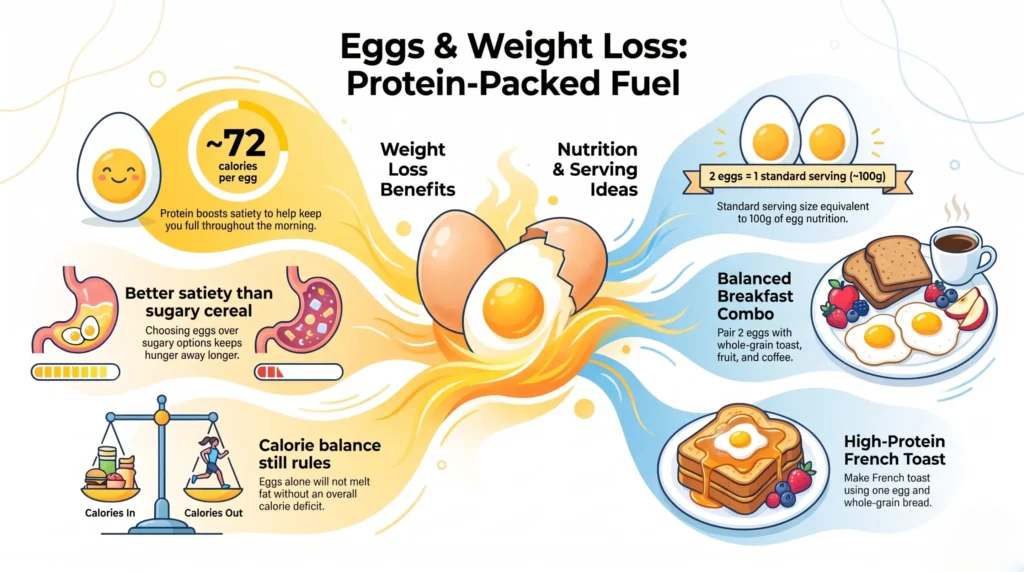
Yes, they can be. At roughly 72 calories each, eggs deliver protein that helps you feel full. Choose a boiled egg over a sugary cereal such as honey nut flakes, and you will likely stay satisfied longer. Eggs alone will not melt fat, though. Your overall calorie balance still rules.
What Are the Nutrition Facts for 2 Eggs?
This is a very common serving, so it is worth knowing. Two eggs also equal about 100 g, which makes them identical to the egg nutrition per 100g numbers above.
For a satisfying breakfast, try two eggs with toast, a side of fruit, and coffee. Or make French toast with one egg and whole-grain bread for a protein-friendly twist.
What About Egg Nutrition Facts Without the Shell?
Egg nutrition facts without the shell are what every number in this article reflects. If you weigh an egg in its shell, you will overestimate your portion by roughly 7 g.
Freshness matters too. Check the carton for the pack date (often a three-digit Julian date) and the sell-by date. USDA guidance says to refrigerate eggs at 40°F (4°C) or below and cook them until the yolk and white are firm.
7 Surprising Egg Nutrition Facts Most People Get Wrong
Eggs attract more myths than any other breakfast food. Here are seven worth knowing before your next grocery run.
- Shell color does not change nutrition. Brown and white shells come from different hen breeds. The USDA treats the nutrition as the same.
- One egg is not 72 calories forever. That number is for the egg alone. A fried egg lands near 90 calories once oil or butter joins the party.
- The white has no cholesterol. All of the roughly 186 mg in a large egg sits in the yolk.
- Raw is not the “stronger” choice. Studies suggest the body absorbs about 91% of protein from cooked eggs versus about 51% from raw (please verify the study yourself). Raw also carries Salmonella risk.
- Eggs are one of the few natural sources of vitamin D. A large egg has about 40 IU, and that sits in the yolk.
- Yolk color is mostly about feed. Pale yellow to deep orange depends on what the hen eats, not on whether the egg is “better.”
- The old 300 mg cholesterol cap is gone. The 2015-2020 Dietary Guidelines for Americans dropped that daily limit.
So the next time someone tells you egg yolks are “pure poison,” you can politely hand them this list and a boiled egg.
Which Eggs Fit Your Goal? A Quick Serving Guide
Use this table to pick a serving that matches what you want from your plate. The numbers are built from the large-egg values earlier in this guide, so they are estimates, not lab results.
| Your goal | Suggested serving | Approx. calories | Approx. protein |
|---|---|---|---|
| Light breakfast | 1 whole egg + 2 whites | ~106 | ~13.5 g |
| Everyday balance | 2 boiled eggs | ~155 | ~12.6 g |
| Fitness and muscle support | 3 boiled eggs | ~234 | ~18.9 g |
| Low-carb or keto | 2 fried eggs | ~180 | ~12.6 g |
Add vegetables, whole grains, or an orange on the side to round out the meal. If you have high cholesterol, diabetes, or heart disease, check your serving with a doctor first.
Final Thoughts
Eggs are one of the most nutrient-dense foods you can buy. For about 72 calories, one large egg delivers complete protein, choline, vitamin B12, selenium, and more. Cook it simply, pair it with real food, and listen to your doctor if you have heart or cholesterol concerns.
For the most accurate numbers on any brand or preparation, check the USDA’s FoodData Central database. Nutrition science evolves, so double-check anything you plan to use for medical decisions.
Sources:
USDA FoodData Central; USDA Agricultural Marketing Service (egg size classes); NIH Office of Dietary Supplements (choline); American Heart Association science advisory (2019); Dietary Guidelines for Americans; CDC and FDA egg safety guidance.

Hi, I’m Salem Nasir, founder of Fiturely. I research and write evidence-based articles on fitness, nutrition, weight loss, and healthy living. My mission is to make reliable health information simple, practical, and easy to understand so readers can build healthier habits with confidence