
Key Takeaways:
- A convenient breakfast option made primarily with whole-grain oats.
- Moderate in calories, making portion control important for weight-management goals.
- Contains added sugar, so checking your serving size can help manage daily sugar intake.
- Provides essential nutrients and some dietary fiber as part of a balanced breakfast.
- Can fit into a healthy diet, especially when paired with protein-rich foods and fresh fruit.
Honey Nut Cheerios has been sitting on breakfast tables for decades, and it’s easy to see why. It’s sweet, crunchy, and made with honey-toasted whole grain oats. But is it actually good for you, or just good marketing? Let’s break down the real numbers.
One serving (3/4 cup / 110 calories) of Honey Nut Cheerios has 1.5g fat, 22g carbs, 2-3g fiber, 8-9g sugar, and 2-3g protein. It’s made with whole grain oats, fortified with iron and vitamin D, and is moderately healthy. It’s good for the heart, not ideal for weight loss or high-protein diets, but manageable for diabetics in a controlled portion with milk and fruit.
Honey Nut Cheerios Nutrition Facts Per Serving
One standard serving of Honey Nut Cheerios has roughly 110 calories, 1.5g fat, 22g carbs, 2-3g fiber, 8-9g sugar, and 2-3g protein. It’s fortified with iron, calcium, and vitamin D, and whole grain oats are the first ingredient.
These numbers make it one of the lighter cereals on a per-serving basis, but the small serving size is deceiving. Most people pour double that amount into a bowl without measuring.
Nutrition Facts Table (Per 3/4 Cup Serving, Dry)
| Nutrient | Amount | % Daily Value* |
|---|---|---|
| Calories | 110 kcal | 5-6% |
| Total Fat | 1.5g | 2% |
| Sodium | 160mg | 7% |
| Total Carbohydrate | 22g | 8% |
| Dietary Fiber | 2-3g | 8-11% |
| Total Sugars | 8-9g | N/A |
| Added Sugars | ~8g | 16% |
| Protein | 2-3g | N/A |
| Iron | Fortified | 45% |
| Calcium | Fortified | 10% |
| Vitamin D | Fortified | 10% |
How Many Calories Are in Honey Nut Cheerios?
A single 3/4 cup serving has about 110 calories. Add a cup of whole milk and you’re looking at closer to 260-270 calories total. Most people eat 1.5-2 servings, pushing the cereal alone to 165-220 calories.
Calories aren’t the villain here. Portion size is. A visual gut-check: 3/4 cup is smaller than most cereal bowls people actually use.
If you’re tracking calories for fitness goals, weighing your cereal once with a kitchen scale is genuinely eye-opening.
Is Honey Nut Cheerios Healthy for Breakfast?
It’s a moderately healthy option. It’s better than sugary cereals loaded with dyes and fillers, but not a “health food” on its own. The whole grain oat base is a real plus; the added sugar content keeps it from being a top-tier choice.

Think of it as “decent, not perfect.” It beats a donut. It loses to plain oatmeal with fruit.
Pairing it with protein, such as milk, Greek yogurt, or even a spoon of peanut butter, helps balance the meal and slow down the sugar spike.
Honey Nut Cheerios Protein and Fiber Content
Protein sits at just 2-3g per serving. That’s low compared to eggs or Greek yogurt. Fiber is around 2-3g per serving, which is respectable for a cereal but still under the 4-5g “high fiber” threshold nutritionists look for.
The Dietary Guidelines for Americans recommend 25-38g of fiber daily, and most U.S. adults don’t hit that number. The CDC has flagged low fiber intake as a widespread gap in the American diet.
So while Honey Nut Cheerios contributes to your fiber goal, it won’t get you there alone. Adding sliced banana, chia seeds, or a few nuts on top meaningfully boosts both fiber and staying power.
Honey Nut Cheerios Sugar Content Per Serving
There’s about 8-9g of total sugar per serving, almost all of it added sugar (not naturally occurring). That’s roughly 16% of the recommended daily added sugar limit, in just one small bowl.
The American Heart Association recommends capping added sugar at about 25g/day for women and 36g/day for men. A single measured serving of Honey Nut Cheerios uses a real chunk of that budget, and most people eat closer to two servings.
Are Honey Nut Cheerios Good for Weight Loss?
It’s not ideal for weight loss on its own because of low protein and moderate added sugar, which means less fullness and quicker hunger return. It’s not off-limits either. Portion control and pairing with protein make a real difference.
Weight loss usually comes down to protein, fiber, and total calories across the day, not just one “good” or “bad” food.
If weight loss is the goal, treating Honey Nut Cheerios as a topping over Greek yogurt (instead of the main event with milk) stretches the protein and fiber ratio in your favor.
Is Honey Nut Cheerios Good for Your Heart?
The whole grain oat base genuinely supports heart health. The FDA has authorized a health claim that soluble fiber from whole grain oats, as part of a diet low in saturated fat and cholesterol, may reduce the risk of heart disease. The added sugar content is the counterweight to keep in mind.
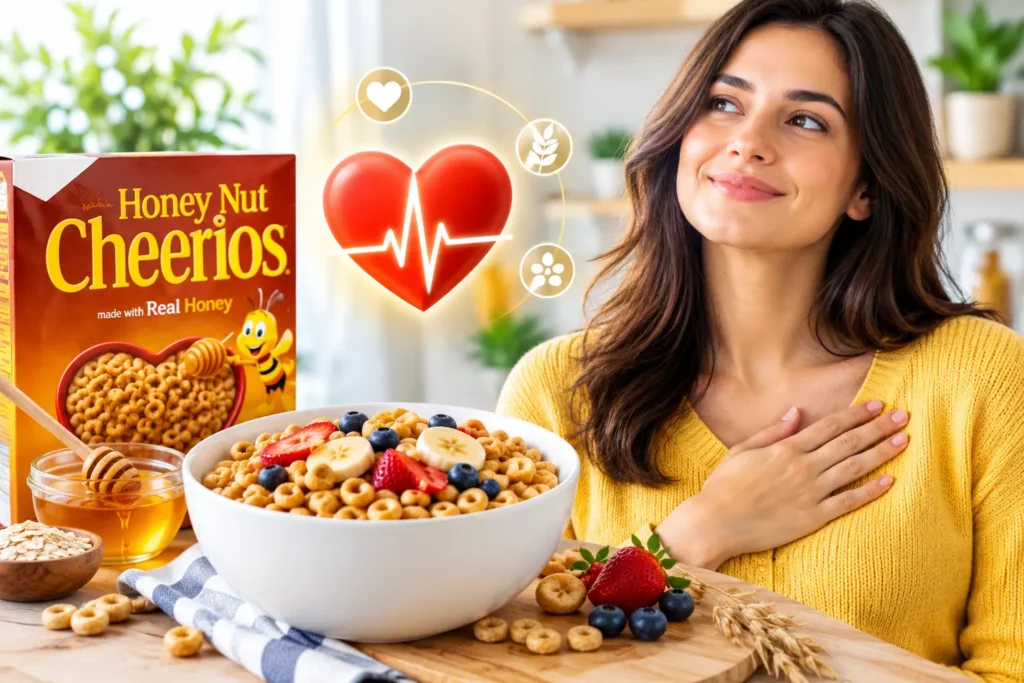
Original Cheerios famously carries the American Heart Association’s Heart-Check mark; Honey Nut Cheerios’ higher sugar content changes that calculation slightly, but the oat-fiber benefit doesn’t disappear.
Low sodium is another point in its favor for heart-conscious eaters.
Honey Nut Cheerios Carbohydrates and Calories With Milk
One serving with milk (dry cereal + 1 cup 2% milk) lands around 200-220 calories and roughly 32-34g total carbohydrates. Whole milk pushes calories closer to 260; skim or unsweetened almond milk brings it down again.
| Combo | Approx. Calories | Approx. Carbs | Approx. Protein |
|---|---|---|---|
| Cereal only (3/4 cup) | 110 | 22g | 2–3g |
| + 1 cup skim milk | ~195 | 34g | 11g |
| + 1 cup 2% milk | ~220 | 34g | 11g |
| + 1 cup whole milk | ~260 | 34g | 11g |
| + 1 cup unsweetened almond milk | ~140 | 24g | 4g |
Milk choice is actually the biggest lever here. Swapping whole milk for skim or unsweetened plant milk changes the calorie count more than most people expect.
Are Honey Nut Cheerios Healthy for Adults? Can Diabetics Eat It?
Adults can eat it in moderation as part of a balanced diet. It’s not a “diet food,” but it’s not a red flag either. For diabetics, it’s manageable in a controlled portion paired with protein and fiber, but it should be counted carefully because of its carb and added-sugar content.
The American Diabetes Association emphasizes pairing carbohydrates with protein and fiber to blunt blood sugar spikes, rather than avoiding carbs entirely.
A diabetic-friendly version: half a serving of Honey Nut Cheerios, mixed with plain Greek yogurt and a handful of nuts, keeps the crunch without the full sugar hit.
Honey Nut Cheerios Ingredients and Nutrition Facts
The core ingredients are whole grain oats, sugar, corn starch, honey, brown sugar syrup, salt, and a mix of vitamins/minerals for fortification (iron, zinc oxide, vitamin C, B vitamins, vitamin D). Whole grain oats top the ingredient list, which is a good sign under FDA labeling rules, since ingredients are listed by weight, heaviest first.
That ordering matters: it means oats genuinely make up the biggest share of the cereal, not just a marketing footnote.
Honey Nut Cheerios Vitamins and Minerals
It’s fortified with iron (around 45% DV), calcium, vitamin D, zinc, and B vitamins like niacin, B6, and folic acid. This fortification is common across breakfast cereals in the U.S., partly because cereal has historically been an easy vehicle for reaching nutrient targets at breakfast.
Iron fortification, in particular, is a meaningful plus. Many people, especially women, fall short on dietary iron.
How Does Honey Nut Cheerios Compare to Other Protein & Fiber Sources?
Compared to whole-food protein sources, Honey Nut Cheerios is low in protein and fiber per calorie. Foods like tilapia, kidney beans, and spam (yes, really) pack far more protein per serving, while medjool dates offer natural sugar with fiber attached, a very different profile than added sugar in cereal.
| Food (per typical serving) | Calories | Protein | Fiber | Sugar Type |
|---|---|---|---|---|
| Honey Nut Cheerios (3/4 cup) | 110 | 2–3g | 2–3g | Added sugar |
| Tilapia (3 oz, cooked) | ~110 | 22g | 0g | None |
| Kidney beans (1/2 cup, cooked) | ~110 | 8g | 6–7g | None (natural) |
| Spam (2 oz) | ~180 | 7g | 0g | None (high sodium) |
| Medjool dates (2 dates) | ~130 | 1g | 3g | Natural sugar |
| Peanut butter (2 tbsp) | ~190 | 8g | 2g | Minimal added |
This isn’t an apples-to-apples swap. Nobody’s suggesting spam or red onion for breakfast cereal (please don’t), but it puts the cereal’s numbers in perspective. Whole-food proteins simply do more nutritional heavy lifting per calorie than a fortified cereal ever will.
That said, cereal isn’t trying to be a protein source. It’s trying to be a fast, kid-friendly, whole-grain-based breakfast, and on that specific job, it does reasonably well.
What Are the Health Benefits of Honey Nut Cheerios?
The main benefits are whole grain oats (linked to heart health), low sodium, iron fortification, and a low calorie count per serving. It’s also a genuinely fast, low-effort breakfast, and that counts for more than people give it credit for.
For anyone juggling a morning workout or a fitness routine, a fast carb-plus-fortified-iron breakfast isn’t nothing. It’s fuel that shows up on time, even if it’s not a protein powerhouse.
The oat base also means you’re getting soluble fiber, the same type of fiber linked by the FDA to potential cholesterol benefits, which is a small but real plus that fully sugar-based cereals don’t offer.
None of this makes it a “superfood.” It just means the benefits are real, specific, and modest: not hype, not zero.
Is Honey Nut Cheerios Healthier Than Other Cereals? (Full Comparison)
Yes, compared to heavily sugared cereals like Frosted Flakes or Cinnamon Toast Crunch, but no, compared to plain Original Cheerios, plain oatmeal, or high-fiber bran cereals. It sits solidly in the middle of the cereal aisle, not at either extreme.
| Cereal (per ~3/4–1 cup) | Calories | Added Sugar | Fiber | Protein |
|---|---|---|---|---|
| Honey Nut Cheerios | ~110 | ~8g | 2–3g | 2–3g |
| Original Cheerios | ~100 | 1g | 3g | 3g |
| Frosted Flakes | ~110 | 11g | 0–1g | 1g |
| Cinnamon Toast Crunch | ~130 | 9g | 1g | 1g |
| Raisin Bran | ~190 | 17g (incl. raisins) | 7g | 5g |
| Plain Oatmeal (1/2 cup dry) | ~150 | 0g | 4g | 5g |
The pattern is clear: Honey Nut Cheerios beats the “kids’ aisle” cereals on sugar and calories, but loses to fiber-forward or unsweetened options. It’s a reasonable middle-ground pick, not the top or bottom of the shelf.
FAQs:
How healthy is Honey Nut Cheerios?
Moderately healthy: whole grain base, low sodium, but noticeable added sugar. Fine in a measured portion, not a daily nutritional powerhouse.
Are Honey Nut Cheerios high in sugar?
Yes, relative to plain cereals. About 8-9g of added sugar per small serving, and most people eat more than one serving.
How much protein is in Honey Nut Cheerios?
About 2-3g dry, or roughly 11g once mixed with a cup of dairy milk.
Can you eat Honey Nut Cheerios every day?
In moderation, yes. Just pair it with protein and fruit, and watch portion size.
Is Honey Nut Cheerios healthier than other cereals?
It’s healthier than most sugary cereals but less healthy than plain whole-grain oats or low-sugar bran cereals.
Are Honey Nut Cheerios good for weight loss?
Not ideal on their own due to low protein, but fine in a measured portion alongside Greek yogurt or eggs.
How many calories are in a bowl of Honey Nut Cheerios?
About 110 calories dry per 3/4 cup, or roughly 200–260 with milk depending on the type you use.
Is Honey Nut Cheerios healthy for kids?
Reasonably. It’s a better pick than most cartoon-mascot cereals, but pediatric nutrition guidelines still recommend watching total added sugar across a child’s day, not just one meal.
The Bottom Line:
Honey Nut Cheerios lands in the “reasonably good, not perfect” category. The whole grain oats and low sodium are genuinely solid. The added sugar and low protein are the trade-offs. Like most packaged foods, the label tells the real story. Measure your serving, add some protein, and it fits comfortably into most balanced diets, whether you’re a busy parent, a student, or hitting the gym before work.
References
- General Mills, Honey Nut Cheerios product page & nutrition label.
- U.S. FDA, Food Labeling: Health Claims; Soluble Fiber from Whole Grain Oats and Risk of Coronary Heart Disease.
- USDA, Dietary Guidelines for Americans, 2020-2025.
- American Heart Association, Added Sugars guidance.
- American Diabetes Association, Carbohydrate & meal planning guidance.
- CDC, Adult fiber intake data.
- USDA FoodData Central, general cereal, legume, and fish nutrient data.

Hi, I’m Salem Nasir, founder of Fiturely. I research and write evidence-based articles on fitness, nutrition, weight loss, and healthy living. My mission is to make reliable health information simple, practical, and easy to understand so readers can build healthier habits with confidence