
Key Takeaways
- You can build stronger traps at home using bodyweight, dumbbells, or resistance bands—no gym membership is required.
- Focus on exercises like shrugs, face pulls, reverse flyes, and Y-raises to target the upper, middle, and lower trapezius muscles.
- Train your traps 2–3 times per week with proper form and progressive overload for the best strength and muscle growth.
- Combine trap workouts with good posture, adequate protein, and recovery to maximize results and reduce the risk of neck and shoulder injuries.
Look at your shoulders in the mirror. Now look at your neck. Is there a smooth slope connecting the two, or does it look like someone forgot to build a bridge? That gap is usually a weak trapezius talking.
you don’t need a gym membership, a squat rack, or a bodybuilder’s schedule to fix it. A solid traps workout at home can build strength, fix posture, and even ease that nagging neck tightness, using nothing more than your bodyweight, a resistance band, and a bit of consistency.
This guide breaks down everything you need: the anatomy, the best home trap exercises, and the mistakes that quietly sabotage most people’s progress.
 What Even Is the Trapezius Muscle?
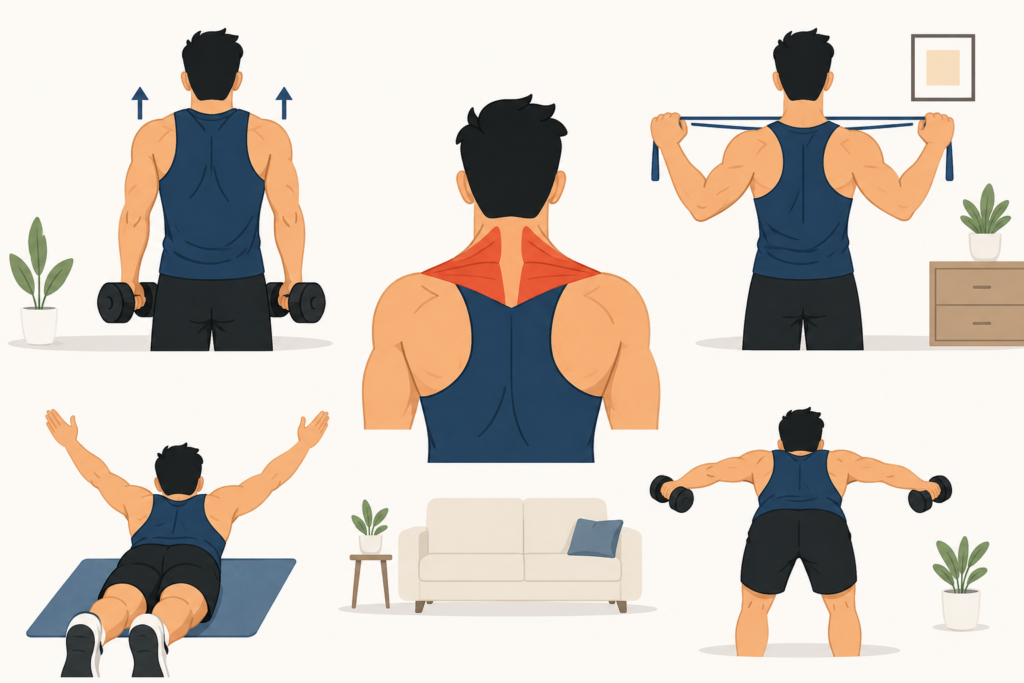 What Even Is the Trapezius Muscle?
The trapezius is a large, kite-shaped muscle running from the base of your skull, across both shoulders, and down to your mid-back. It’s one of the most visible muscles in the body, and also one of the most misunderstood.
Most people picture it as “that neck muscle bodybuilders have.” In reality, Cleveland Clinic explains that the traps help you turn your head, hold good posture, twist your torso, and shrug or pull your shoulders back. It’s a workhorse, not just a show muscle.
Anatomically, the trapezius splits into three regions, and each one needs different attention:
- Upper traps: lift and rotate the shoulder blades, and support the neck
- Middle traps: pull the shoulder blades together, improving posture
- Lower traps: pull the shoulder blades down, which is the part most people neglect
According to Physiopedia, the trapezius also stabilizes the shoulder joint alongside the serratus anterior muscle, which is exactly why weak traps often show up as shoulder pain, not just neck pain.
Why Train Your Traps at Home?
You don’t need heavy barbells to get results. In fact, most trap muscle workout routines rely on simple, controlled movements: shrugs, rows, and squeezes. These translate perfectly to a home setup.
Here’s why a home workout for traps actually works:
- Bodyweight and light resistance bands create enough tension to activate the traps.
- You can train more frequently since there’s no commute or equipment queue.
- Consistency beats intensity here. Ten focused minutes, four times a week, beats one brutal gym session that leaves you sore and skipping the next three workouts.
Think of it like brushing your teeth. Nobody needs a dentist’s chair to do it well, just the right technique, repeated often.
The Best Upper Traps Workout Moves
The upper traps get worked automatically during shrugging or lifting motions. Here are the most effective, equipment-light options for an upper traps workout.
1. Standing Shrugs:
Stand tall, arms relaxed at your sides. Raise your shoulders straight up toward your ears, hold for two seconds, then lower slowly. Do 3 sets of 15–20 reps. Hold a water bottle or a backpack in each hand if you want extra resistance.
2. Banded Upright Row:
Stand on a resistance band with both feet, holding the ends with your fists. Pull your hands up toward your collarbone, keeping your elbows higher than your wrists. This is a favorite for anyone chasing that classic, sculpted neckline look.
3. Wall Slides:
Stand with your back against a wall, arms bent at 90 degrees. Slide your arms up and down while keeping your elbows and wrists touching the wall. It looks easy. It is not.
Lower Traps Exercises You’re Probably Skipping
Here’s an uncomfortable truth: most people over-train the upper traps and completely ignore the lower ones. That imbalance is a common cause of neck and shoulder pain, and it’s why lower traps exercises deserve equal billing in your routine.
1. Standing Y-Raise:
Stand tall with your arms out in front of you, palms together, like you’re about to dive into a pool. Squeeze your shoulder blades and lift your arms up and out into a Y shape. Lower with control.
2. Prone Y-Raise:
Lie face-down on a mat, arms extended overhead in a Y shape, thumbs pointing up. Lift your arms a few inches off the floor, squeezing your shoulder blades down and together. Hold, then release.
3. Bent-Over T-Raise:
Hinge at your hips until your torso is around a 45-degree angle, keeping your back flat. Raise your arms out to the sides in a T shape, then lower slowly. This one quietly humbles even people who lift heavy elsewhere.
A Complete Trap Strengthening Exercises Routine:
Here’s a simple, balanced session that covers all three regions of the trapezius. No equipment beyond a resistance band (optional).
| Exercise | Region Targeted | Sets x Reps |
|---|---|---|
| Standing Shrugs | Upper | 3 x 15 |
| Shoulder Blade Squeeze | Middle | 3 x 12 |
| Standing Y-Raise | Lower | 3 x 12 |
| Banded Upright Row | Upper | 3 x 12 |
| Bent-Over T-Raise | Lower | 3 x 10 |
| Push-Up (any variation) | Full trapezius | 3 x 10 |
Run through this twice a week for a well-rounded trapezius exercises program, and add a third day once your shoulders stop complaining the next morning.
How to Build Traps at Home Without Overdoing It
If you want to genuinely build traps at home, three principles matter more than any single exercise:
Progressive overload. Add reps, sets, or resistance gradually. Your traps adapt the same way any muscle does: by being asked to do slightly more over time.
Form before load. The trapezius is a stabilizer as much as a mover. Rushing through shrugs with sloppy form mostly works your ego, not your muscle.
Recovery matters. The traps get involved in almost every upper-body movement, so they fatigue easily if trained daily without rest. Two to three sessions a week is plenty for most people.
Common Mistakes in Traps Training at Home
A few habits quietly stall progress in traps training at home setups:
- Only doing shrugs. Shrugs mainly hit the upper traps. Skipping Y-raises and T-raises leaves the middle and lower fibers undertrained.
- Using momentum. Swinging the arms up instead of controlling the movement reduces muscle activation and increases injury risk.
- Ignoring posture during the day. No amount of exercise fully offsets eight hours of hunching over a laptop. Traps respond best when paired with better daily posture habits.
When Trap Pain Signals Something More
Trapezius strains aren’t extremely common, but they do happen, usually from lifting too much weight too soon or from sudden, forceful movements, such as a car accident or a sports collision.
Persistent pain in the upper back, neck, or head lasting more than a week is a signal to see a healthcare provider rather than push through it, according to Cleveland Clinic. Muscle soreness after a new routine is normal. Sharp or radiating pain is not.
Final Thoughts
You don’t need a gym, a coach, or a bodybuilder’s genetics to get real results from a traps workout at home. A resistance band, a bit of floor space, and two or three sessions a week are enough to build strength, fix posture, and take pressure off your neck and shoulders.
Start with the basics, stay consistent, and let your form lead the way. The traps aren’t a muscle you build overnight, but they are one of the most rewarding ones to train, since almost everything else you do with your upper body gets a little easier once they’re strong.

Hi, I’m Salem Nasir, founder of Fiturely. I research and write evidence-based articles on fitness, nutrition, weight loss, and healthy living. My mission is to make reliable health information simple, practical, and easy to understand so readers can build healthier habits with confidence
Pingback: Calisthenics Workout Plan for Beginners (2026): 4 Week Full Body Routine to Build Strength Fast
Pingback: What Is Military Calisthenics? Complete Workout Plan for Beginners (2026)
Pingback: No Gym? Try These 15 Best Bicep Workouts at Home - fiturely.com