
Key Takeaways:
- Military calisthenics builds real-world strength, endurance, and agility using bodyweight exercises like push-ups, pull-ups, squats, and burpees, no gym required.
- Consistency matters more than intensity. Following a structured military workout routine 3-5 times per week can improve fitness, stamina, and overall performance.
- Focus on proper form before increasing reps. Good technique helps maximize results while reducing the risk of injury.
- Military-style bodyweight training is suitable for all fitness levels. Beginners can start with modified exercises and progress as strength improves.
- Pair your workouts with quality nutrition, hydration, and recovery to build lean muscle, enhance endurance, and achieve long-term fitness goals.
Military calisthenics is a bodyweight training system used by armed forces to build functional strength, endurance, mobility, and mental toughness. It combines push-ups, pull-ups, squats, core exercises, running, and progressive overload to improve real-world fitness without requiring expensive gym equipment.
This guide covers everything: what it is, why it works, exact exercises, a full 8-week plan, nutrition, recovery, and how it stacks up against gym training and CrossFit. If you’re also exploring a Calisthenics Workout Plan for Beginners or want to pair this with Resistance Band Exercises at home, you’re in the right place.
 What Is Military Calisthenics?
 What Is Military Calisthenics?
Military calisthenics is bodyweight training used by armed forces worldwide to build strength, stamina, and mental grit, using push-ups, pull-ups, squats, and running instead of machines. It’s cheap, portable, and battlefield-relevant. That’s why it has survived unchanged for decades while gym trends come and go.
At its core, a military bodyweight workout relies on your own body as resistance. Think push-ups, sit-ups, pull-ups, squats, lunges, and sprints, done in structured circuits or timed sets, often under fatigue or time pressure to simulate real combat stress.
Soldiers can’t carry a squat rack into the field. Military physical training (PT) needs to be doable anywhere, a barracks floor, a muddy field, a ship deck. It also builds strength that transfers directly to carrying gear, climbing walls, and dragging teammates, not just looking good in a mirror.
Bodybuilding isolates muscles for size (think bicep curls). Military strength training trains movement patterns, pushing, pulling, carrying, running, that work multiple muscle groups together. The goal isn’t aesthetics; it’s being able to perform under stress, repeatedly, without breaking down.
If you’re new to bodyweight training in general, our Calisthenics Workout Plan for Beginners is a gentler starting point before jumping into military-style intensity.
Why Military Forces Use Calisthenics Instead of Machines
Armed forces choose bodyweight training because it builds strength that actually works in the field, not just in a mirror. It’s cheap, portable, and scalable to hundreds of recruits at once. According to the U.S. Army Field Manual on physical readiness training (FM 7-22), functional movement is prioritized over isolated muscle work for exactly this reason.
Every exercise mimics a real task, climbing (pull-ups), carrying (farmer walks), crawling (bear crawls), or sprinting under load. This is the backbone of any solid tactical fitness training approach.
Machines let you lift heavy weight while sitting supported. Calisthenics forces you to move your own bodyweight through space, which builds strength-to-weight ratio, critical when you’re the one being carried out, or carrying someone else.
A soldier might need to scale a wall, drag a teammate, or sprint in full gear. No machine replicates that combination of strength, balance, and endurance the way military conditioning workout routines do.
Deploy to a desert, jungle, or ship, and your “gym” comes with you. This is why military-style bodyweight training remains the default even in 2026, despite access to modern fitness tech.
Benefits of Military Calisthenics
This training style delivers physical, mental, and everyday-life benefits that few gym programs match in one package. It builds real strength, sharpens discipline, and makes daily physical tasks noticeably easier. Below is the full breakdown by category.
Physical Benefits
- Strength: Push-ups, pull-ups, and squats build compound strength across your chest, back, shoulders, and legs.
- Muscle endurance: High-rep circuits condition muscles to work longer before fatigue sets in.
- Fat loss: Circuit-style military workout for weight loss routines burn calories through both strength and cardio elements combined.
- Better posture: Pulling exercises (rows, pull-ups) counterbalance the forward-hunch caused by desk work and phone use.
Mental Benefits
- Discipline: Sticking to a structured daily military calisthenics routine builds consistency that carries into other areas of life.
- Confidence: Hitting new push-up or pull-up numbers is a visible, undeniable marker of progress.
- Resilience: Training through fatigue builds mental toughness that helps you handle stress outside the gym too.
Everyday Benefits
- Climbing: Stairs, ladders, and fences become easier with real pulling and pushing strength.
- Carrying: Groceries, luggage, kids, functional strength shows up in daily chores.
- Running: Improved leg endurance and lung capacity from regular cardio-strength combos.
- Balance: Single-leg and core work (lunges, planks) improve coordination and reduce fall risk.
For older adults or anyone easing back into activity, pairing this with Mobility Exercises for Seniors can help build a safer foundation first.
Is Military Calisthenics Right for You?
Military calisthenics suits most healthy beginners, athletes, and anyone wanting home-based fitness, but it’s not ideal if you’re recovering from injury or have joint issues. The intensity and impact (think burpees, running, jumping) can aggravate existing conditions if you skip proper progression.
| Best For | Not Ideal For |
|---|---|
| Beginners | Injury recovery |
| Weight loss | Severe joint pain |
| Home workouts | Medical restrictions |
| Athletes | N/A |
If joint pain or mobility limits you, start with Low Impact Exercises and build up gradually rather than jumping straight into a military boot camp workout.
Military Calisthenics Exercises:
These ten movements form the backbone of nearly every military fitness routine worldwide. Master these before adding complexity, form always comes before volume.
Push-Ups

The most basic upper-body move in any military calisthenics workout, done in the plank position by lowering and raising your chest off the ground. It needs zero equipment, making it the go-to test exercise in almost every military fitness assessment worldwide.
Benefits: Builds chest, shoulder, and triceps strength; improves core stability.
Target muscles: Chest, triceps, shoulders, core.
Difficulty: Beginner-friendly.
Common mistakes: Sagging hips, flaring elbows too wide.
Progression: Knee push-ups → standard → decline → clap push-ups.
Reps: Start with 3 sets of 10-15.
Pull-Ups

A vertical pulling move where you hang from a bar and lift your chin above it, using an overhand grip. It’s often the toughest test in a military calisthenics workout, since it demands real relative strength.
Benefits: Builds back and grip strength; a key army calisthenics workout staple.
Target muscles: Lats, biceps, forearms.
Difficulty: Intermediate-advanced.
Common mistakes: Using momentum (kipping) instead of controlled reps.
Progression: Dead hangs → negative pull-ups → assisted → full reps.
Reps: 3 sets of max effort (aim for 5-8 to start).
Chin-Ups
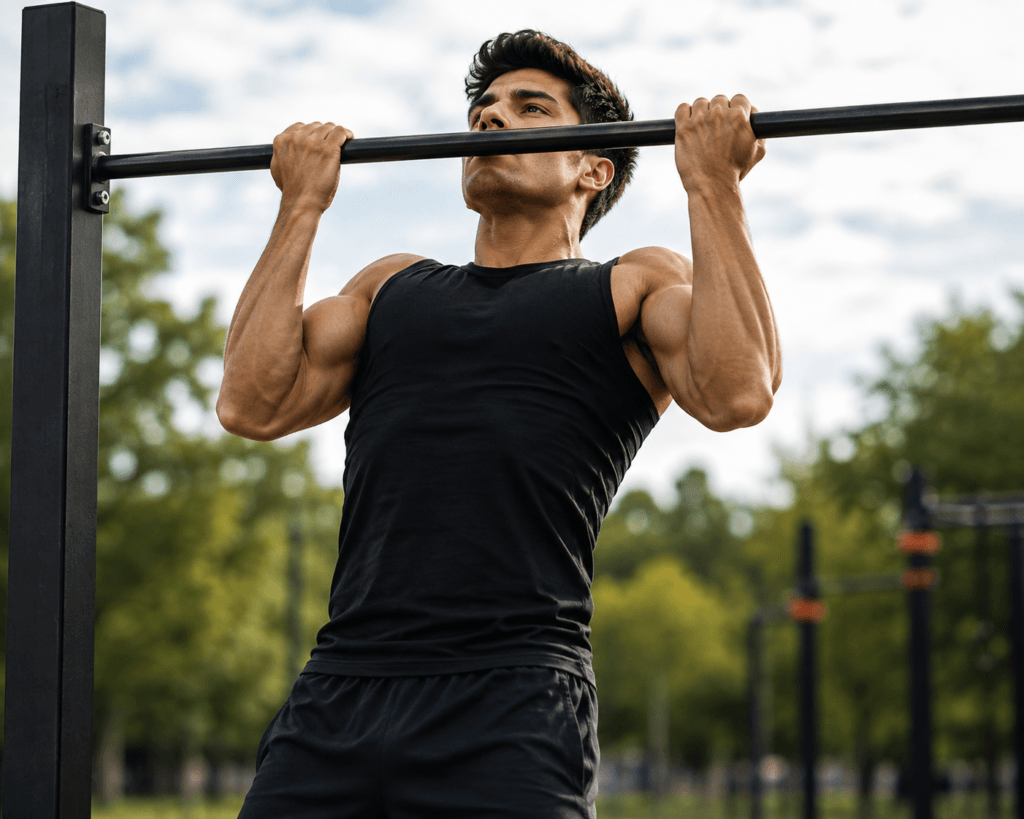
Same movement as a pull-up but performed with an underhand grip, shifting more load onto the biceps. Many beginners find chin-ups slightly easier, making them a smart bridge toward full pull-ups.
Benefits: Similar to pull-ups but emphasizes biceps more.
Target muscles: Biceps, lats.
Difficulty: Intermediate.
Common mistakes: Partial range of motion.
Progression: Same as pull-ups, underhand grip.
Reps: 3 sets of 5-10.
Squats
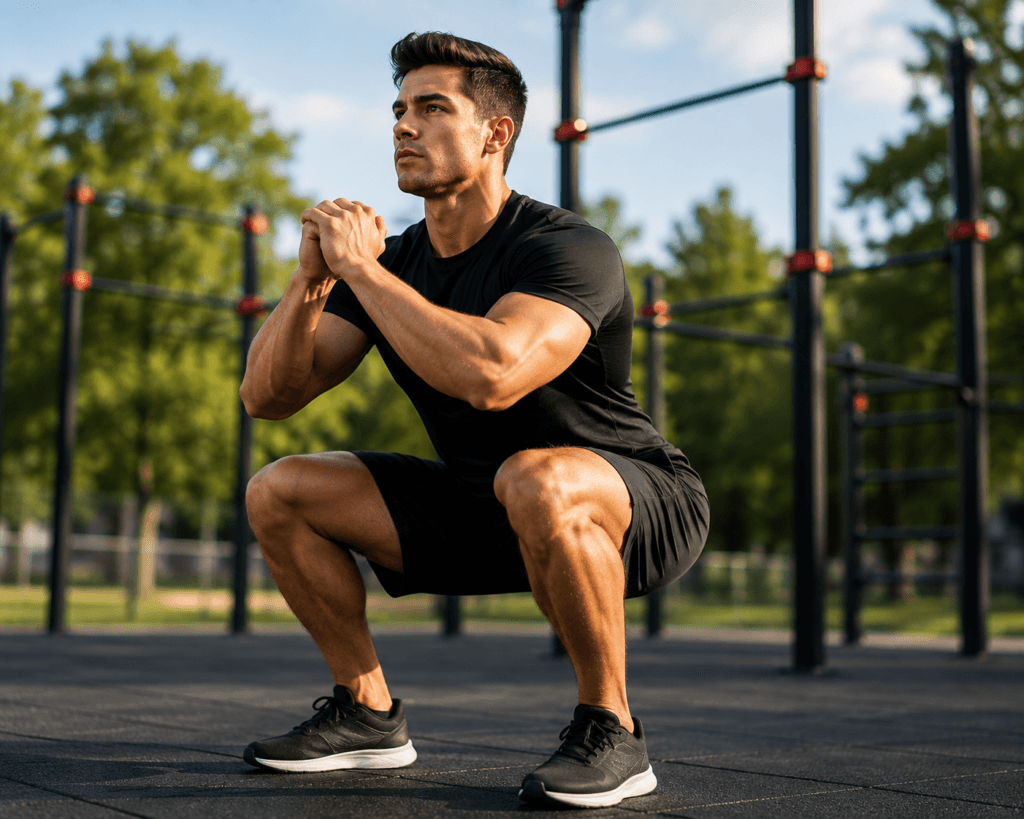
A lower-body movement where you bend your knees and hips to lower your body, then stand back up with control. It’s the foundation of nearly every military conditioning workout, since strong legs support running, rucking, and carrying.
Benefits: Builds leg and glute strength, core stability.
Target muscles: Quads, glutes, hamstrings.
Difficulty: Beginner.
Common mistakes: Knees caving inward, heels lifting.
Progression: Bodyweight → jump squats → weighted vest squats.
Reps: 3-4 sets of 15-20.
Lunges

A single-leg movement where you step forward, lower your back knee toward the ground, then push back to standing. It trains each leg independently, exposing and fixing strength imbalances that squats alone can miss.
Benefits: Builds unilateral leg strength and balance.
Target muscles: Quads, glutes, hamstrings, core.
Difficulty: Beginner-intermediate.
Common mistakes: Knee going past toes, leaning too far forward.
Progression: Static → walking lunges → jumping lunges.
Reps: 3 sets of 12 per leg.
Burpees
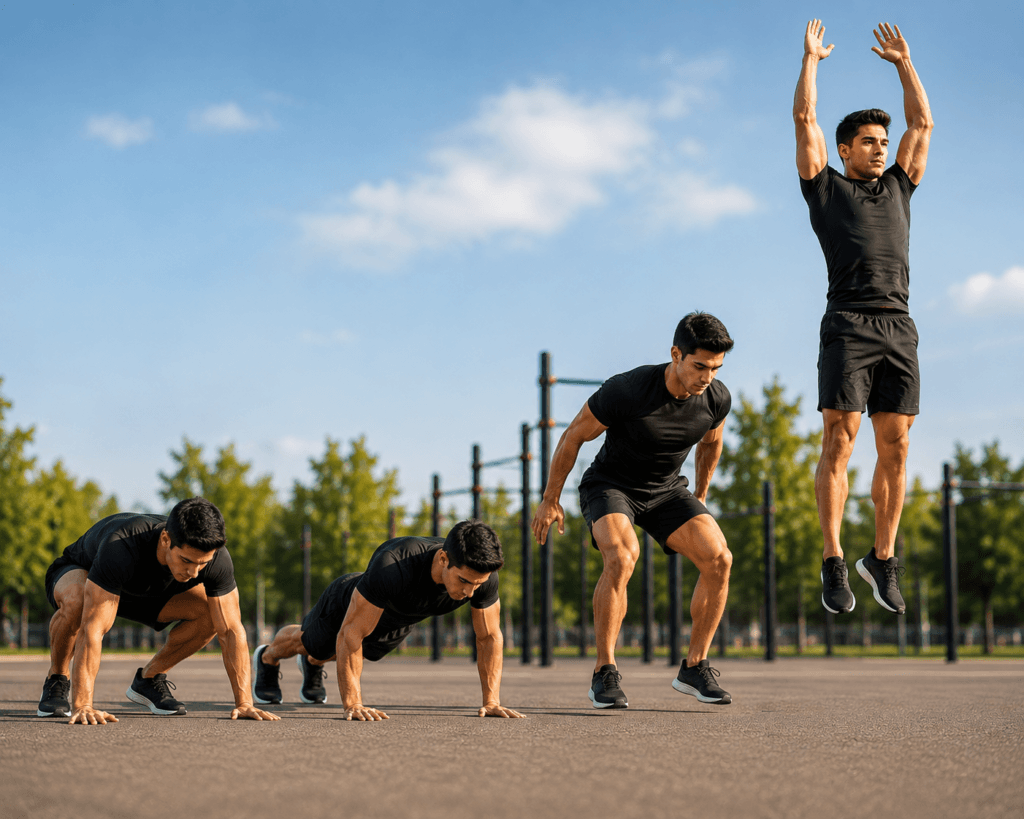
A full-body combo move: squat down, kick your feet into a plank, do a push-up, then jump back up. It spikes your heart rate fast, which is exactly why it’s a staple of any military boot camp workout.
Benefits: Full-body conditioning; core of most HIIT bodyweight workout circuits.
Target muscles: Full body, cardiovascular system.
Difficulty: Intermediate.
Common mistakes: Skipping the chest-to-floor portion.
Progression: Step-back burpees → standard → burpee with tuck jump.
Reps: 3-4 sets of 10.
Mountain Climbers
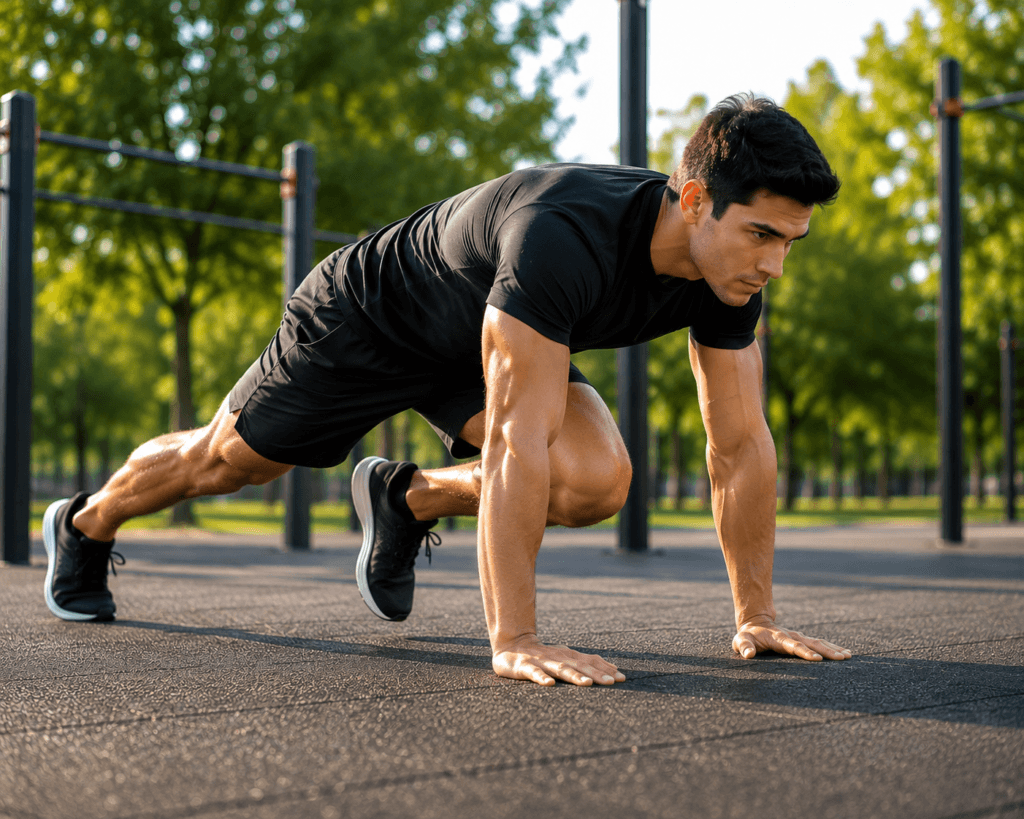
Starting in a plank, you drive your knees toward your chest alternately, in a fast running-like motion. It’s a low-impact way to raise your heart rate while still training core stability under fatigue.
Benefits: Core and cardio conditioning combined.
Target muscles: Core, shoulders, hip flexors.
Difficulty: Beginner-intermediate.
Common mistakes: Hips bouncing too high.
Progression: Slow controlled → fast-paced → cross-body.
Reps: 3 sets of 30-40 seconds.
Plank

A static hold on your forearms and toes, keeping your body in a straight line from head to heel. It builds the core endurance that protects your lower back during running, carrying, and heavy lifting.
Benefits: Core stability, injury prevention.
Target muscles: Abs, lower back, shoulders.
Difficulty: Beginner.
Common mistakes: Hips sagging or piking up.
Progression: Knee plank → full plank → plank with leg lift.
Reps: 3 sets, hold 30-60 seconds.
Hanging Knee Raise
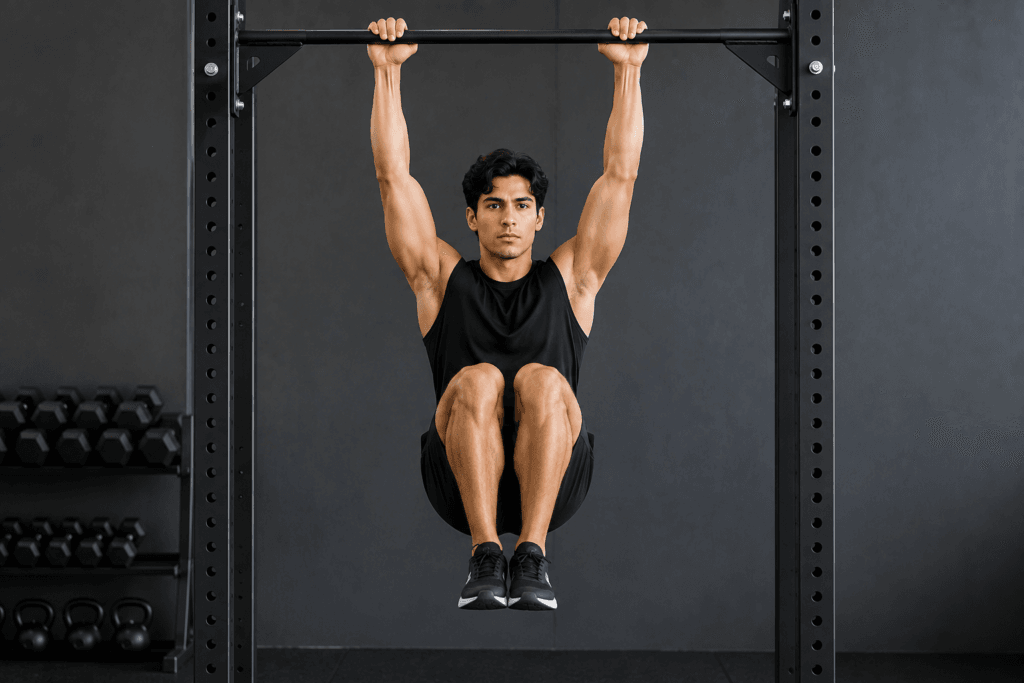
Hanging from a bar, you lift your knees toward your chest in a controlled motion, then lower slowly. It isolates the lower abs better than most standard core exercises, while also building grip strength.
Benefits: Lower ab strength, grip endurance.
Target muscles: Abs, hip flexors, forearms.
Difficulty: Intermediate.
Common mistakes: Swinging instead of controlled lift.
Progression: Lying leg raise → hanging knee raise → hanging leg raise.
Reps: 3 sets of 10-12.
Dips

Using parallel bars or a bench, you lower your body by bending your elbows, then push back up to full extension. It’s one of the most effective bodyweight moves for building pressing strength alongside push-ups.
Benefits: Builds triceps and chest strength.
Target muscles: Triceps, chest, shoulders.
Difficulty: Intermediate.
Common mistakes: Going too deep, causing shoulder strain.
Progression: Bench dips → parallel bar dips → weighted dips.
Reps: 3 sets of 8-12.
Bear Crawl

You move on hands and feet with knees hovering just off the ground, crawling forward in a controlled pattern. It’s a favorite in real military training exercises because it mimics low-crawling under obstacles.
Benefits: Full-body coordination and core strength; common in tactical athlete training.
Target muscles: Shoulders, core, quads.
Difficulty: Beginner-intermediate.
Common mistakes: Hips too high or too low.
Progression: Slow crawl → distance crawl → weighted vest crawl.
Reps: 3 sets of 20-30 seconds.
For extra arm-focused accessory work between sessions, check our guide on Bicep Workouts at Home.
Beginner Military Calisthenics Workout
This military calisthenics workout for beginners focuses on learning correct form across three non-consecutive days per week, giving your body time to recover and adapt.
Day 1: Push-ups (3×10), Bodyweight squats (3×15), Plank (3×30 sec), 10-minute walk.
Day 2: Rest or Mobility Exercises for Seniors-style stretching for active recovery.
Day 3: Lunges (3×10 per leg), Knee push-ups (3×12), Mountain climbers (3×20 sec).
Intermediate Workout
Once you can complete the beginner phase comfortably, this military workout plan adds pull-ups, dips, and longer circuits.
Pull-ups (3×5),
Push-ups (4×15),
Squats (4×20),
Plank (3×45 sec),
Burpees (3×8),
15-minute jog.
Advanced Military Workout
This military calisthenics training program mirrors actual boot camp intensity with minimal rest and higher volume.
Pull-ups (5×8),
Push-ups (5×25),
Dips (4×12),
Hanging knee raises (4×15),
Burpees (5×15),
Bear crawls (3×30 sec),
20-minute run with intervals.
8-Week Military Calisthenics Progression Plan
This structured military calisthenics training program takes you from beginner to advanced over two months, increasing volume gradually to avoid injury while building real endurance.
- Week 1: Learn form, push-ups, squats, planks (2-3 sessions).
- Week 2: Add lunges and mountain climbers; increase reps by 10%.
- Week 3: Introduce assisted pull-ups and dips.
- Week 4: First full-body circuit day; add a 10-minute run.
- Week 5: Increase circuit rounds; add burpees.
- Week 6: Add hanging knee raises and bear crawls.
- Week 7: Reduce rest time between sets; add timed challenges.
- Week 8: Test week, max push-ups, max pull-ups, timed 1.5-mile run.
This kind of progressive plan is what separates a real military fitness routine for beginners from a random workout list, structure beats intensity every time.
Military Fitness Standards Around the World
Different branches and countries test fitness differently, but the core themes, push-ups, running, and core endurance, repeat across almost every system. This is a general comparison only, not a recruitment or enlistment guide.
| Branch | Typical Tests |
|---|---|
| US Army | Push-ups, plank, run |
| Marines | Pull-ups, run |
| Air Force | Push-ups, sit-ups |
| Navy | Swimming, push-ups |
The U.S. Army’s Combat Fitness Test and similar assessments across NATO forces consistently emphasize the same fundamentals: pushing strength, pulling strength, core endurance, and aerobic capacity, the same pillars this guide is built around.
Military Calisthenics vs Traditional Gym Training
Military-style training builds functional, transferable strength using your bodyweight, while gym training typically isolates muscles for size using machines. Neither is “better.” They serve different goals.
| Military | Gym |
|---|---|
| Functional | Isolation |
| Bodyweight | Machines |
| Endurance | Hypertrophy |
If your goal is raw strength and stamina you can use anywhere, military strength training wins. If your goal is maximum muscle size, machine-based hypertrophy training has the edge. Many people now combine both.
Military Calisthenics vs CrossFit
Both are intense, but they differ in structure. Military conditioning workout routines follow a fixed, repeatable progression built around a handful of core movements. CrossFit rotates constantly varied functional movements, often including barbells, kettlebells, and Olympic lifts alongside bodyweight work.
Military training is simpler and more accessible, no equipment or coach required. CrossFit typically needs a gym (“box”) membership and more equipment variety. If you want minimalism and portability, calisthenics wins; if you want variety and competition, CrossFit may suit you better.
Nutrition for Military Calisthenics
Your training is only as good as your fuel. A solid military fitness exercises routine needs matching nutrition to actually build strength and recover properly.
Protein:
Supports muscle repair after high-rep bodyweight circuits, aim for lean meats, eggs, dairy, or legumes at each meal.
Carbs:
Fuel endurance work like running and long circuits; whole grains and fruit are reliable sources.
Hydration:
Even mild dehydration (as little as 2% body weight loss in fluids) can measurably reduce endurance performance, according to sports science research from the American College of Sports Medicine.
Recovery:
Post-workout meals with both protein and carbs speed up muscle glycogen replenishment.
Electrolytes:
Sodium, potassium, and magnesium losses through sweat need replacing, especially during outdoor army fitness workout sessions in heat.
Military Calisthenics Roadmap: Beginner to Elite
| Level | Goal | Focus | Time |
|---|---|---|---|
| Beginner | Learn form | Push-ups, squats | 2-4 weeks |
| Intermediate | Build endurance | Pull-ups, dips, runs | 4-8 weeks |
| Advanced | Strength & stamina | Weighted calisthenics, circuits | 8-16 weeks |
| Elite | Military-style performance | High-volume circuits, loaded carries, timed runs | Ongoing |
Common Beginner Mistakes
Most people don’t fail at military calisthenics workout routines because of low effort, they fail because of avoidable technical errors. Here’s what to watch for.
- Skipping warm-up: Jumping straight into burpees cold increases injury risk significantly.
- Too many burpees: Overloading one exercise burns you out before building balanced strength.
- Poor recovery: Training hard every day without rest stalls progress and increases injury risk.
- Ignoring mobility: Tight hips and shoulders limit form on squats and push-ups.
- No progression: Doing the same reps for months without increasing difficulty plateaus results.
- Bad form: Rushing reps sacrifices the muscle engagement that makes the exercise work.
Pairing your routine with Low Impact Exercises on rest days can help avoid burnout while staying active.
Equipment You May Need
While military bodyweight workout no equipment routines are entirely possible, a few affordable tools can add variety and progression.
- Pull-up bar: The single best investment for back and grip strength.
- Resistance bands: Useful for assisted pull-ups and mobility work, see our full Resistance Band Exercises guide.
- Dip bars: Great for triceps and chest development.
- Jump rope: Cheap, portable cardio that complements running.
- Weighted vest: Adds resistance to push-ups, squats, and runs for advanced progression.
If you’re building a home ab station too, our Home Workout Equipment for Abs guide covers budget-friendly picks.
Recovery Tips
Recovery is where the actual strength-building happens, not during the workout itself. Neglecting it undoes the benefits of even the best military endurance workout.
- Sleep: 7-9 hours supports muscle repair and hormone regulation.
- Protein: Aids tissue repair between sessions.
- Stretching: Maintains range of motion and reduces stiffness.
- Walking: Light movement on rest days boosts blood flow without added strain.
- Rest days: At least 1-2 full rest days per week prevent overtraining.
Older adults or anyone rebuilding strength should also check Leg Strength Exercises for Seniors for safer functional-training alternatives.
How Long Does It Take to See Results?
Most people notice early strength and endurance gains within two weeks, with visible changes by week eight, consistency matters more than intensity here.
- Week 2: Improved stamina; push-ups feel slightly easier.
- Week 4: Noticeable strength gains; better posture.
- Week 8: Visible muscle tone and major endurance improvement.
- Week 12: Significant fitness transformation; higher pull-up and push-up max reps.
Frequently Asked Questions
Can beginners do military calisthenics?
Yes. Start with modified versions (knee push-ups, assisted squats) and build up gradually using a structured beginner plan.
Is military calisthenics enough to build muscle?
Yes, especially for beginners and intermediates, bodyweight progression (harder variations, more reps) can build meaningful muscle over time.
Can you lose fat?
Yes. Circuit-style training combines strength and cardio, making it effective for a military workout for weight loss approach when paired with proper nutrition.
How many days per week?
3-5 days per week works well for most people, with at least one rest day between intense sessions.
Is running required?
Not strictly, but it’s commonly included because it builds the cardiovascular endurance real military training emphasizes.
Do soldiers only use bodyweight exercises?
No. They also use running, rucking (weighted marching), and sometimes free weights, bodyweight is the foundation, not the whole system.
Can I train at home?
Absolutely. A military calisthenics workout at home needs zero equipment for most core movements.
Do I need equipment?
No, but a pull-up bar and resistance bands add variety and help progress faster.
How many push-ups should beginners do?
Start with 3 sets of 8-15 reps, focusing on form before increasing volume.
Is it better than gym training?
Neither is objectively “better”, it depends on your goal. Functional strength and portability favor calisthenics; maximum muscle size favors gym machines.
Can women do military calisthenics?
Yes. The movements and progressions apply equally; only the starting reps and pacing may differ based on individual fitness level.
What is the biggest mistake beginners make?
Skipping progression and jumping straight into advanced moves like full burpee circuits without building a base first.
Conclusion:
Military calisthenics proves you don’t need a fancy gym to get seriously strong. With consistency, smart progression, and the right recovery habits, this military training exercises system builds functional strength, endurance, and mental toughness that carries into everyday life, not just the battlefield.
References:
- U.S. Army Publishing Directorate, FM 7-22: Holistic Health and Fitness (Physical Readiness Training doctrine): armypubs.army.mil
- American College of Sports Medicine (ACSM), Guidelines on Exercise, Hydration, and Performance: acsm.org
- U.S. Army, Army Combat Fitness Test (ACFT) Overview: army.mil
- United States Marine Corps, Physical Fitness Test (PFT) Standards: marines.mil
- U.S. Air Force, Fitness Assessment Overview: airforce.com
- U.S. Navy, Physical Readiness Test (PRT) Standards: navy.mil
- National Academy of Sports Medicine (NASM), Bodyweight and Functional Training Principles: nasm.org
- Centers for Disease Control and Prevention (CDC), Physical Activity Guidelines for Americans: cdc.gov
Note: This article draws on publicly available military fitness frameworks (such as the U.S. Army’s FM 7-22 physical readiness training manual), sports science research on hydration and recovery from bodies like the American College of Sports Medicine, and widely documented calisthenics training principles used across armed forces worldwide. It is written for general fitness education purposes and is not affiliated with, endorsed by, or a recruitment resource for any military branch. Always consult a certified fitness professional or physician before starting a new intense training program, especially if you have existing injuries or medical conditions.

Hi, I’m Salem Nasir, founder of Fiturely. I research and write evidence-based articles on fitness, nutrition, weight loss, and healthy living. My mission is to make reliable health information simple, practical, and easy to understand so readers can build healthier habits with confidence
Pingback: Home Workout Equipment for Abs: Best Ab Gear 2026
Pingback: Calisthenics Workout Plan for Beginners (2026): 4 Week Full Body Routine to Build Strength Fast
Pingback: Is Pilates Good for Weight Loss? The Truth About Fat Loss, Calories & Results (2026)
Pingback: Chair Yoga for Seniors: Easy Seated Stretches for Pain Relief & Flexibility (2026) - fiturely.com
Thanks for your marvelous posting! I actually enjoyed
reading it, you happen to be a great author.I will make certain to bookmark your blog and definitely will come back in the future.
I want to encourage you to definitely continue your great work, have a nice morning!