
Key Takeaways
- Tai Chi walking can support weight loss when combined with a calorie-controlled diet.
- Gentle movement still counts-regular practice can increase daily physical activity.
- It may help reduce body fat over time, but you cannot target belly fat alone.
- Consistency matters more than intensity for building a sustainable walking routine.
- Low-impact and beginner-friendly, Tai Chi walking can be a comfortable option for many adults.
- Pair it with healthy eating and strength training for better overall weight-management results.
Tai chi walking for weight loss works, but slowly and gently. It burns roughly 150 to 250 calories per hour, similar to brisk walking, and a 2021 clinical trial found it reduces waist circumference as effectively as conventional exercise. It’s low-impact, joint-friendly, and ideal for beginners, seniors, and anyone who wants sustainable fat loss without high-intensity strain.
What Is Tai Chi Walking?
Taichi walking blends the slow, flowing stance work of traditional tai chi with the forward motion of walking. Instead of striding normally, you shift your weight deliberately, bend your knees slightly, and coordinate breath with each step. It’s part martial art, part meditation, part cardio.
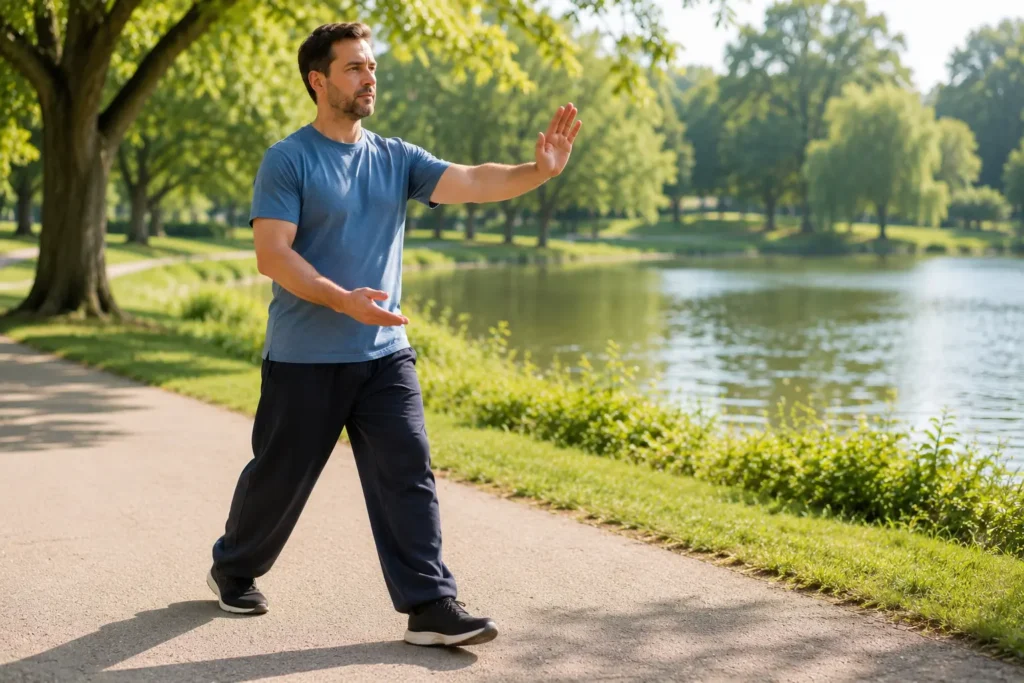
So what is tai chi walking, exactly, in plain terms? Think of it as walking meditation with structure. You’re moving, but every step is controlled rather than automatic. This is different from casually strolling while scrolling your phone. It demands attention, which is part of why it works.
The practice comes from Chinese martial arts traditions going back centuries, and it’s still taught today in community centers, hospitals, and rehab clinics across the U.S. According to the National Center for Complementary and Integrative Health (NCCIH), tai chi is classified as a mind-body practice, and it’s one of the few exercises recommended across nearly every age group.
Does Tai Chi Walking Help You Lose Weight?
Yes. Does tai chi walking help you lose weight is a fair question, and the honest answer is: it can, but slowly and mostly through consistency rather than calorie torching. It’s a moderate-intensity activity, similar in effort to brisk walking, not a HIIT substitute. Pair it with a sensible diet, and it becomes a legitimate part of a weight loss plan.
A notable 2021 randomized controlled trial published in the Annals of Internal Medicine by researchers at Hong Kong Baptist University found that tai chi was just as effective as conventional aerobic exercise at reducing waist circumference in adults with central obesity. That’s a real, peer-reviewed data point, not marketing fluff.
The takeaway isn’t that tai chi walking beats running for raw calorie burn. It’s that tai chi for weight loss can match traditional exercise for certain outcomes, especially in people who can’t tolerate high-impact routines.
What Are the Benefits of Tai Chi Walking for Weight Loss?
Tai chi walking benefits for weight loss go beyond the number on the scale. It improves posture, balance, mental focus, and cardiovascular health while being gentle on joints. Many people stick with it longer than harder workouts simply because it doesn’t leave them sore or dreading the next session.
Here are the core benefits, based on published research and clinical guidance:
- Lower stress hormones. Studies cited by Harvard Health tai chi to reduced cortisol and improved mood regulation.
- Better balance and fall prevention. The CDC lists tai chi among its recommended fall-prevention exercises for older adults.
- Improved cardiovascular markers. Multiple trials show modest improvements in blood pressure and resting heart rate.
- Joint-friendly movement. Low-impact mechanics reduce strain compared to running or jump training.
- Sustainable habit-building. Because it’s low-intensity, people are more likely to do it daily, which matters more than any single hard workout.
Tai Chi Walking for Belly Fat
Tai chi walking for belly fat specifically has research behind it, which is rare for a gentle exercise. The same Hong Kong Baptist University trial mentioned above measured waist circumference directly and found meaningful reductions after 12 weeks of consistent practice.

Belly fat responds to overall calorie balance more than any single exercise, but the stress-reduction angle matters here too. Chronic stress raises cortisol, and elevated cortisol is linked to abdominal fat storage. So a calming, moderate practice like this one attacks the problem from two directions.
Tai Chi Walking to Burn Calories
Tai chi walking to burn calories puts it in a similar range to brisk walking, roughly 150 to 250 calories per hour depending on body weight and intensity, based on general physical activity compendium estimates used by exercise physiologists. That’s not dramatic, but it adds up over a week of daily sessions.
Tai chi calorie burn increases if you add longer sessions, deeper stances, or combine it with resistance-style tai chi forms. It’s not going to out-burn spin class, and it was never meant to.
Tai Chi Walking vs Regular Walking vs Traditional Tai Chi
Tai chi walking vs regular walking is a common comparison, so here’s how the three approaches actually stack up side by side.
| Feature | Tai Chi Walking | Regular Brisk Walking | Traditional Tai Chi (stationary forms) |
|---|---|---|---|
| Calories burned/hour (avg.) | 150 to 250 | 250 to 400 | 150 to 200 |
| Impact on joints | Very low | Low to moderate | Very low |
| Balance & coordination benefit | High | Moderate | High |
| Stress reduction | High | Moderate | High |
| Beginner-friendly | Very high | High | Moderate (learning curve) |
| Best for seniors | Excellent | Good | Excellent |
| Cardio intensity | Moderate | Moderate to high | Low to moderate |
This is where low impact exercise for weight loss planning gets practical: if your joints can’t handle daily brisk walking, tai chi walking closes some of that calorie gap while staying gentle.
How to Do Tai Chi Walking (Step-by-Step for Beginners)
How to do tai chi walking comes down to five repeatable steps, and you can start practicing them in your living room today. This is a genuine tai chi walking exercise for beginners sequence used in many community classes.
- Stand tall, knees soft. Weight centered, shoulders relaxed, not locked.
- Shift weight fully onto one leg before lifting the other foot, no rushing this part.
- Step slowly, heel first, rolling through to the ball of your foot.
- Coordinate breath with movement. Inhale as you lift, exhale as you place the foot down.
- Keep arms loose and flowing, moving naturally with your torso rather than stiffly at your sides.
Repeat for 10 to 20 minutes. That’s genuinely it. No equipment, no gym membership, no learning curve steep enough to scare off a beginner.
What’s a Good Tai Chi Walking Routine for Weight Loss?
A solid tai chi walking routine for weight loss starts small and builds gradually. Five to seven sessions a week beats one long, exhausting session. Consistency is the entire game here, since this isn’t a high-calorie-burn activity on its own.
A simple weekly structure:
- Days 1 to 5: 15 to 20 minutes of tai chi walking, ideally outdoors or in a quiet space.
- Days 2 and 4: Add 10 minutes of traditional tai chi forms for extra core and balance work.
- Weekends: Combine with a 20 to 30 minute regular walk for added calorie burn.
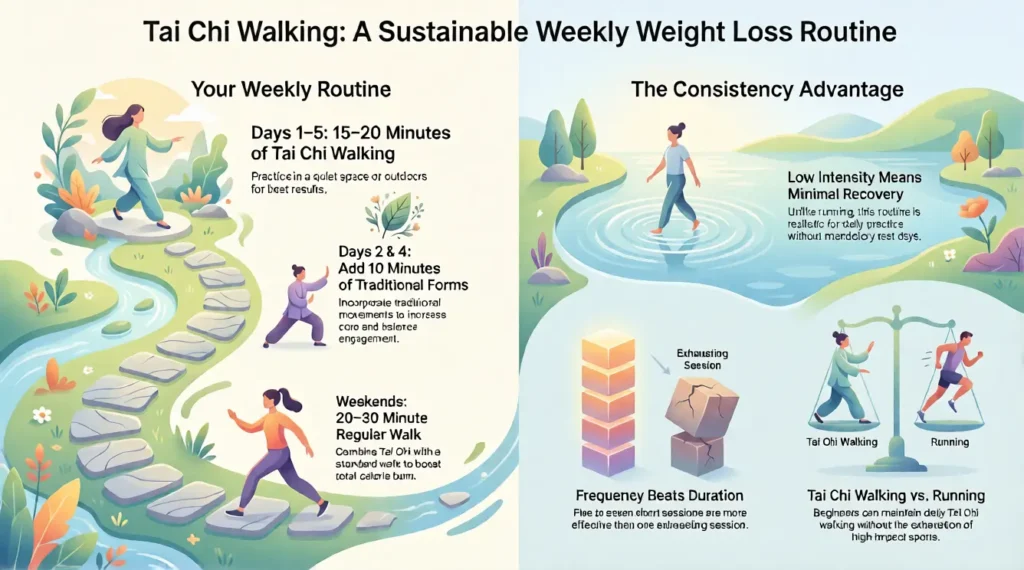
Tai chi walking every day for weight loss is genuinely realistic because the low intensity means minimal recovery time. Compare that to running, where rest days are non-negotiable for most beginners.
What Are the Best Tai Chi Walking Techniques?
Best tai chi walking exercises emphasize slow, weighted transitions rather than speed. Tai chi walking techniques worth learning include the “cloud hands” step, the “crane stance” pause, and the basic forward-shift walk described above.
Tai chi walking exercises for weight loss work best when you focus on depth of stance rather than pace. A slightly deeper knee bend recruits more muscle without adding impact. That’s the trade-off that makes this a legitimate tai chi walking workout, not just a stroll with extra steps.
Is Tai Chi Walking Good for Seniors?
Yes, and this is arguably where tai chi walking for seniors shines brightest. The CDC and Mayo Clinic both list tai chi among evidence-based options for improving balance and reducing fall risk in older adults, a genuinely serious health concern since falls are a leading cause of injury in people over 65.
Balance exercises for seniors don’t get much gentler than this. A low impact tai chi walking workout allows people with arthritis, joint replacements, or limited mobility to stay active without aggravating existing conditions.
Low impact workouts for seniors and walking exercises for seniors both benefit from the structured breathing tai chi walking builds in. It’s not just physical, it’s a mind body exercise that keeps cognitive engagement part of the movement.
Does Tai Chi Work? What the Research Actually Says
Does tai chi work for meaningful health outcomes, or is it just gentle stretching with good marketing? The evidence says it genuinely works for balance, stress, blood pressure, and moderate weight management, just not as a substitute for high-intensity training if fast fat loss is the goal.
Is tai chi good for you beyond weight loss too. Harvard Health Publishing has covered its links to improved sleep quality, reduced anxiety, and better joint mobility in arthritis patients. The tai chi health benefits list is long enough that physical therapists regularly prescribe it as rehab.
Tai chi cardio benefits are real but modest. Expect a moderate heart-rate elevation, not a sprint-level spike. That’s fine, because gentle exercise for weight loss isn’t about maximizing one metric, it’s about a routine you’ll actually keep doing for months, not days.
How Much Weight Can You Realistically Lose with Tai Chi Walking?
Most people can expect 2 to 5 pounds of weight loss in the first month with consistent daily practice, combined with a modest calorie deficit. That’s not dramatic, but it’s realistic, sustainable, and far less likely to bounce back than crash-diet results.
The 2021 Annals of Internal Medicine trial tracked participants over 12 weeks and found measurable waist-circumference reduction, not overnight transformation. Real results built gradually, session by session, which is exactly how sustainable tai chi for weight loss is supposed to work.
Here’s a rough timeline based on what the research shows:
- Weeks 1 to 2: Improved energy, better sleep, minimal scale movement.
- Weeks 3 to 6: Noticeable balance and posture improvement, early inches lost around the waist.
- Weeks 8 to 12: Measurable waist circumference reduction and modest overall weight loss, matching or approaching conventional aerobic exercise results.
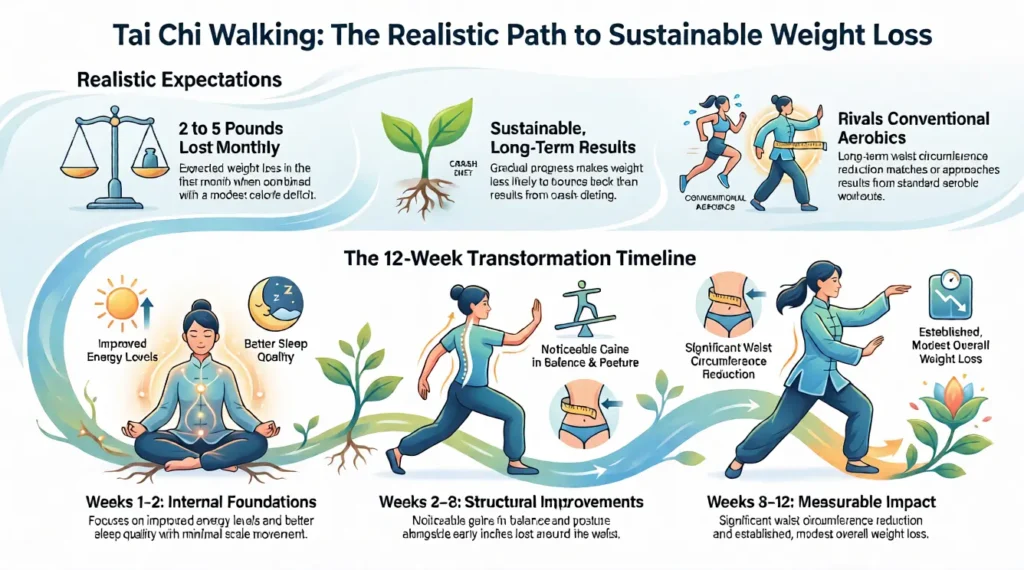
If you’re expecting rapid fat loss, this isn’t that exercise. If you want something you’ll still be doing in a year, it’s one of the better bets on the table.
5 Common Mistakes That Stop Tai Chi Walking from Working
Most people who quit tai chi walking early aren’t doing anything dangerous, they’re just making small mistakes that quietly cancel out the results. Fixing these takes minutes, not weeks.
- Moving too fast. Rushing through steps turns it into regular walking and strips away the balance and muscle-engagement benefits that make it effective.
- Skipping the breathing. Breath coordination isn’t decoration, it’s what keeps heart rate elevated enough to count as real, moderate-intensity movement.
- Practicing on a soft or cluttered surface. A flat, stable floor matters for proper weight transfer and injury prevention, especially for beginners and seniors.
- Expecting fast results. Comparing week-one results to a HIIT program sets you up to quit right before the real changes start showing up.
- Doing it without any dietary awareness. Even the best gentle exercise for weight loss can’t outpace a consistent calorie surplus, tai chi walking works best alongside sensible eating, not instead of it.
Fix these five, and daily practice starts paying off much faster.
FAQs:
Does tai chi walking actually help you lose weight, or is it just relaxation?
Yes, it genuinely helps. Does tai chi walking help you lose weight comes down to calorie balance plus consistency, and a 2021 clinical trial confirmed measurable waist-size reduction from regular practice, not just stress relief.
How many calories does tai chi walking burn in 30 minutes?
Roughly 75 to 125 calories in 30 minutes for most adults, depending on body weight and stance depth. It’s moderate, not extreme, which is exactly why people can do it daily without burning out.
Is tai chi walking better than regular walking for weight loss?
Not better, but different. Tai chi walking vs regular walking shows regular walking burns more calories per hour, while tai chi walking wins on joint protection, balance training, and stress reduction.
Can beginners start tai chi walking with zero experience?
Absolutely. Tai chi for beginners classes typically take a single session to explain the basics, and the five-step sequence in this guide is enough to start practicing today at home.
Is tai chi walking safe for seniors or people with joint pain?
Yes, it’s considered one of the safest options available. Tai chi walking for seniors and people with arthritis or joint replacements can practice it daily without the impact that running or jumping causes.
How long before you see weight loss results from tai chi walking?
Most published research shows measurable waist and balance improvements after 8 to 12 weeks of consistent practice, several sessions per week. It’s a slow-and-steady approach, not a quick fix.
Does tai chi walking help specifically with belly fat?
Yes. Tai chi walking for belly fat is backed by a real clinical trial showing waist circumference reduction, partly through calorie burn and partly through lower cortisol from stress reduction.
Can you do tai chi walking every day without overtraining?
Yes, and that’s actually the point. Tai chi walking every day for weight loss works because the low intensity needs minimal recovery time, unlike high-impact cardio that requires rest days.
The Bottom Line
What is tai chi walking for weight loss, in one sentence? It’s a low-impact, sustainable movement practice that supports gradual fat loss, better balance, and lower stress, best used alongside good nutrition and, ideally, a couple of higher-intensity workouts each week. It won’t replace intense cardio, but it might replace the excuses that keep you from moving at all.
Source:
NCCIH (National Center for Complementary and Integrative Health) The U.S. government’s own research body on mind-body practices. They explain what tai chi actually is and who it’s safe for.
Harvard Health Publishing Harvard Medical School’s public health arm. They’ve covered tai chi’s effects on sleep, anxiety, and joint mobility in detail. Mayo Clinic One of the most trusted hospital systems in the world. Their guide focuses on tai chi as a stress-management and low-impact fitness tool.
CDC’s STEADI Program The CDC’s official fall-prevention initiative for older adults, which recommends tai chi as an evidence-based exercise. Annals of Internal Medicine (2021 study) A peer-reviewed clinical trial by Hong Kong Baptist University researchers, comparing tai chi to conventional exercise for reducing belly fat. This is the actual science behind the “tai chi walking for belly fat” claims in this article.

Hi, I’m Salem Nasir, founder of Fiturely. I research and write evidence-based articles on fitness, nutrition, weight loss, and healthy living. My mission is to make reliable health information simple, practical, and easy to understand so readers can build healthier habits with confidence
Pingback: Tai Chi for Weight Loss: Does It Really Work? (2026 Guide) - fiturely.com