
Key Takeaways
- Low impact exercises help women burn fat, build strength, and improve fitness without putting excessive stress on the joints.
- Walking, squats, glute bridges, wall push-ups, bird dog, and cycling are some of the most effective beginner-friendly low impact exercises.
- Aim for at least 30 minutes of low impact exercise 4-5 days per week for steady weight loss and better overall health.
- Combine regular workouts with a balanced diet, adequate protein, and quality sleep to achieve faster and more sustainable results.
- Stay consistent and gradually increase workout intensity over time small daily improvements lead to lasting fitness success.
 What Are Low Impact Exercises for Women?
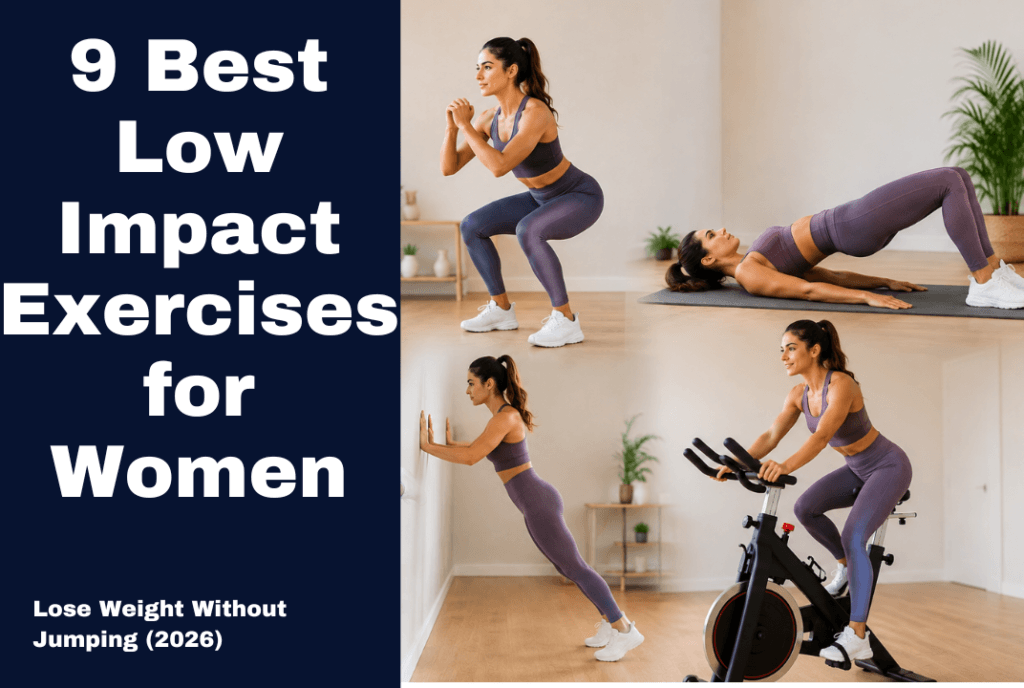 What Are Low Impact Exercises for Women?
Low impact exercises for women are workouts like walking, yoga, Pilates, cycling, and bodyweight strength moves that avoid jumping or hard pounding on joints. They improve heart health, build strength, and support weight loss without the injury risk that comes with high impact training. They suit beginners, busy women, and anyone managing joint pain.
What Are Low Impact Exercises?
A low intensity exercise or low impact movement is any activity where you do not leave the ground with both feet at once. Think walking instead of sprinting, or a squat instead of a jump squat.
Walking, swimming, cycling, yoga, Pilates, and bodyweight strength training are classic examples. None of these require flashy equipment, which makes them a natural fit for a low impact home workout no equipment routine.
High Impact vs Low Impact
High impact exercises, like running or jump rope, involve both feet leaving the ground, creating more force through your joints. Low impact training keeps that force lower, making it a genuinely gentle workout routine without cutting corners on results. It is also, refreshingly, a no jumping workout for women who would rather skip the burpees, thank you very much.
Related reading: Mobility Exercises for Seniors | Glute Exercises for Women | Home Workout Equipment
Benefits of Low Impact Exercises for Women
| Benefit | What It Does |
|---|---|
| Weight loss | Consistent movement builds a calorie deficit over time |
| Joint friendly | Protects knees and hips as true joint friendly exercises |
| Heart health | Steady cardio supports endurance training for a stronger heart |
| Muscle strength | Bodyweight moves build real, functional muscle |
| Better balance | Many routines double as balance exercises |
| Flexibility | Stretching-based moves count as genuine flexibility exercises |
| Posture | Core and back work correct slouching over time |
| Bone health | Weight-bearing movement like walking supports bone density (NIH) |
| Mental health | Linked to lower stress and better mood (WHO) |
| Daily energy | A short daily low impact workout wakes you up better than a second coffee |
Related reading: Bicep Workouts at Home
1. Walking
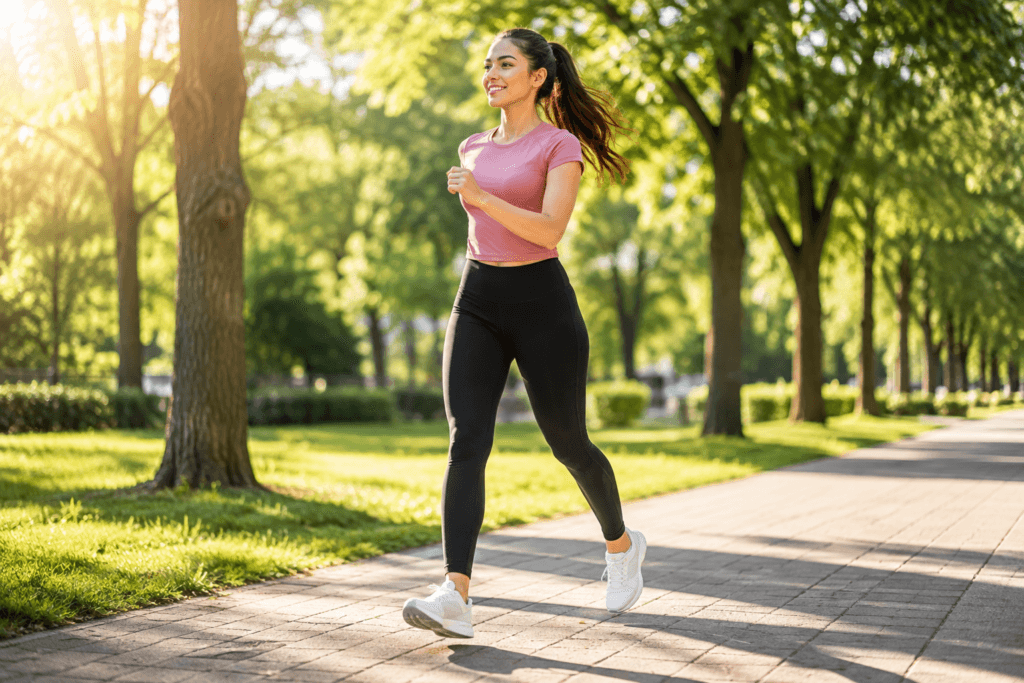
Walking is the most underrated cardio tool women have, and honestly, it deserves more credit. No equipment, no learning curve, and you can do it in a park, on a treadmill, or around your own living room while pretending it’s a park.
Why it’s effective: It raises your heart rate gently without pounding your joints, which makes it sustainable for years rather than weeks.
Benefits: Supports heart health, mood, weight management, and daily energy. It is also a genuine low impact cardio for women staple that doubles as active recovery on harder training days.
How to do it:
- Stand tall, shoulders relaxed, and look ahead rather than down at your phone.
- Swing your arms naturally instead of keeping them stiff by your sides.
- Land on your heel and roll through to your toes with each step.
- Pick up the pace until you can talk but not sing comfortably.
- Cool down with 3-5 minutes of slower walking before stopping.
Duration: 20-45 minutes, most days of the week.
Calories burned: Varies by pace, terrain, and body weight even a moderate walk contributes meaningfully to a calorie burning workout routine over time.
2. Bodyweight Squats
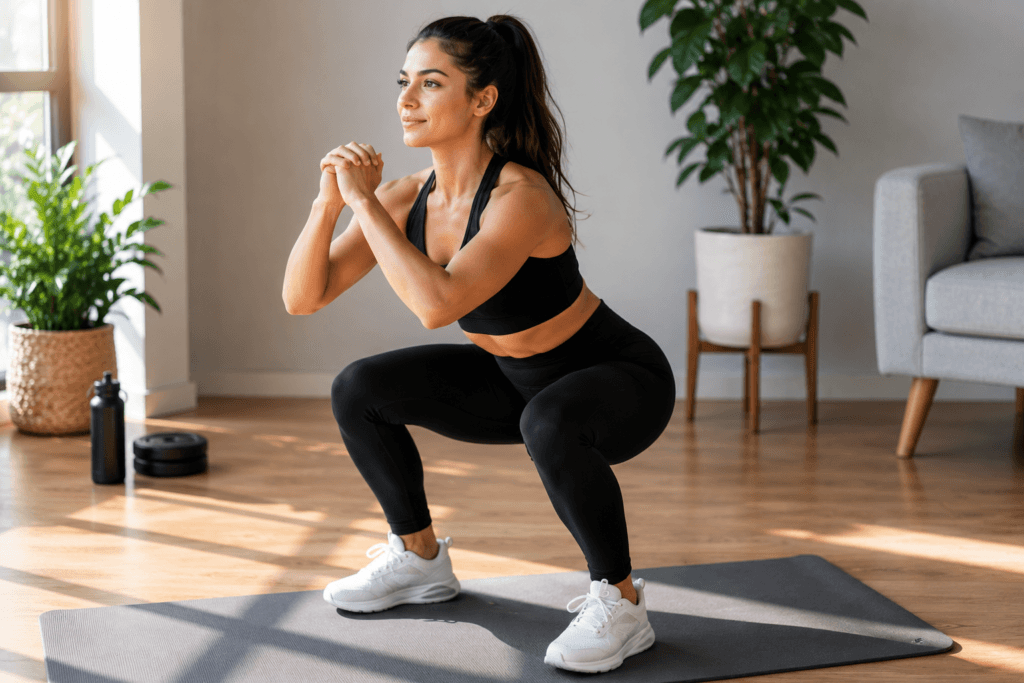
Squats look simple, but they quietly do more for your lower body than half the machines at a gym. They are a staple of any bodyweight exercises for women routine and need nothing but floor space.
Why it’s effective: Squats train multiple large muscle groups at once, which means more calorie burn and strength gain per minute spent.
Benefits: Builds leg and glute strength, supports knee stability, and improves everyday movements like sitting and standing. A core part of any muscle toning workout.
How to do it:
- Stand with feet shoulder-width apart, toes pointing slightly outward.
- Push your hips back as if sitting into an invisible chair.
- Lower until thighs are roughly parallel to the floor, keeping your chest up.
- Push through your heels to stand back up, squeezing your glutes at the top.
- Repeat for 2-3 sets of 10-15 reps, resting briefly between sets.
Duration: 8-12 minutes, including rest between sets.
Calories burned: Depends on body weight and pace, but the strength demand makes it a solid contributor to any low impact workout to burn calories session.
3. Glute Bridges
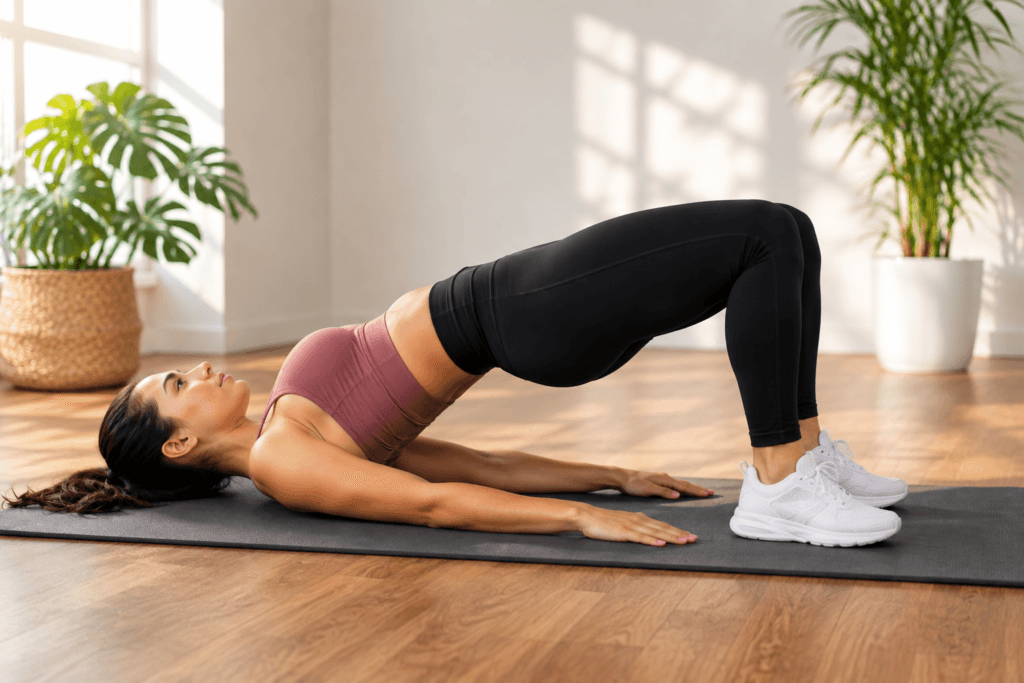
If squats are the headline act, glute bridges are the reliable co-star that never lets you down, especially for anyone dealing with lower back tightness.
Why it’s effective: The movement isolates the glutes and hamstrings while keeping the spine in a safe, supported position.
Benefits: Strengthens the glutes and lower back, improves hip stability, and supports posture. Excellent for a low impact strength workout for women who want results without heavy weights.
How to do it:
- Lie on your back with knees bent and feet flat, hip-width apart.
- Press your feet into the floor and lift your hips toward the ceiling.
- Squeeze your glutes at the top and hold for a second.
- Lower slowly back down without letting your hips drop suddenly.
- Aim for 12-15 reps per set, 2-3 sets total.
Duration: 6-10 minutes.
Calories burned: Modest but consistent, since the move works larger muscle groups like the glutes and hamstrings.
4. Wall Push-Ups
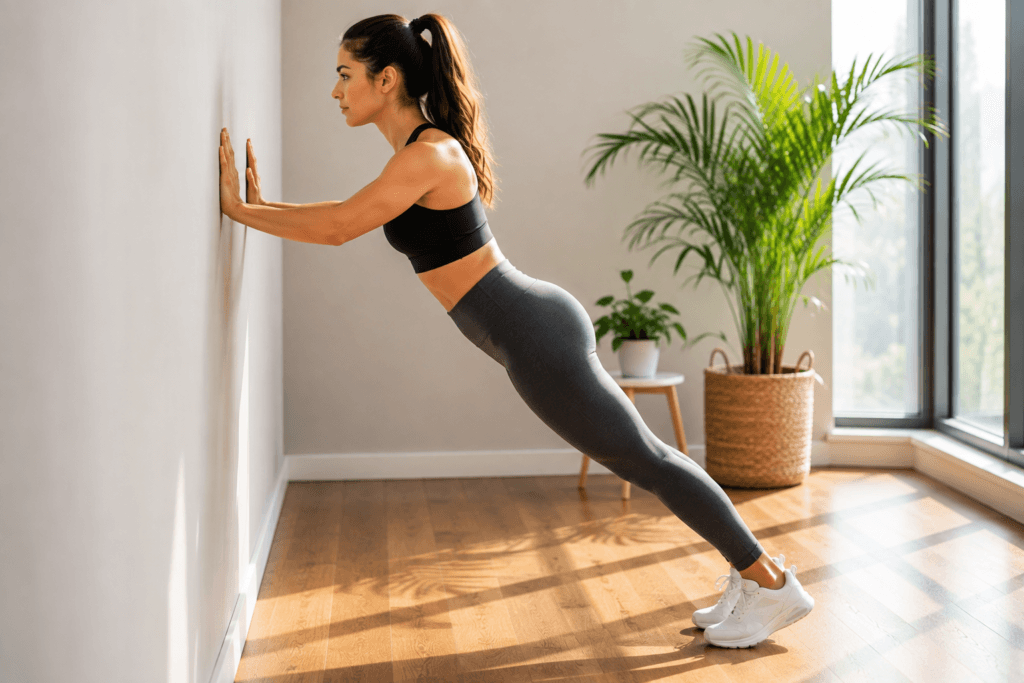
Wall push-ups are the friendly, less intimidating cousin of the floor push-up, and a genuinely smart entry point into upper body strength.
Why it’s effective: The upright angle reduces the load on your wrists, shoulders, and lower back, making it ideal for beginners rebuilding upper body strength.
Benefits: Strengthens the chest, shoulders, and arms while protecting joints. Great for absolute beginner fitness exercises without straining wrists or shoulders.
How to do it:
- Stand facing a wall, about arm’s length away.
- Place your hands on the wall at shoulder height and width.
- Bend your elbows to lower your chest toward the wall.
- Push back to the starting position, keeping your core engaged throughout.
- Repeat for 10-15 reps, 2 sets, increasing distance from the wall as you progress.
Duration: 5-8 minutes.
Calories burned: Low compared to cardio, but the strength benefit for the chest, shoulders, and arms makes it well worth the short time investment.
5. Bird Dog
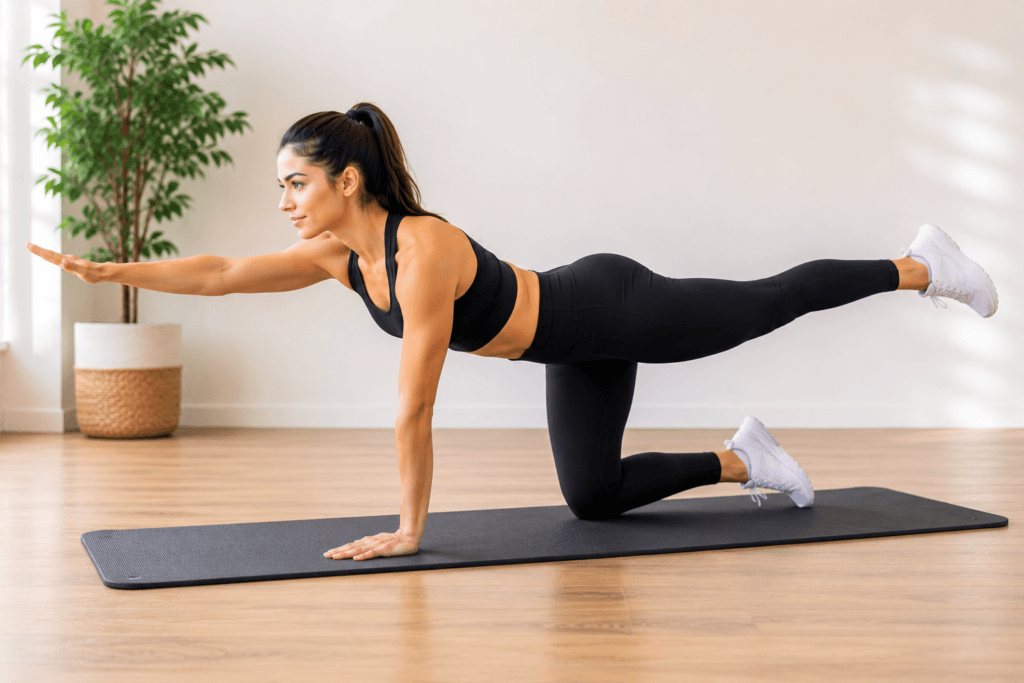
Bird dog looks a little silly the first time you try it, but it is one of the smartest moves for anyone who sits at a desk all day.
Why it’s effective: It challenges balance and core stability simultaneously, training the body to stay controlled under mild instability.
Benefits: Builds balance and works as genuine core strengthening exercises, while also doubling as light mobility workout practice for the hips and shoulders.
How to do it:
- Start on hands and knees, wrists under shoulders and knees under hips.
- Extend your right arm forward and left leg back at the same time.
- Keep your hips level and avoid arching your lower back.
- Hold briefly, then return to the start and switch sides.
- Repeat for 8-10 reps per side, 2 sets.
Duration: 5-7 minutes.
Calories burned: Minimal, since this is primarily a stability and control exercise rather than a calorie-focused one.
6. Cat-Cow Stretch
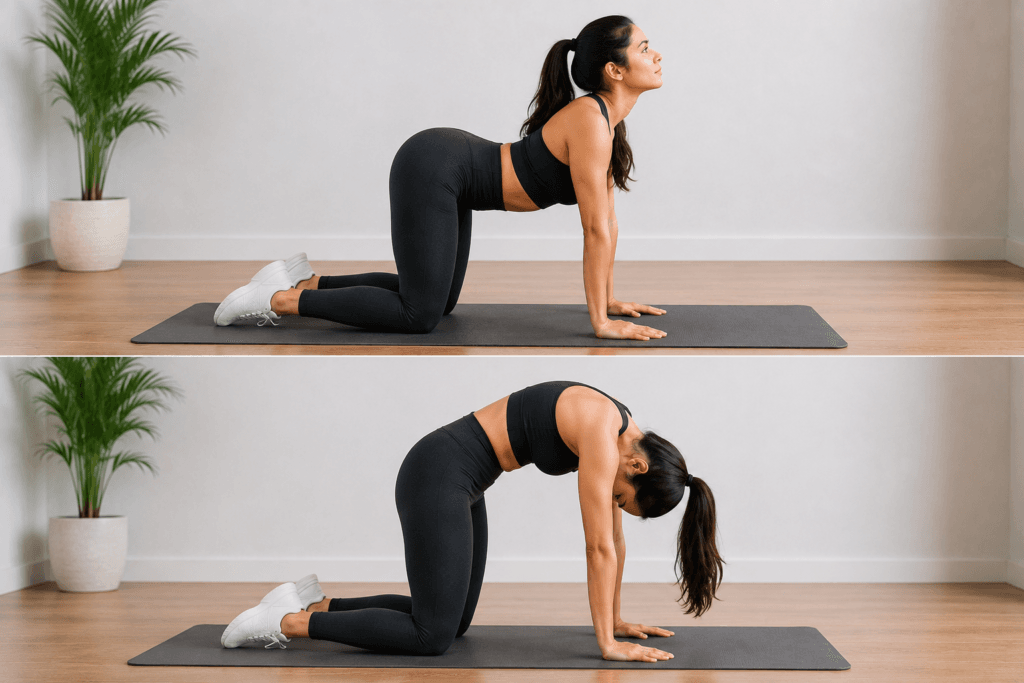
Cat-Cow is less of a workout and more of a reset button for your spine, best done first thing in the morning or after a long day of sitting.
Why it’s effective: The gentle spinal movement releases tension built up from static posture and improves circulation to the back muscles.
Benefits: Eases back tension, improves posture, and supports overall mobility workout goals in under two minutes.
How to do it:
- Start on hands and knees in a tabletop position.
- Inhale, drop your belly, and lift your chest and tailbone (cow pose).
- Exhale, round your spine toward the ceiling and tuck your chin (cat pose).
- Move slowly between the two positions, matching breath to movement.
- Repeat for 8-10 rounds.
Duration: 2-5 minutes.
Calories burned: Very low, since the goal here is mobility and tension release rather than calorie expenditure.
7. Pilates
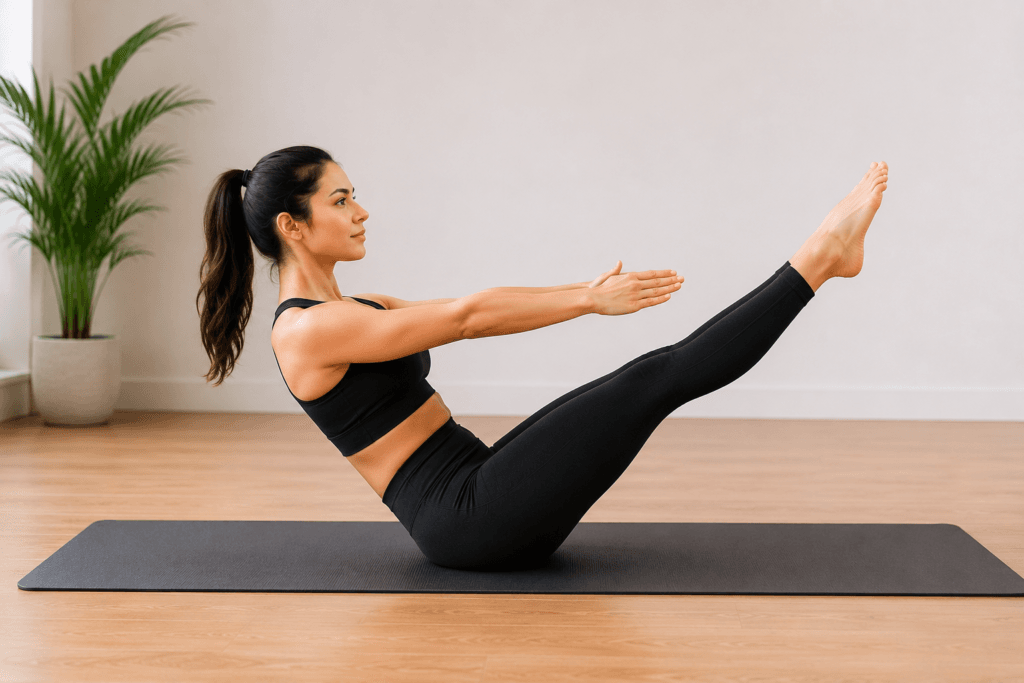
Pilates has a reputation for being both gentle and brutally effective at the same time, which is exactly why it has stayed popular for decades.
Why it’s effective: It focuses on controlled, deliberate movement and breathing, engaging deep core muscles that everyday exercise often skips.
Benefits: Builds strength without strain, improves posture, and remains one of the most satisfying forms of low impact strength training available.
How to do it:
- Start with mat-based basics like the hundred, roll-ups, and leg circles.
- Focus on slow, controlled breathing paired with each movement.
- Keep your core engaged throughout rather than rushing through reps.
- Follow a beginner video or class until the form feels natural.
- Practice for 20-30 minutes, 2-3 times a week.
Duration: 20-30 minutes per session.
Calories burned: Moderate, with the added benefit of building deep core strength that many cardio workouts miss entirely.
8. Stationary Cycling
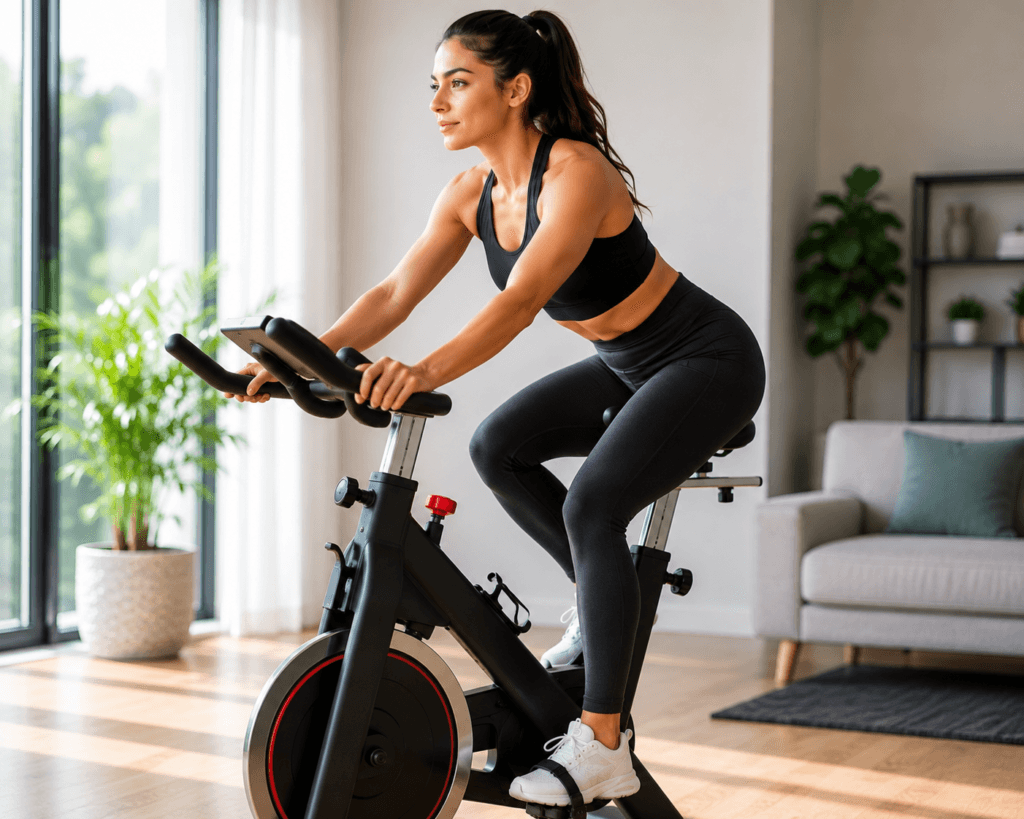
Stationary cycling is the exercise equivalent of a reliable friend steady, low-drama, and always there when your knees need a break from impact.
Why it’s effective: It raises your heart rate significantly while keeping your feet supported throughout the movement, protecting the knees from jarring impact.
Benefits: A genuine low impact cardio workout that builds leg endurance and cardiovascular fitness without stressing the joints.
How to do it:
- Adjust the seat height so your knee has a slight bend at full extension.
- Start pedaling at a light resistance to warm up for 3-5 minutes.
- Increase resistance gradually and maintain a steady, controlled pace.
- Keep your back straight and shoulders relaxed, not hunched forward.
- Cycle for 15-20 minutes, extending duration as fitness improves.
Duration: 15-30 minutes.
Calories burned: Higher than most low impact options here, since it sustains an elevated heart rate throughout the session.
9. Yoga
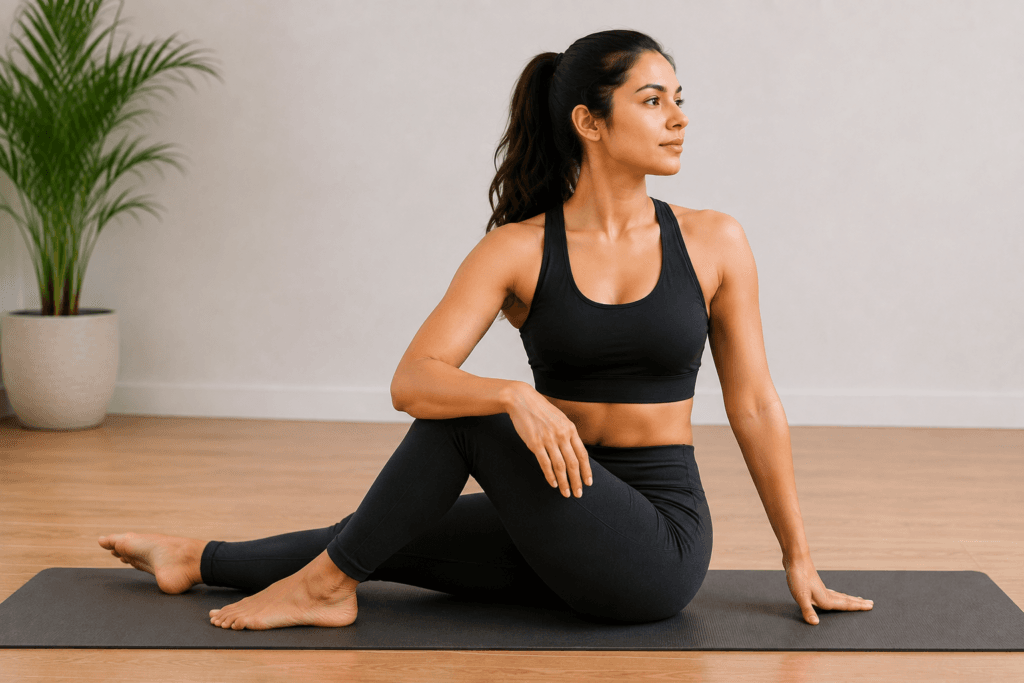
Yoga blends strength, breath, and stillness in a way few other workouts manage, and it rewards patience more than intensity.
Why it’s effective: Holding poses builds strength and stability, while controlled breathing lowers stress hormones and improves focus.
Benefits: Improves flexibility exercises-level mobility, strength, and mental calm, noticeably reducing stress even in short daily sessions.
How to do it:
- Choose a beginner-friendly sequence like sun salutations or a gentle flow.
- Move slowly between poses, breathing deeply through the nose.
- Hold each pose for several breaths rather than rushing to the next.
- Focus on alignment over depth, especially when starting out.
- Practice for 15-30 minutes, ideally most days of the week.
Duration: 15-30 minutes.
Calories burned: Varies widely by style and intensity a gentle flow burns less than a faster-paced vinyasa session, but both count toward daily activity.
Beyond these nine, women often round out their week with swimming, tai chi, standing marches, resistance band rows, step touches, and elliptical training all genuinely joint-safe options worth rotating in.
Related reading: Calisthenics Workout Plan for Beginners
Low Impact Workout Plan for Beginners
Here is a simple 7-day low impact exercise routine for women to get started:
| Day | Focus |
|---|---|
| Day 1 | Walking + Squats + Stretch |
| Day 2 | Yoga |
| Day 3 | Glute Bridge + Bird Dog |
| Day 4 | Cycling |
| Day 5 | Full Body Routine |
| Day 6 | Pilates |
| Day 7 | Recovery Walk |
This structure works well as a home fitness routine and doubles nicely as a low impact full body workout across the week, without demanding a gym membership.
Who Should Do Low Impact Exercises?
This style of training is one of the most inclusive women fitness routine categories out there. It suits:
- Beginners starting their first-ever beginner fitness exercises journey
- Women over 40 managing early joint stiffness
- Women over 50 protecting bone density
- Women over 60 focused on staying mobile and independent
- Overweight women who need joint-safe cardio
- Women with knee pain looking for low impact exercises for knee pain
- Women recovering from injury, under a doctor’s guidance
- Office workers who need a low impact workout for busy women that fits a lunch break
Low Impact Exercises for Weight Loss
Low impact exercises for weight loss work through the same basic principle as any fitness plan: calories in versus calories out.
Calorie deficit: You need to burn slightly more than you consume, consistently, over weeks.
Strength training: Building muscle through low impact strength training raises your resting metabolic rate.
Cardio combination: Pairing walking or cycling with strength days creates an effective low impact fat burning workout structure.
Protein intake: Adequate protein supports muscle repair and keeps you fuller for longer, which makes the deficit easier to sustain.
Related reading: Best Rice for Weight Loss | Cottage Cheese Nutrition Facts
Low Impact Exercises to Lose Belly Fat
Spot reduction myth: You cannot choose where fat disappears from first, no matter how many crunches you do. Genetics decides that part.
Best combination: A mix of cardio, strength, and a sensible diet reduces overall body fat, belly included, over time.
Core exercises: Moves like bird dog and Pilates strengthen the core muscles underneath, which improves posture and definition once fat levels drop.
Common Mistakes to Avoid
- Skipping warm-up: Cold muscles are more prone to strain.
- Poor posture: Sloppy form reduces results and raises injury risk.
- Doing too much too soon: Enthusiasm is great, but so is not being unable to walk the next day.
- Ignoring recovery: Muscles rebuild on rest days, not just workout days.
- Not progressing exercises: Staying at the same difficulty forever stalls results.
Tips for Better Results
- Consistency beats intensity almost every time.
- Follow a healthy lifestyle with balanced meals.
- Stay hydrated before and after sessions.
- Prioritize sleep it is when muscles actually recover.
- Apply progressive overload: add reps, resistance, or time gradually.
- Keep walking daily; it remains the simplest functional fitness habit there is.
Related reading: Exercises to Do Every Day for Seniors
FAQs:
Are low impact exercises good for weight loss?
Yes. Combined with a calorie-aware diet, they support steady, sustainable fat loss.
Can women lose belly fat with low impact workouts?
Yes, as part of overall fat loss, not through spot reduction alone.
How many days a week should women do low impact exercises?
Most health guidelines recommend around 150 minutes of moderate activity weekly, spread across 4-6 days.
Are low impact workouts effective for beginners?
Absolutely. They build a beginner low impact workout for women foundation without overwhelming the body.
Which low impact exercise burns the most calories?
Brisk walking and stationary cycling tend to burn the most, depending on intensity and duration.
Are low impact exercises good for women over 50?
Yes, they protect joints and bone density while still improving strength and heart health.
Can I build muscle with low impact workouts?
Yes, through bodyweight and resistance-based low impact strength training, though heavier loading may be added over time for faster gains.
What is the best low impact exercise for knee pain?
Swimming, cycling, and knee friendly workout options like glute bridges are usually the safest starting points.
Final Thoughts:
Low impact exercises genuinely deliver results without punishing your joints, which is exactly why so many women call them low impact workouts that actually work.
Start small, stay consistent, and build a low impact fitness routine you can actually stick with for years, not just for a few motivated weeks. Progress gradually, listen to your body, and let simple daily movement do the heavy lifting.
References:
- World Health Organization: Physical Activity Fact Sheet
- Centers for Disease Control and Prevention: Physical Activity Basics for Adults
- National Institute on Aging (NIH): Exercise and Physical Activity
- National Institute of Arthritis and Musculoskeletal and Skin Diseases (NIH): Osteoporosis and Bone Health
- American Heart Association: Recommendations for Physical Activity in Adults
- Mayo Clinic: Exercise: 7 Benefits of Regular Physical Activity

Hi, I’m Salem Nasir, founder of Fiturely. I research and write evidence-based articles on fitness, nutrition, weight loss, and healthy living. My mission is to make reliable health information simple, practical, and easy to understand so readers can build healthier habits with confidence