
Key Takeaways
- Sourdough bread provides carbohydrates, fiber, protein, and essential minerals like iron, magnesium, and potassium.
- Natural fermentation may improve digestibility and can result in a lower glycemic impact than many regular breads.
- Whole-grain sourdough offers more fiber and nutrients than refined white sourdough.
- Enjoy sourdough as part of a balanced diet by choosing minimally processed, whole-grain varieties whenever possible.
If you’ve been reaching for sourdough at the grocery store and wondering whether it’s actually better for you, you’re not alone. Millions of people are making the same choice, and for good reason. Sourdough bread isn’t just trendy artisan bread. It’s one of the oldest fermented foods on Earth, and its nutrition profile is genuinely interesting.
Let’s break it all down: calories, carbs, protein, fiber, vitamins, minerals, and the science that makes sourdough different from your average white sandwich loaf.
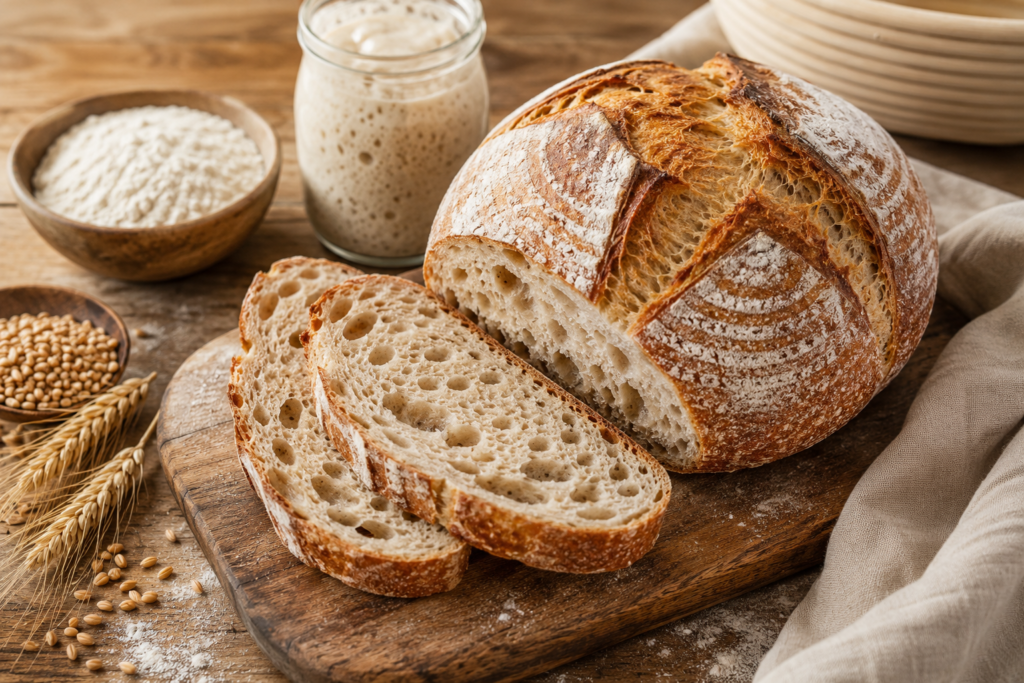
Sourdough Bread Nutrition Facts:
One medium slice of sourdough bread (about 56g) contains roughly 160 calories, 32g of carbohydrates, 6g of protein, 1g of fat, and 1-2g of fiber. These numbers vary depending on whether you’re eating white sourdough, whole wheat sourdough, or a homemade loaf.
Here’s a straightforward nutrition breakdown for one standard slice of white sourdough bread (56g serving size):
| Nutrient | Amount Per Slice |
|---|---|
| Calories | 160 kcal |
| Carbohydrates | 32g |
| Protein | 6g |
| Total Fat | 1g |
| Dietary Fiber | 1-2g |
| Sodium | 280-320mg |
| Iron | 2mg (11% DV) |
| Calcium | 20-30mg |
| Potassium | 100-130mg |
| Magnesium | 15-20mg |
What makes sourdough unique isn’t just these raw numbers. It’s what fermentation does to these nutrients, and that’s where things get genuinely fascinating.
Calories:
Sourdough bread calories typically range from 140 to 180 per slice, depending on thickness and flour type. That’s comparable to regular bread, but sourdough’s metabolic effect on your body may be notably different.
A 2008 study published in Acta Diabetologica found that sourdough bread produced a lower postprandial blood glucose response compared to regular bread made with commercial yeast. In plain terms: your blood sugar rises more slowly after eating sourdough. That matters a lot if you’re tracking energy levels or managing weight.
Whole wheat sourdough calories run slightly higher, around 170-190 per slice, because whole grain flours are denser. But the trade-off is more fiber and nutrients, which we’ll get to shortly.
If you’re baking at home, homemade sourdough nutrition will depend on your exact recipe, but a typical loaf made with 500g of flour yields about 12-14 slices at roughly 150-165 calories each.
Protein:
Sourdough bread protein content is about 5-7g per slice, which is solid for a plant-based food. White sourdough provides around 5-6g per slice; whole wheat sourdough nudges up to 6-8g.
The protein in sourdough comes primarily from wheat flour’s naturally occurring proteins, most famously gluten, which is a combination of the proteins gliadin and glutenin. During fermentation, wild yeast and lactic acid bacteria partially break down gluten proteins. This doesn’t eliminate gluten (sourdough is not safe for people with celiac disease unless certified gluten-free), but it does make the bread easier to digest for people with mild gluten sensitivity.
This is actually one of sourdough bread’s most studied characteristics. A 2014 paper in Clinical Gastroenterology and Hepatology explored how fermentation alters gluten structure, suggesting improved tolerability for non-celiac individuals.
So while sourdough isn’t a protein powerhouse, its protein is better structured and more digestible than the protein in most commercial breads.
Fiber:
White sourdough contains about 1-2g of dietary fiber per slice. Whole wheat sourdough jumps to 2-3g per slice, a meaningful difference if you’re eating 2-3 slices a day.
Dietary fiber is non-negotiable for gut health. The American Heart Association recommends 25-30g of fiber per day for adults, and most people fall short. Choosing whole wheat sourdough over white sourdough is one of the easiest, tastiest upgrades you can make to hit that target.
Beyond traditional fiber, sourdough also contains resistant starch (discussed above), which acts as a prebiotic, feeding beneficial bacteria in your gut. This is distinct from probiotics (live bacteria). The fermentation process produces lactic acid bacteria, but most of them are killed during baking. However, the prebiotics, the food for good bacteria, survive the oven just fine.
Think of it this way: sourdough bread doesn’t bring soldiers (live probiotics). It brings supplies (prebiotics and resistant starch) for the soldiers already living in your gut.
Vitamins:
Sourdough bread vitamins include B-vitamins like folate (B9), thiamine (B1), riboflavin (B2), and niacin (B3), all of which come from wheat flour and are made more bioavailable through fermentation.
This is a key point. Fermentation doesn’t just add nutrients. It unlocks them. Wheat contains phytic acid (also called phytate), a compound that binds minerals and vitamins in the grain, making them harder for your body to absorb. Phytic acid is basically wheat’s natural lock on its own nutrients.
Sourdough fermentation breaks down phytic acid by up to 62%, according to research published in the Journal of Agricultural and Food Chemistry. That means your body absorbs more of the vitamins and minerals already present in the flour, without any added supplements.
Artisan sourdough bread nutrition benefits particularly from this, since artisan bakers typically use longer fermentation times (12-24 hours or more), which gives phytic acid more time to break down.
Minerals:
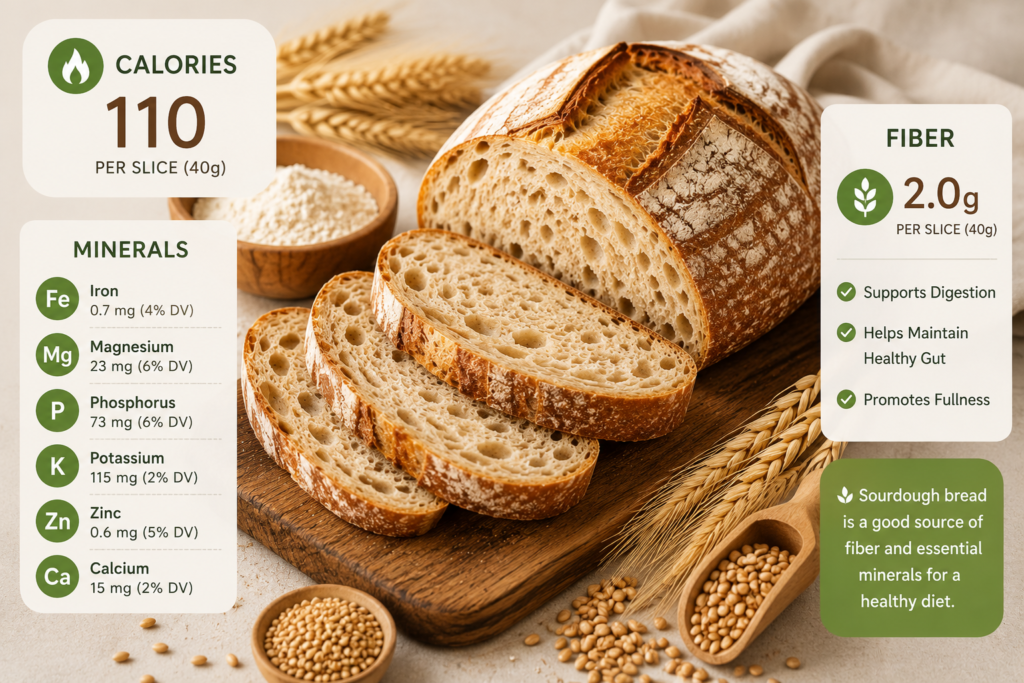
Sourdough bread minerals include iron, calcium, potassium, magnesium, zinc, and phosphorus, and thanks to reduced phytic acid, your body actually absorbs them.
Here’s a snapshot of key minerals per slice of sourdough:
- Sourdough bread iron:About 2mg per slice (around 11% of daily value). Iron supports red blood cell production and energy metabolism.
- Sourdough bread calcium:Around 20-30mg per slice. Supports bone health, though dairy is still a far richer source.
- Sourdough bread potassium: Around 100-130mg per slice. Potassium helps regulate blood pressure and muscle function.
- Sourdough bread magnesium: Around 15-20mg per slice. Magnesium plays a role in 300+ enzymatic reactions in the body, according to the NIH Office of Dietary Supplements.
- Sourdough bread sodium: Around 280-320mg per slice. This is something to watch if you’re on a low-sodium diet. Two slices puts you at 560-640mg, nearly 25-28% of the recommended daily limit of 2,300mg (per FDA guidelines).
Whole wheat sourdough consistently provides higher amounts of all these minerals compared to white sourdough, simply because the bran and germ of the wheat kernel (where most minerals live) are kept intact.
Is Sourdough Bread High in Carbohydrates?
Yes, sourdough bread carbohydrates are still significant at around 30-33g per slice. But not all carbs behave the same way, and sourdough’s carb quality is genuinely better than most breads.
During fermentation, lactic acid bacteria (LAB) partially break down the starches in the dough. This process increases the amount of resistant starch, a type of carbohydrate that your body can’t fully digest, so it passes into the large intestine and acts more like dietary fiber than a sugar spike
 What’s Actually in Sourdough Bread? Understanding the Ingredients
 What’s Actually in Sourdough Bread? Understanding the Ingredients
Traditional sourdough bread ingredients are beautifully simple: just flour, water, salt, and a sourdough starter. That’s it. No commercial yeast, no preservatives, no dough conditioners.
The sourdough starter is the magic ingredient. It’s a fermented mixture of flour and water that contains wild yeast and lactic acid bacteria (LAB), naturally occurring microorganisms that leaven the bread and give it its characteristic tang. Some starters are decades old, passed down through bakeries and families like living heirlooms.
During fermentation, these wild yeast organisms and lactic acid bacteria do several things simultaneously:
- They produce carbon dioxide gas, which makes the dough rise.
- They produce lactic acid and acetic acid, which give sourdough its flavor and act as natural preservatives.
- They break down phytic acid, improve gluten structure, and produce antioxidants.
The type of flour matters enormously for nutrition. Wheat flour (white) produces the lightest loaves with the mildest flavor. Whole wheat flour retains the bran and germ for higher fiber and mineral content. Rye flour creates denser bread with an even more complex flavor and exceptional prebiotic content.
White Sourdough vs. Whole Wheat Sourdough:
Whole wheat sourdough wins on nutrition across almost every category. But white sourdough is still better than most commercial breads, and both are legitimate choices depending on your goals.
| Category | White Sourdough | Whole Wheat Sourdough |
|---|---|---|
| Calories per slice | ~160 kcal | ~170-180 kcal |
| Fiber | 1-2g | 2-4g |
| Protein | 5-6g | 6-8g |
| Minerals | Moderate | Higher |
| Glycemic Index | ~65 | ~53 |
| Flavor | Mild, slightly tangy | Earthy, nutty, complex |
Whole grain bread has been consistently linked to better long-term health outcomes. The Harvard T.H. Chan School of Public Health cites whole grain consumption as associated with reduced risk of heart disease, type 2 diabetes, and certain cancers.
Does Sourdough Bread Have Probiotics?
Here’s the honest answer: by the time you eat sourdough bread, most of the live lactic acid bacteria have been killed by oven temperatures (above 200°F/93°C). So no, baked sourdough is not a significant probiotic source in the clinical sense.
What it does offer are prebiotics, the non-digestible compounds (including resistant starch and certain fibers) that feed the beneficial bacteria already living in your gut. This is a meaningful distinction and shouldn’t be dismissed.
Some researchers also suggest that the fermentation by-products, including organic acids, certain peptides, and antioxidants, may benefit gut health even after baking, though more human trials are needed to confirm the exact mechanisms.
What Is the Glycemic Index of Sourdough Bread?
Sourdough bread’s glycemic index (GI) is approximately 53-65, which is lower than regular white bread (GI of 70-75) and even many whole grain breads made with commercial yeast.
Several factors explain this:
- Organic acids (lactic acid and acetic acid) from fermentation slow gastric emptying, which is the rate at which food leaves your stomach, reducing blood sugar spikes.
- Resistant starch formed during fermentation isn’t rapidly digested.
- Modified gluten structure changes how quickly the bread breaks down in your digestive system.
The sourdough bread glycemic load, a measure that accounts for both GI and portion size, is around 15-17 per slice, sitting comfortably in the moderate range. This makes sourdough one of the more blood-sugar-friendly bread options available.
Final Thoughts:
Yes, and the science backs it up. Sourdough bread isn’t a superfood, but it’s arguably the most nutritionally intelligent way to eat bread. The fermentation process, driven by wild yeast and lactic acid bacteria, transforms simple sourdough bread ingredients into something genuinely more nourishing than the sum of its parts.
Whether you’re watching your sourdough bread calories, managing blood sugar, improving gut health, or simply eating food that tastes real and satisfying, sourdough delivers.
Choose whole wheat or rye varieties for the highest fiber and mineral content. Check ingredient labels for authentic fermentation. And if you have time and a sourdough starter? Bake it yourself.
Your gut, your blood sugar, and honestly your taste buds will all thank you.

Hi, I’m Salem Nasir, founder of Fiturely. I research and write evidence-based articles on fitness, nutrition, weight loss, and healthy living. My mission is to make reliable health information simple, practical, and easy to understand so readers can build healthier habits with confidence
Pingback: Pickled Beetroot Nutrition: Calories, Carbs, Protein & Health Benefits (2026 Guide)
Pingback: Paneer Nutrition Facts (2026): Calories, Protein, Carbs & Health Benefits
Pingback: Parsnip Nutrition Facts (2026): Calories, Carbs, Protein & Health Benefits