
Key Takeaways
- Resistance band exercises are low-impact and joint-friendly, making them ideal for seniors.
- They help improve strength, balance, flexibility, and mobility without heavy weights.
- Most exercises can be done at home with minimal equipment, making them convenient for daily fitness.
- Aim for 2-3 resistance band workouts per week, focusing on proper form and controlled movements.
- Stop exercising and consult a healthcare professional if you experience sharp pain, dizziness, or unusual discomfort.
Most people just want to carry the groceries, climb the stairs, and get up from a chair without sound effects. That’s exactly where resistance band exercises for seniors come in.
These stretchy little bands look almost too simple to matter. But according to the National Institute on Aging, regular strength training helps older adults maintain muscle mass, protect bone density, and stay independent longer. Bands make that kind of training accessible, affordable, and honestly, a little fun.
This guide covers everything you need: the benefits, the best moves, and how to build a safe routine at home. No gym membership. No fancy equipment. Just a band, a chair, and a bit of consistency.
Quick Overview:
| Feature | Details |
|---|---|
| Best for | All ages 60+, including beginners and rehab patients |
| Equipment needed | One or two elastic resistance bands |
| Time per session | 15-25 minutes |
| Frequency | 2-3 times per week |
| Difficulty level | Beginner to intermediate |
| Key benefits | Muscle strength, balance, flexibility, joint health |
| Good for | Osteoporosis, arthritis, fall prevention |
| Space required | A chair and a few feet of open space |
Why Resistance Bands Work So Well for Older Adults
Elastic resistance bands create tension through stretch instead of gravity. That single difference makes them gentler on joints than free weights, while still building real strength.
The Mayo Clinic notes that resistance training is one of the most effective ways to slow age-related muscle loss, a condition called sarcopenia. Bands apply steady resistance throughout the entire movement, which helps muscles work harder without the jarring impact of heavier equipment.
They also travel well. A band fits in a drawer, a suitcase, or a bag. You don’t need a squat rack to get a proper senior fitness exercises session done.
Here’s what consistent band training can support:
- Muscle strength and muscle endurance
- Bone health, which matters for anyone managing osteoporosis
- Joint health for people living with arthritis
- Balance and coordination, reducing the risk of falls
- Flexibility and general mobility
None of this requires straining or pushing to exhaustion. It requires showing up, a few times a week, with a band and a plan.
Getting Started: Beginner Resistance Band Exercises for Seniors
If you’re new to this, start slow. The goal isn’t to feel sore tomorrow. The goal is to move safely today and come back for more next week.
Beginner resistance band exercises for seniors should focus on control, not speed. Choose a light band first. You can always move to a heavier one once the current level feels too easy for two weeks in a row.
A few ground rules before starting any home workout for older adults:
- Check with your doctor first, especially if you have joint replacements, heart conditions, or recent surgeries.
- Warm up for five minutes with light walking or arm circles.
- Move through the full range of motion slowly, both stretching and returning.
- Stop if you feel sharp pain. Muscle fatigue is normal; joint pain is not.
- Breathe out during effort, breathe in during release. Holding your breath raises blood pressure unnecessarily.
This isn’t complicated. It’s just training your body to trust the movement again.
Related reading: Best Low Impact Exercises can help you build a broader routine around your band workouts.
Seated Resistance Band Exercises for Seniors
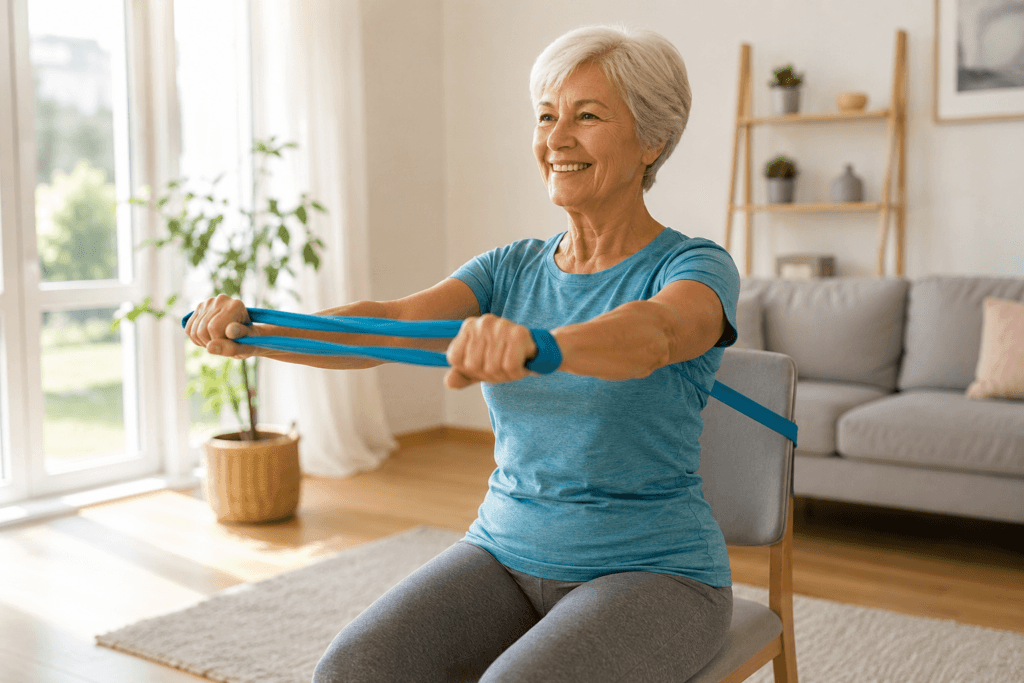
For anyone with limited standing balance, or simply anyone who prefers stability, seated resistance band exercises for seniors offer a safe starting point. A sturdy chair, no armrests, is all you need.
Seated Chest Press:
Loop the band behind the chair back, hold one end in each hand, and press forward until your arms extend. Return slowly. This targets the chest, shoulders, and triceps.
Seated Row:
Anchor the band around your feet or a stable object in front of you. Pull the band toward your torso, squeezing your shoulder blades together. This strengthens the upper back, which helps posture more than most people realize.
Seated Leg Extension:
Loop the band around one chair leg and your ankle. Extend your leg forward, hold briefly, then return. This works the quadriceps without stressing the knee joint.
Seated Bicep Curl:
Sit on the band, hold both ends, and curl your hands toward your shoulders. Simple, effective, and great for daily tasks like carrying bags.
These moves double as chair exercises for seniors, useful for anyone recovering from surgery or managing limited mobility. They’re also a favorite in many physical therapy exercises programs because they isolate muscles without demanding balance under load.
Standing Resistance Band Exercises for Seniors
Once seated exercises feel comfortable, standing movements add another layer of challenge, mostly through balance and core engagement.
Standing resistance band exercises for seniors should still be performed near a wall or sturdy chair for support if needed.
Band Squats:
Stand on the band with feet shoulder-width apart, holding the handles at shoulder height. Lower into a small squat, keeping knees behind your toes. This builds lower body strength, one of the biggest predictors of independence in later years, according to the CDC’s guidance on healthy aging.
Lateral Band Walks:
Loop a small band around your ankles or thighs, and step sideways in a controlled, athletic stance. This targets the hip muscles responsible for balance exercises for seniors and fall prevention.
Standing Row:
Anchor the band at chest height around a doorknob or sturdy post. Pull the band back, elbows close to your body, squeezing the shoulder blades. Great for posture and upper back strength.
Overhead Press:
Stand on the band, hold the handles at shoulder height, and press upward. This builds shoulder strength useful for reaching cabinets and lifting overhead.
Standing work naturally improves mobility workout quality because it trains muscles the way they’re actually used in daily life, not in isolation.
Related reading: A steady band routine pairs well with Exercises to Do Everyday for Seniors for a more complete daily habit.
Resistance Band Exercises for Seniors Over 60
At this stage, most people are still fairly active, and resistance band exercises for seniors over 60 can be a bit more dynamic. Standing exercises, moderate band tension, and slightly higher repetitions all work well here.
A simple structure: two to three sets of 10 to 12 reps per exercise, two to three times a week. This aligns with general strength training guidance from the American College of Sports Medicine for older adults, which recommends resistance training on non-consecutive days to allow muscle recovery.
Focus on compound movements like squats, rows, and presses. These train multiple muscle groups at once, which makes workouts efficient without needing an hour at a time.
Resistance Band Exercises for Seniors Over 70
Resistance band exercises for seniors over 70 often benefit from a slightly slower tempo and a stronger emphasis on balance support. Holding onto a chair back during standing moves isn’t “cheating.” It’s smart training.
At this age, joint health becomes a bigger priority. Bands are especially useful here because they don’t create the compressive joint stress that heavier weights can. A lighter band, performed with good form, beats a heavier band performed with strain, every single time.
Seated variations remain valuable too. Mixing seated and standing moves in the same session keeps the body challenged without overloading any one joint.
Resistance Band Exercises for Seniors Over 80
For resistance band exercises for seniors over 80, safety and simplicity lead the way. Seated exercises usually make up the bulk of the routine, with standing moves added only if balance is stable and a support surface is nearby.
Shorter sessions, spread across the week, tend to work better than one long workout. Five to ten minutes, a few times a day, adds up. It also keeps fatigue and frustration low.
This age group benefits enormously from functional fitness for seniors training, meaning exercises that mirror real movements: standing from a chair, reaching for a shelf, or turning to look behind you. A resistance band supports every one of these patterns.
Related reading: For gentle stretching between band sessions, Chair Yoga for Seniors is a natural complement.
Full Body Resistance Band Workout for Seniors
A well-rounded full body resistance band workout for seniors hits the major muscle groups without requiring separate equipment for each one. Here’s a sample routine:
- Seated Row – 10 reps
- Band Squats (or seated leg extensions) – 10 reps
- Standing or Seated Chest Press – 10 reps
- Lateral Band Walks -10 steps each side
- Bicep Curl – 10 reps
- Overhead Press – 10 reps
Rest 30 to 60 seconds between exercises. This structure supports resistance band strength training for seniors by covering the chest, back, legs, shoulders, and arms, all in about 20 minutes.
This isn’t a race. Two rounds of this circuit, twice a week, builds real muscle strengthening exercises progress over a few months. Patience matters more than intensity here.
Related reading: If your goal includes core and back stability, Back Workouts at Home offers useful additions to this circuit.
Resistance Band Exercises for Seniors: Quick Comparison Table
Not every age group or ability level should train the same way. Here’s a quick side-by-side look to help you match the right approach to where you are right now.
| Age Group / Level | Best Exercise Style | Recommended Band Level | Sets & Reps | Support Needed |
|---|---|---|---|---|
| Beginner (any age) | Seated, slow tempo | Light (yellow/red) | 1-2 sets of 8-10 | Chair with back support |
| Resistance band exercises for seniors over 60 | Mixed seated and standing | Light to medium | 2-3 sets of 10-12 | Minimal, chair nearby |
| Resistance band exercises for seniors over 70 | Mostly standing, slower pace | Medium | 2 sets of 8-10 | Chair or wall for balance |
| Resistance band exercises for seniors over 80 | Mostly seated, functional moves | Light | 1-2 sets of 6-8 | Sturdy chair, caregiver if needed |
| Post-surgery / rehab | Seated, isolated movements | Very light | 1 set of 8-10 | Physical therapist guidance |
Use this table as a starting point, not a strict rule. Everyone ages differently, and your own comfort level should always guide the final call.
Building a Sustainable Senior Home Fitness Routine
Senior home fitness works best as a habit, not a project. Trying to do everything at once usually leads to burnout or soreness that discourages the next session.
A realistic weekly plan:
- Monday: Full body band workout
- Wednesday: Balance and mobility focus
- Friday: Full body band workout
- Weekends: Light walking or stretching
This structure supports resistance training for older adults without overwhelming the schedule. It also fits naturally alongside general physical activity for seniors guidelines from the World Health Organization, which recommends at least two days of muscle-strengthening activity per week for older adults, alongside regular movement throughout the week.
Consistency, not intensity, is what turns a few exercises into a genuine daily strength routine for older adults.
A Few Words on TheraBand and Choosing the Right Band
Many physical therapists use theraband, a well-known brand of flat resistance bands often color-coded by resistance level. Beginners typically start with yellow or red, moving to green or blue as strength improves.
If you’re shopping for exercise bands, look for options with handles for grip comfort and a range of resistance levels in one set. This lets your routine grow with you instead of needing a full replacement every few months.
Loop bands and tube bands both work well. The right choice usually comes down to comfort and what feels easiest to grip and control.
Frequently Asked Questions
What is the best resistance band exercise for seniors?
The seated row and standing squat are two of the best resistance band exercises for seniors because they train major muscle groups (back, legs, and core) while staying joint-friendly. Both can be adjusted for balance and strength level.
How often should seniors do resistance band exercises?
Most guidance, including the American College of Sports Medicine’s recommendations for older adults, suggests two to three sessions per week on non-consecutive days. This allows muscles to recover while still building senior strength training progress steadily.
Can resistance bands help with osteoporosis or arthritis?
Yes. Resistance training supports bone health, which matters for people managing osteoporosis, and the low-impact nature of bands is gentler on joints affected by arthritis. Always check with a doctor before starting if you have either condition.
What resistance band level should a beginner start with?
Start with a light band, usually yellow or red in color-coded sets. If you can complete 12 reps with good form and no strain, it’s time to move up. This is the safest approach for any beginner elastic band workout.
Are resistance bands better than weights for seniors?
Bands aren’t necessarily “better,” but they’re often more practical. They’re portable, affordable, and apply resistance more evenly through a movement, which can feel safer for joints than free weights, especially for anyone new to strength training.
Final Thoughts:
Active aging doesn’t require anything extreme. It requires showing up, using tools that respect your body’s needs, and building strength gradually over time.
Resistance band exercises for seniors offer a low-cost, low-impact, genuinely effective path toward that goal. Whether you’re just starting out or building a senior muscle building exercises routine after months of consistency, the same principle applies: small, steady effort beats occasional bursts of intensity.
Grab a band, pick two or three moves from this guide, and start today. Your future self, the one still climbing stairs without a second thought, will thank you.
Continue building your fitness routine with these related guides: Best Strength Exercises, Best Low Impact Exercises, Exercises to Do Everyday for Seniors, Chair Yoga for Seniors, Back Workouts at Home, and Weight Loss for Women Over 40.

Hi, I’m Salem Nasir, founder of Fiturely. I research and write evidence-based articles on fitness, nutrition, weight loss, and healthy living. My mission is to make reliable health information simple, practical, and easy to understand so readers can build healthier habits with confidence
Pingback: Military Calisthenics (2026): 11 Best Exercises to Build Strength & Endurance
Pingback: PCOS Workout: Best Exercises for Weight Loss & Hormone Health - fiturely.com
Pingback: Stretching Exercises for Seniors: 10 Simple Moves for Daily Relief and Flexibility - fiturely.com