
A kettlebell chest workout builds real chest strength and muscle using kettlebell presses, floor presses, and push-ups, no bench required. Beginners should start with 6-8kg kettlebells, doing 3 exercises for 3 sets of 8=12 reps, 2=3 times weekly. Focus on form first, then apply progressive overload by slowly adding weight or reps for steady, safe chest growth at home.
This guide breaks down every major kettlebell chest exercises movement, explains the actual science behind them, and gives you real workouts for beginners, home training, and muscle growth. No fluff, no fake numbers, just what works.
What Is a Kettlebell Chest Workout and Does It Actually Work?
Yes, a kettlebell chest workout works, because your chest muscles don’t know the difference between a barbell, dumbbell, or kettlebell. What matters is tension, range of motion, and consistency. Kettlebells simply deliver that tension in a more dynamic, joint-friendly package.
The offset handle of a kettlebell forces your stabilizer muscles to work harder than a dumbbell would. This means your pectoral muscles, triceps, and shoulder stability all get trained together, not in isolation.
According to the American Council on Exercise (ACE), kettlebell training can burn roughly 20 calories per minute during high-intensity circuits, nearly double the rate of treadmill running at a moderate pace. That’s why a kettlebell workout for chest doubles as a metabolic finisher, not just a strength session.
If you’re new to kettlebell training in general, it helps to start with a Beginner Kettlebell Workout before layering in chest-specific presses. Building a base of functional strength first reduces injury risk once you start adding load.
Can Kettlebells Build Chest Muscle?
Yes, can kettlebells build chest muscle is one of the most searched questions, and the science says absolutely. Muscle growth (muscle hypertrophy) depends on mechanical tension, not the shape of the equipment.
The CDC recommends muscle-strengthening activity for all major muscle groups at least twice a week . Kettlebell pressing movements easily satisfy this guideline while also improving grip and shoulder health.
A 2019 study published in JAMA Network Open found that push-up capacity was strongly linked to better cardiovascular health outcomes in men, reinforcing that pressing-pattern training (like kettlebell presses and the kettlebell push up) carries benefits far beyond aesthetics.
The key is progressive overload: gradually increasing weight, reps, or range of motion over time. Kettlebells make this easy because you can go up in small increments (4kg, 6kg, 8kg jumps) instead of large barbell plate jumps.
The best exercises for chest are Below is exactly how to perform each of these 7 movements, plus the real benefits of each one.
1. Kettlebell Floor Press
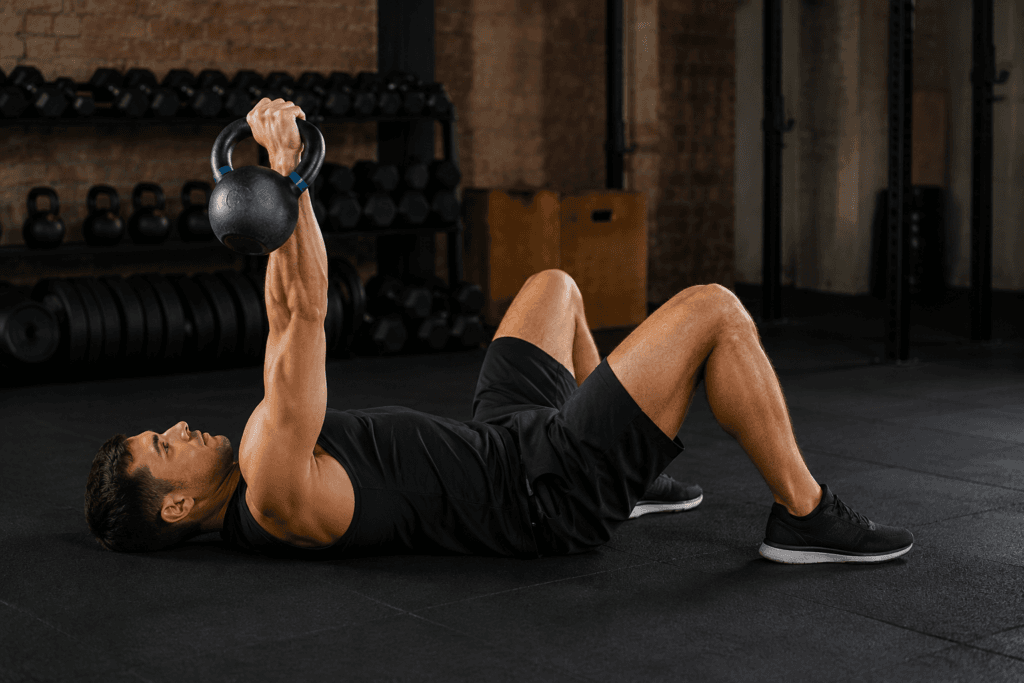
How to perform:
- Lie on your back on the floor with knees bent, feet flat.
- Hold a kettlebell in each hand at chest level, elbows resting on the floor.
- Press both kettlebells straight up until arms are fully extended.
- Pause briefly at the top, then lower slowly until elbows touch the floor again.
- Repeat for 10-12 controlled reps.
Benefits:
- One of the safest pressing movements for beginners and anyone with shoulder issues, since the floor limits how far the elbow can drop.
- Builds real chest strength without needing a bench.
- Reduces shoulder strain compared to a full-range bench press.
2. Kettlebell Chest Press (Double Kettlebell)
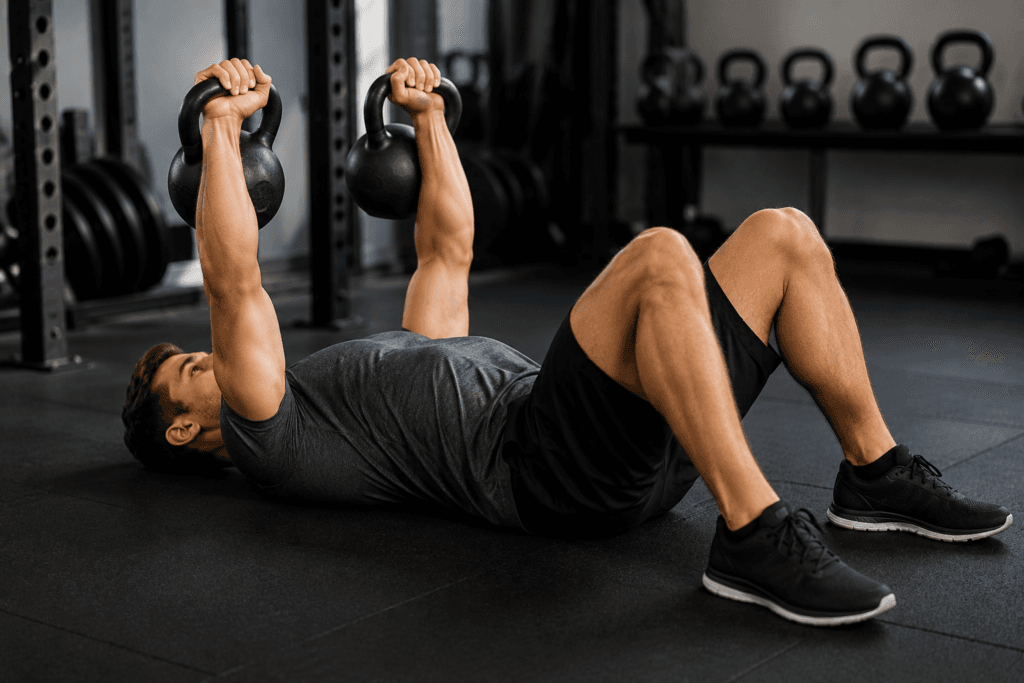
How to perform:
- Lie on a mat or bench, holding two kettlebells at chest height.
- Keep wrists stacked directly over elbows.
- Press both kettlebells up and slightly inward until arms are extended.
- Squeeze the chest briefly at the top.
- Lower under control back to the starting position.
Benefits:
- Your foundation movement for maximizing muscle activation across the whole chest.
- Because kettlebells aren’t rigid like a barbell, triceps and shoulders stabilize the weight through the entire rep. That’s more work per rep than a machine press.
- Builds symmetrical pressing strength when done with two bells at once.
3. Single-Arm Kettlebell Chest Press
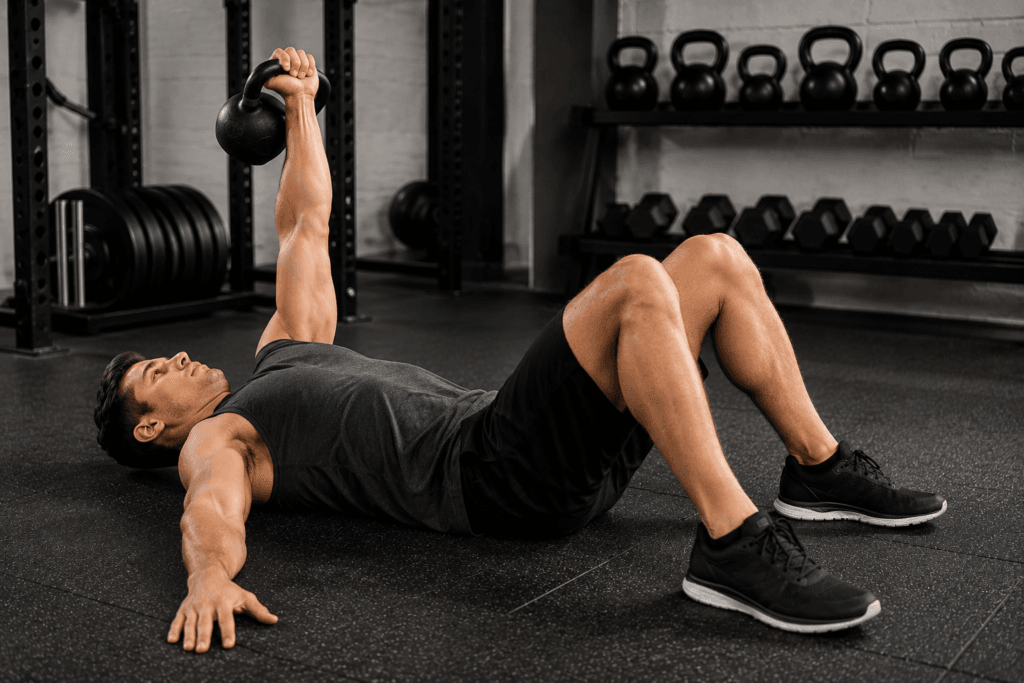
How to perform:
- Lie on your back, holding one kettlebell in one hand at chest level.
- Keep the free hand flat on the floor or resting on your stomach for balance.
- Press the kettlebell straight up, resisting the urge to let your torso twist.
- Lower slowly and repeat all reps on one side before switching.
Benefits:
- A true unilateral exercises movement that exposes and fixes left-right strength imbalances bilateral lifts often hide.
- Forces the core to resist rotation, training core stability and chest strength in the same rep.
- Great for people training with just one kettlebell at home.
4. Kettlebell Push-Up
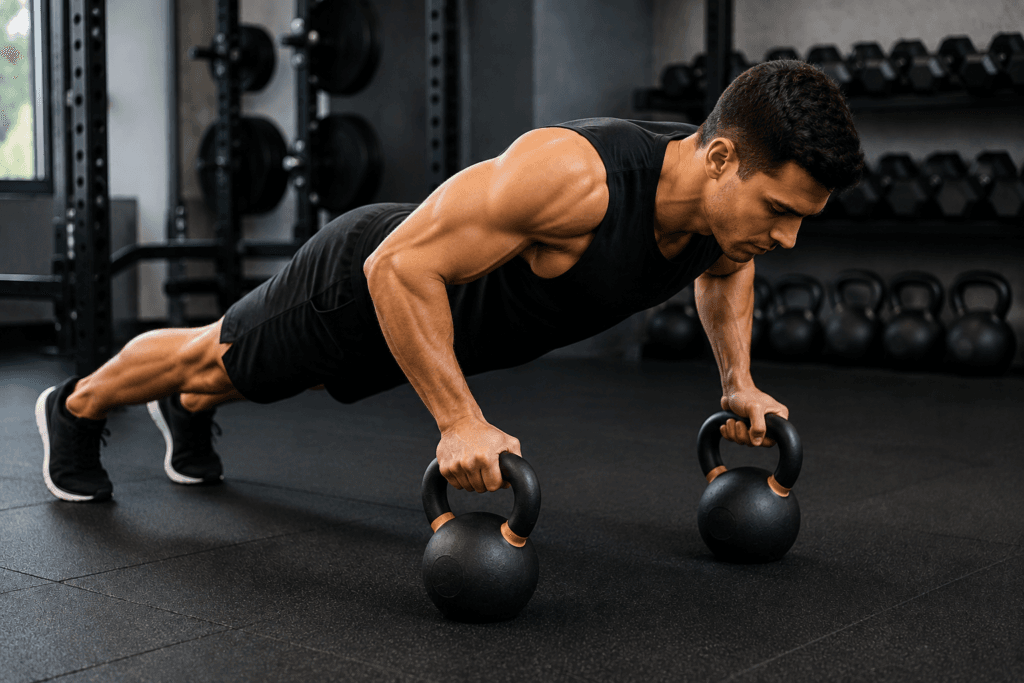
How to perform:
- Place two kettlebells shoulder-width apart, handles facing you.
- Grip the handles and set up in a push-up position, body in a straight line.
- Lower your chest between the kettlebells with control.
- Press back up to full arm extension without letting hips sag.
- Repeat for 8-12 reps.
Benefits:
- The neutral handle grip is often more comfortable on wrists than flat palms on the floor.
- Adds instability that stabilizer muscles must control, hitting the lower chest and triceps hard.
- Doubles as a core and shoulder-stability exercise, not just a chest move.
5. Kettlebell Squeeze Press
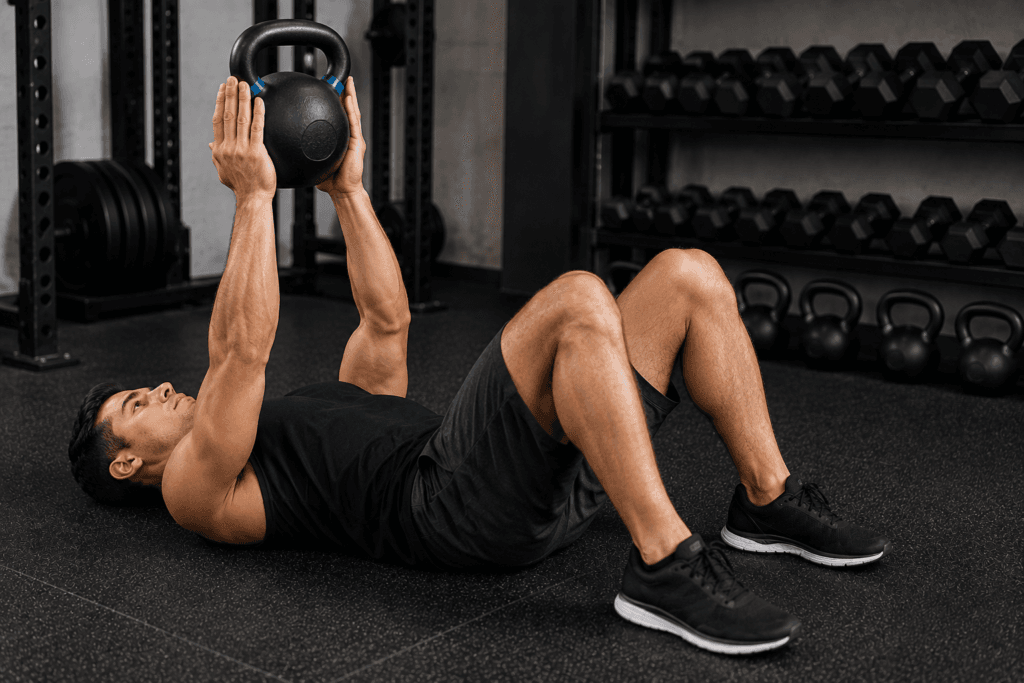
How to perform:
- Lie on your back, holding two kettlebells together, bells touching, at chest height.
- Squeeze the kettlebells into each other as hard as possible.
- Press up while maintaining constant inward pressure.
- Lower back to the chest without losing the squeeze.
- Repeat for 10-12 reps.
Benefits:
- Specifically targets kettlebell exercises for inner chest, a spot flat pressing alone often misses.
- Builds constant tension throughout the entire rep, not just at the top.
- Improves mind-muscle connection with the chest, which helps with all other pressing movements.
6. Kettlebell Alternating Press
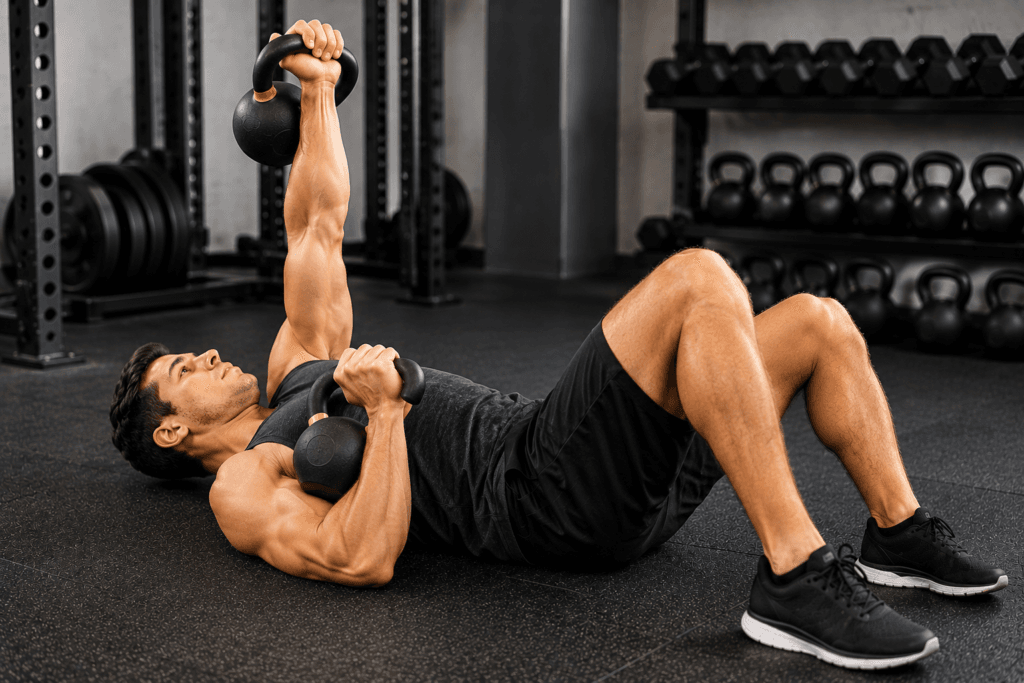
How to perform:
- Lie on the floor or bench holding two kettlebells at chest level.
- Press one kettlebell up while the other stays at chest height.
- As you lower the first, press the second up (alternating rhythm).
- Keep the torso still, avoid rocking side to side.
- Continue for 8-10 reps per side.
Benefits:
- Keeps constant tension on the chest since one side is always under load.
- Builds functional strength and coordination between both sides of the body.
- Great transition exercise between double presses and full single-arm work.
7. Kettlebell Pullover
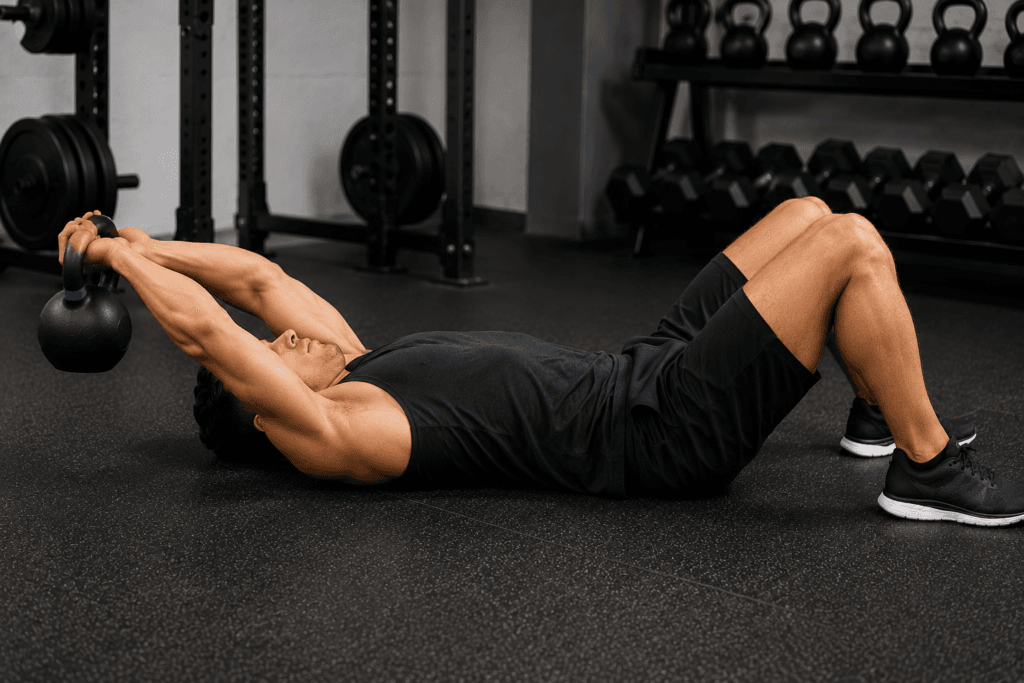
How to perform:
- Lie on your back (floor or bench), holding one kettlebell with both hands above your chest.
- Keeping a slight bend in the elbows, lower the kettlebell slowly behind your head.
- Feel a stretch through the chest and lats at the bottom.
- Pull the kettlebell back over the chest to the starting position.
- Repeat for 10-12 slow, controlled reps.
Benefits:
- Increases range of motion and chest flexibility, which most pressing movements don’t train.
- Stretches and activates the chest and lats together for a fuller upper-body stimulus.
- A useful accessory move to finish off any kettlebell chest press workout.
How Do You Train Chest With One Kettlebell?
You can absolutely train your whole chest with a single kettlebell, how to train chest with one kettlebell comes down to using single-arm presses, floor presses, and push-ups in rotation.
Single kettlebell training isn’t a compromise; it’s actually how most home-gym owners train, and it works because of the unilateral loading discussed above.
A simple one-kettlebell chest circuit:
- Single-arm floor press, 10 reps per side
- Kettlebell push-up (hands on the bell, alternating), 10 reps
- Kettlebell squeeze press (hold bell horizontally, squeeze and press), 12 reps
- Rest 60 seconds, repeat 3-4 rounds
This kind of circuit also builds upper body strength more broadly, since your shoulders and triceps are constantly engaged. If you’re curious how this compares to lower-body training, our guide on Leg Strength Exercises covers similar single-implement logic for the Lower Body.
Kettlebell Chest Workout at Home: What Do You Need?
A kettlebell chest workout at home needs almost nothing, one or two kettlebells and enough floor space to lie down. No bench, no rack, no gym membership required.
This is genuinely one of the most accessible forms of strength training that exists. According to Statista’s fitness industry reports, home workout equipment demand has stayed consistently high since 2020, reflecting a lasting shift toward home-based training routines.
For a kettlebell chest exercises at home routine, floor presses replace bench presses entirely, and honestly, many coaches now prefer floor presses for general lifters because of the joint-friendly range of motion mentioned earlier.
If space or noise is a concern, kettlebell chest training pairs well with other quiet, effective options. Check out Low Impact Exercises and Simple Exercises if you want to build a fuller Home Workout around your chest day.
Best Kettlebell Chest Workout for Beginners
The best kettlebell chest workout for beginners should start light, focus on form, and stick to 2-3 exercises max. Don’t chase heavy weight in week one, chase clean technique.
A kettlebell chest workout for beginners template:
| Exercise | Sets | Reps | Rest |
|---|---|---|---|
| Kettlebell floor press | 3 | 10-12 | 60 sec |
| Kettlebell push-up (knees if needed) | 3 | 8-10 | 60 sec |
| Single-arm floor press | 2 | 8 per side | 60 sec |
Beginners often overestimate the weight they need. A 6-8kg kettlebell per hand is plenty to start pressing work, you can always add load once form is solid, following the same progressive overload principle used in every serious strength program.
Kettlebell Chest Workout for Muscle Growth
For hypertrophy, a kettlebell chest workout for muscle growth needs higher volume, controlled tempo, and shorter rest periods (45-75 seconds) to maximize time under tension.
Effective kettlebell chest exercises for muscle growth typically combine presses (mechanical tension) with push-up variations (metabolic stress), the two main drivers of muscle hypertrophy according to strength research from the National Strength and Conditioning Association (NSCA).
Sample growth-focused session:
- Kettlebell chest press, 4 sets x 10-12 reps
- Kettlebell floor press (slow 3-second lowering), 3 sets x 10 reps
- Single-arm kettlebell chest press, 3 sets x 10 per side
- Kettlebell push-up, 3 sets to near failure
This is also a great time to superset with arm work. Pairing chest day with a session from our Bicep Workouts guide keeps your upper-body training balanced and time-efficient.
Kettlebell Chest Workout for Strength
A kettlebell chest workout for strength prioritizes heavier loads, lower reps (4-6), and longer rest (2-3 minutes) so your nervous system fully recovers between sets.
Strength-focused training relies less on burning out the muscle and more on lifting genuinely heavy, controlled reps. This is where kettlebell exercises for upper chest and kettlebell exercises for lower chest angles matter. Adjusting your press angle (incline vs. flat vs. decline on the floor) shifts emphasis across the chest.
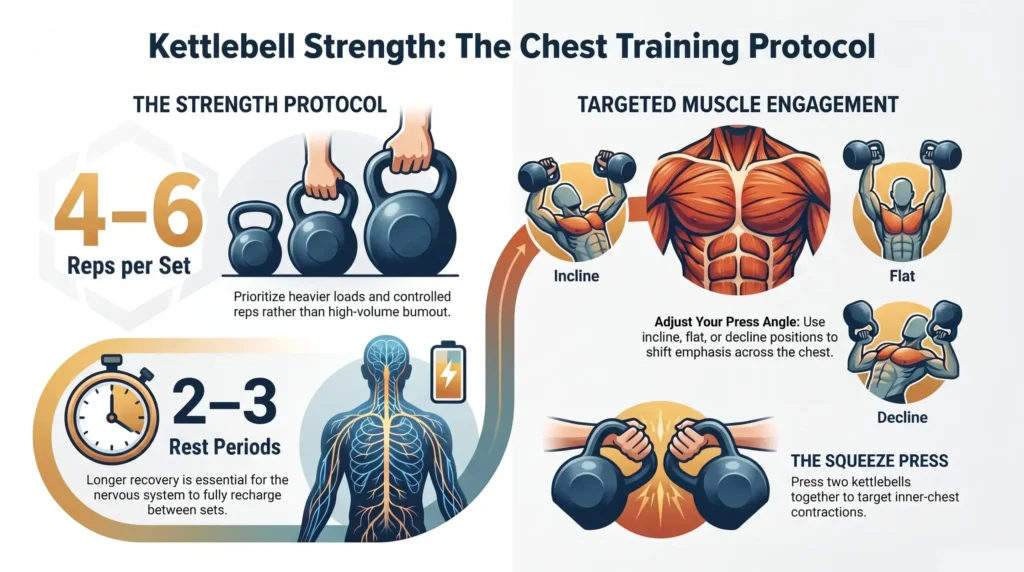
Don’t skip kettlebell exercises for inner chest either. The squeeze press (pressing two kettlebells together throughout the rep) specifically targets that inner-chest contraction that flat pressing alone misses.
Kettlebell Chest Workout Without a Bench
You don’t need furniture. A kettlebell chest workout without bench relies entirely on floor presses and push-up variations, and honestly, the floor press is arguably the safer option anyway.
For a kettlebell chest workout no bench session, simply swap every “bench press” style movement for its floor equivalent. The strength and muscle stimulus barely changes; only the range of motion at the bottom is slightly reduced.
A kettlebell chest workout without equipment beyond the kettlebell itself might look like:
- Floor press ladder (2, 4, 6, 8 reps ascending)
- Push-up finisher (max reps)
- Standing chest squeeze press
This same no-bench logic applies well to other muscle groups too. If you enjoy floor-based, equipment-light training, our Kettlebell Leg Workout uses a similar minimalist approach for the Leg Workout side of things.
Kettlebell Chest and Shoulder / Triceps Workout
Chest, shoulders, and triceps share the same pressing pattern, so a kettlebell chest and shoulder workout or kettlebell chest and triceps workout is one of the most time-efficient combos in strength training.
Try this combined session:
| Exercise | Target | Sets x Reps |
|---|---|---|
| Kettlebell floor press | Chest | 3 x 10 |
| Kettlebell overhead press | Shoulders | 3 x 8 |
| Kettlebell push-up | Chest/Triceps | 3 x 10 |
| Kettlebell tricep extension | Triceps | 3 x 12 |
This kind of pairing is also a smart way to build a genuine full-body kettlebell training habit rather than isolating one muscle at a time. If your upper back and traps feel neglected in pressing-heavy routines, balance it out. Our Traps guide covers pulling movements that offset all this pressing volume.
Kettlebell vs. Dumbbell vs. Barbell for Chest: Which Is Best?
There’s no single “best” tool. Each has strengths. Here’s an honest, side-by-side comparison for chest training specifically.
| Factor | Kettlebell | Dumbbell | Barbell |
|---|---|---|---|
| Range of motion | Good (floor-limited) | Excellent | Excellent (with bench) |
| Stabilizer demand | High | Moderate | Low |
| Home-friendly | Very high | High | Low (needs rack/bench) |
| Max load potential | Moderate | High | Highest |
| Injury risk (shoulder) | Lower | Moderate | Higher (if form breaks) |
| Best for | Functional strength, home training | Hypertrophy, isolation | Max strength, powerlifting |
For most home trainees, kettlebells win on convenience and joint-friendliness. For raw maximal strength numbers, barbells still lead. There’s no honest way around that. Pick based on your goal, not internet hype.
How to Grow Your Chest With Kettlebells: Long-Term Tips
How to grow your chest with kettlebells long-term comes down to three things: consistent progressive overload, adequate workout recovery, and enough protein intake to support muscle hypertrophy.
Here’s how to actually build chest with kettlebells over months, not days:
- Track your weights and reps every session. Memory lies, notebooks don’t.
- Increase load or reps every 1-2 weeks, even slightly.
- Sleep 7+ hours; recovery is when muscle is actually built, not during the workout itself.
- Rotate rep ranges (strength weeks vs. hypertrophy weeks) every 4-6 weeks.
This same recovery-first mindset applies across your whole training plan, whether you’re doing a Kettlebell Workout for chest or adding in Equipment for Abs work later in the week. Consistency beats intensity, every single time.
Kettlebell Chest Workout at Home for Men and Women: Any Difference?
Not really. A kettlebell chest workout at home for men and a kettlebell chest workout at home for women use the same exercises. The only real difference is starting weight, which depends on individual strength, not gender.
Women often start with 4-8kg kettlebells, men often start with 8-12kg, but these are averages, not rules. The exercises, rep ranges, and progression principles stay identical for everyone chasing real best kettlebell exercises for chest muscle results.
Fitness and general wellness resources, including broader Fitness and women Fitness guides, consistently support this: strength training benefits are universal, and chest training is no exception.
FAQs:
Can Kettlebells Build Chest Muscle?
Yes, can kettlebells build chest muscle with the right approach. It absolutely can, as long as you apply progressive overload and train with enough volume and intensity, just like any other tool.
Are Kettlebells Good for Chest Workouts?
Yes, are kettlebells good for chest workouts? They’re actually excellent for shoulder-friendly pressing and unilateral strength work that barbells can’t easily replicate.
Can You Train Chest With One Kettlebell?
Yes, can you train chest with one kettlebell? Single-arm presses, floor presses, and push-ups all work perfectly with just one bell in the house.
How Often Should You Do a Kettlebell Chest Workout?
2-3 times per week is ideal for most people. This gives your chest muscles 48 hours of workout recovery between sessions, which is when actual muscle growth happens, not during the workout itself.
What Weight Kettlebell Is Best for Chest Exercises?
Beginners should start with 6–8kg per hand, while intermediate lifters can move to 10–16kg. The right weight is one that lets you complete all reps with good form on the last set, not just the first.
Is Kettlebell Chest Press Better Than Push-Ups?
Neither is “better.” They work differently. The kettlebell chest press allows heavier loading for strength, while the kettlebell push up builds bodyweight control and core endurance. Combining both gives the most complete chest development.
References:
- American Council on Exercise (ACE), Kettlebell Training and Calorie Burn: acefitness.org
- Centers for Disease Control and Prevention (CDC), Muscle-Strengthening Activity Guidelines: cdc.gov/physicalactivity
- JAMA Network Open (2019), Push-Up Capacity and Cardiovascular Disease Risk: jamanetwork.com
- National Strength and Conditioning Association (NSCA), Principles of Hypertrophy Training: nsca.com
- Statista, Home Fitness Equipment Market and Consumer Trends: statista.com
- Harvard Health Publishing, Strength Training and Muscle Recovery: health.harvard.edu

Hi, I’m Salem Nasir, founder of Fiturely. I research and write evidence-based articles on fitness, nutrition, weight loss, and healthy living. My mission is to make reliable health information simple, practical, and easy to understand so readers can build healthier habits with confidence
Pingback: Kettlebell Ab Workout: The Ultimate Guide to a Stronger, Real-World Core - fiturely.com