
A kettlebell ab workout builds real core strength by combining weighted resistance with rotation, bracing, and stability, something regular crunches can’t do alone. Start with the kettlebell dead bug, plank, and sit up if you’re a beginner, then progress to Russian twists, leg raises, and the Turkish get up. A 10 minute, 5 move circuit done 2 to 4 times a week is enough to build noticeable strength within 3 to 4 weeks. Pair it with a calorie appropriate diet, since ab exercises build the muscle, not remove the fat covering it.
This guide breaks down the best kettlebell abs exercises, a beginner friendly kettlebell core workout, and an at home routine you can start today, all backed by real training science, not guesswork.
What Is a Kettlebell Ab Workout and Why Does It Work So Well?
A kettlebell ab workout uses the offset weight of a kettlebell to challenge your core from multiple angles at once. Unlike dumbbells or machines, the kettlebell’s handle sits above its bell, which forces your abs, obliques, and lower back to work together to control it. This is called anti rotation and anti extension training, and it’s how elite strength coaches build functional cores.
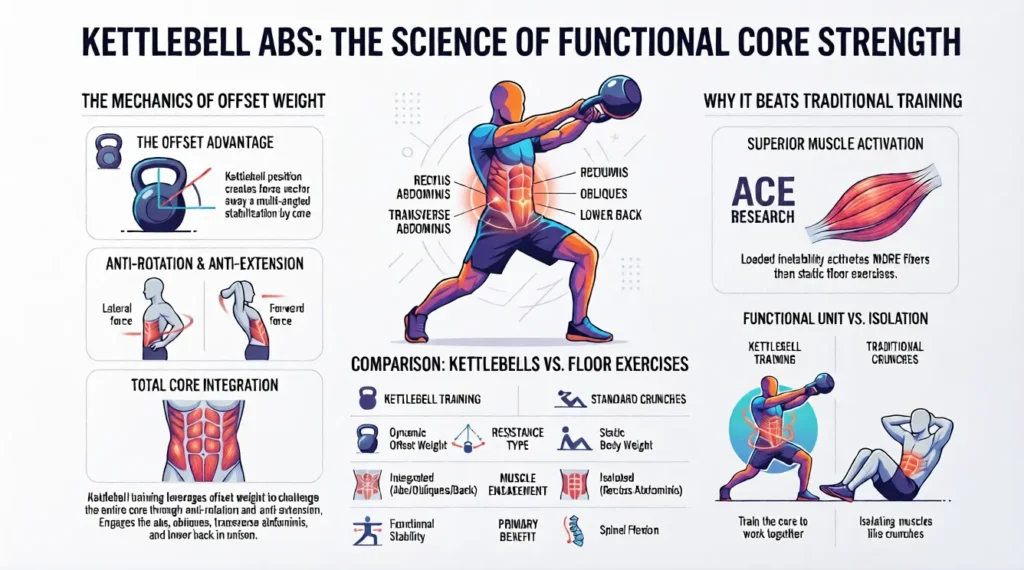
The American Council on Exercise (ACE) has published research showing that instability based and loaded core movements activate significantly more muscle fibers than static floor exercises like standard crunches. That’s the science behind why kettlebell core exercises feel harder, and work better, than a basic sit up.
Your core isn’t just your “abs.” It includes your obliques, transverse abdominis, and lower back, and a good kettlebell workout for abs trains all of them together, not in isolation. If you’re completely new to weighted training, it’s worth easing in with a simple kettle beginner routine before layering on rotational core work.
How Is a Kettlebell Core Workout Different from Regular Ab Exercises?
A kettlebell core workout trains stability and rotation, while traditional ab exercises mostly train flexion (bending forward). Kettlebells add external load, so your core has to brace under real resistance, similar to how it works when you carry groceries or lift a suitcase. That carryover to daily life is the biggest advantage.
Bodyweight crunches are useful for beginners, but they max out quickly. Once your abs adapt, you need progressive resistance to keep improving, and that’s exactly what a kettlebell provides.
The Centers for Disease Control and Prevention (CDC) recommends adults do muscle strengthening activity at least two days a week, and loaded core training like this checks that box far more efficiently than floor only ab routines. Once your core is solid, this style of training also builds a great base for a broader Lower Body strength program, since your midsection stabilizes almost every lower body lift.
What Are the Best Kettlebell Abs Exercises for Beginners?
The best beginner moves are the ones that teach control before they demand power. Start with the kettlebell dead bug, kettlebell plank, and kettlebell sit up, all low risk, high carryover exercises. Master these first, and everything more advanced becomes easier and safer.
Kettlebell Dead Bug
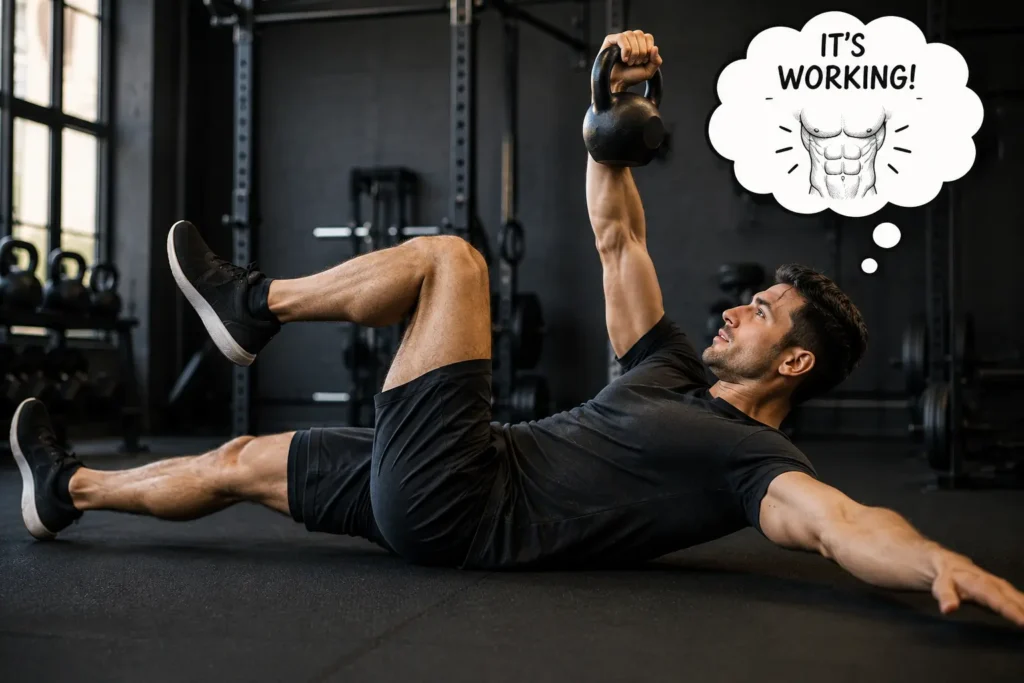
The kettlebell dead bug is one of the safest ways to train deep core stability without straining your spine. Lie on your back, hold the kettlebell straight up with both hands, and slowly extend the opposite arm and leg while keeping your lower back pressed to the floor. It looks easy. It isn’t.
Kettlebell Plank
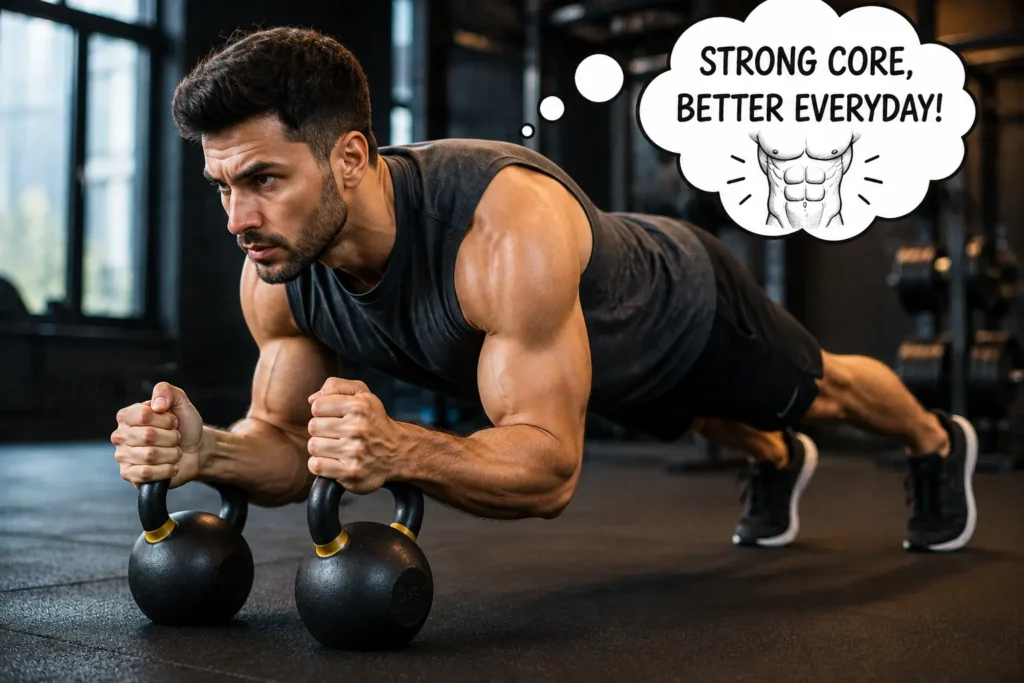
Add a kettlebell to your kettlebell plank by placing one hand on the handle instead of the floor, which instantly increases core activation because your body fights to stay level. Physical therapists often recommend loaded planks for people rebuilding core strength after injury, and pairing them with gentle Mobility Exercises helps protect the shoulders and lower back while you build tolerance.
Kettlebell Sit Ups
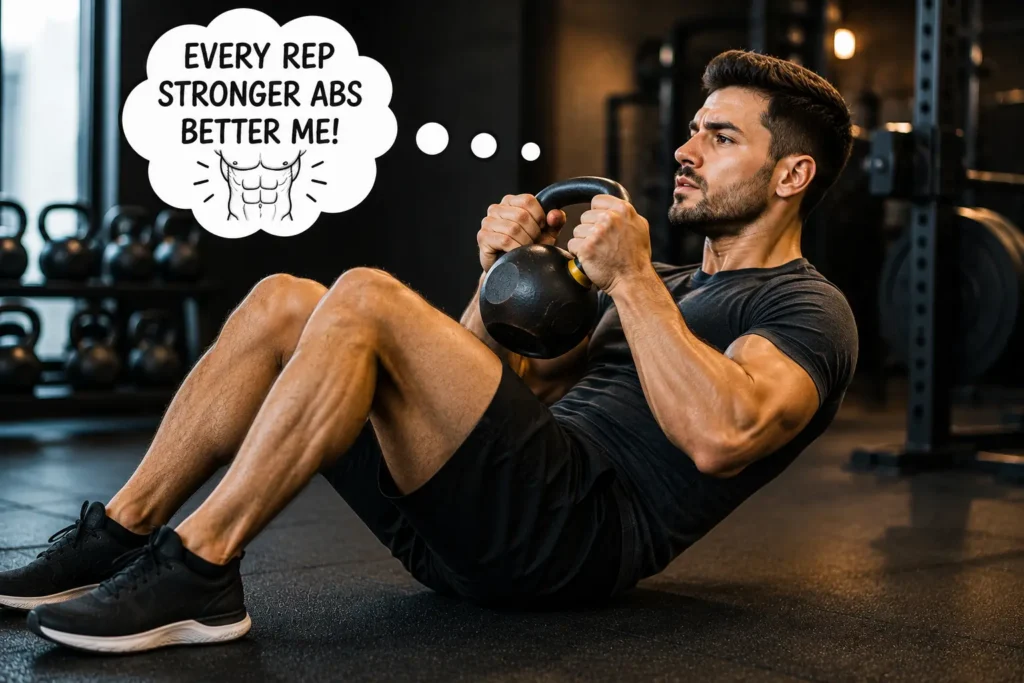
Kettlebell sit ups add resistance to a familiar movement, which builds strength faster than bodyweight alone. Hold the kettlebell at your chest, goblet style, and sit up slowly, keeping the weight close to your body throughout.
Which Kettlebell Exercises Target the Obliques and Lower Abs?
For obliques, the kettlebell Russian twist and kettlebell side bend are the two most effective movements. For lower abs, kettlebell leg raises win by a wide margin because they load the pelvis directly instead of just the upper torso.
These oblique kettlebell exercises and lower abs kettlebell exercises matter because most people over train their upper abs (from crunches) and completely neglect the lower region and sides, which is often why the “six pack” look never fully shows up, regardless of diet.
Kettlebell Russian twists rotate a kettlebell side to side while seated, feet slightly off the floor for added difficulty. Kettlebell side bend has you hold the kettlebell in one hand and bend sideways at the waist, and it’s one of the few moves that isolates obliques directly. Kettlebell leg raises are done lying flat, kettlebell held between your feet or ankles, lifting your legs slowly to 90 degrees.
If your goal includes visible lower belly definition, pair these with a proper Glutes and hip focused training day, since abs respond to overall fat loss, not spot reduction. The Harvard T.H. Chan School of Public Health confirms spot reduction of fat is not physiologically possible.
What’s a Good 10-Minute Kettlebell Ab Workout at Home?
A solid 10 minute kettlebell ab workout rotates between anti rotation, flexion, and rotation movements so no single muscle group gets overworked. You only need one kettlebell (8 to 12 kg for most beginners) and a small patch of floor space.
Kettlebell abs workout at home, 10 Minute Circuit:
- Kettlebell dead bug: 40 seconds
- Kettlebell Russian twists: 40 seconds
- Kettlebell plank (hand on handle): 30 seconds each side
- Kettlebell leg raises: 40 seconds
- Kettlebell sit ups: 40 seconds
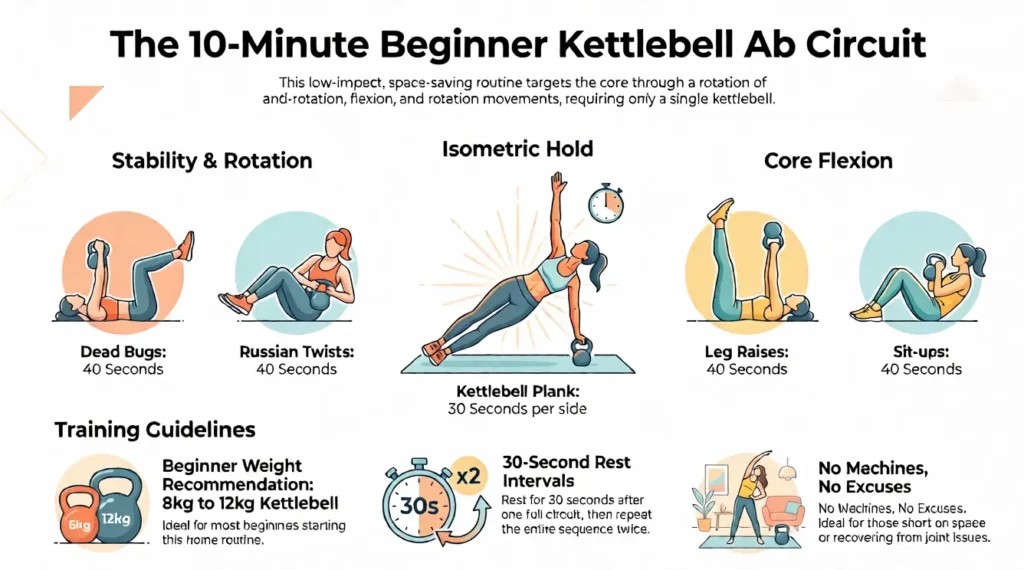
Rest 30 seconds, then repeat the circuit twice. This is genuinely one of the most time efficient kettlebell core workout for beginners options out there, no bench, no machines, no excuses. If you’re short on space or recovering from joint issues, this doubles nicely as a Low Impact session too.
Do Kettlebell Swings Really Work Your Core?
Yes, kettlebell swings are technically a hip hinge exercise, but they demand serious core bracing to protect your spine during the hip snap. Strength coaches often call the swing a “moving plank” because your abs stay contracted the entire time.
Kettlebell swings for core work best as a finisher, not a warm up, since they’re demanding on your grip and lower back once form starts to break down. If you’re also building a full body routine, swings pair naturally with a Glutes focused day, since the hip drive trains both areas simultaneously, and a bit of Mobility Exercises beforehand keeps your hips moving freely for a cleaner hinge pattern.
A well known ACE sponsored study on kettlebell training found that a 20 minute kettlebell workout burned roughly 20 calories per minute on average among tested subjects, comparable to running a 6 minute mile pace.
How Does a Kettlebell Ab Workout Compare to Other Core Training Methods?
| Training Method | Core Muscles Targeted | Equipment Needed | Best For | Injury Risk (if done with poor form) |
|---|---|---|---|---|
| Kettlebell ab workout | Rectus abdominis, obliques, transverse abdominis, lower back | 1 kettlebell | Functional strength, rotation, full body core | Moderate |
| Bodyweight crunches | Upper rectus abdominis only | None | Absolute beginners | Low |
| Weighted ab machine | Rectus abdominis (isolated) | Gym machine | Isolation, controlled range | Low |
| Pilates core work | Deep stabilizers, transverse abdominis | Mat, sometimes reformer | Posture, mobility, low impact | Very low |
| Calisthenics core (hanging leg raises, L sits) | Full core plus grip and shoulders | Pull up bar | Advanced strength athletes | High |
Kettlebell training sits in a sweet spot: more functional than machines, more loaded than Pilates, and safer than advanced calisthenics if you start light. If bodyweight training interests you long term, it’s worth exploring Military Calisthenics once your core foundation is solid, and combining it occasionally with a dedicated leg workout for a truly balanced routine.
Kettlebell Ab Workout for Men vs Beginners: What’s the Difference?
The exercises are largely the same, the difference is load, volume, and pacing. A kettlebell ab workout for men chasing visible definition typically uses heavier kettlebells (16 to 24 kg) with lower reps, while true beginners of any gender should start at 8 to 12 kg and prioritize form over weight.
Beginners should also cap sessions at 2 to 3 times per week to let connective tissue adapt, while more advanced lifters can train core 4 to 5 times weekly since recovery demand is lower for smaller muscle groups. This is consistent with general strength training guidance from the American College of Sports Medicine (ACSM). Men building toward a broader strength split often combine this with a kettle chest day and a set of Bicep Workouts for complete upper body balance.
Can Kettlebell Abdominal Exercises Help Reduce Belly Fat?
Not directly, no ab exercise burns fat from the belly specifically. What kettlebell abdominal exercises do is build the muscle underneath, so once overall body fat drops through diet and total daily movement, your abs actually show. The exercise itself is only half the equation.
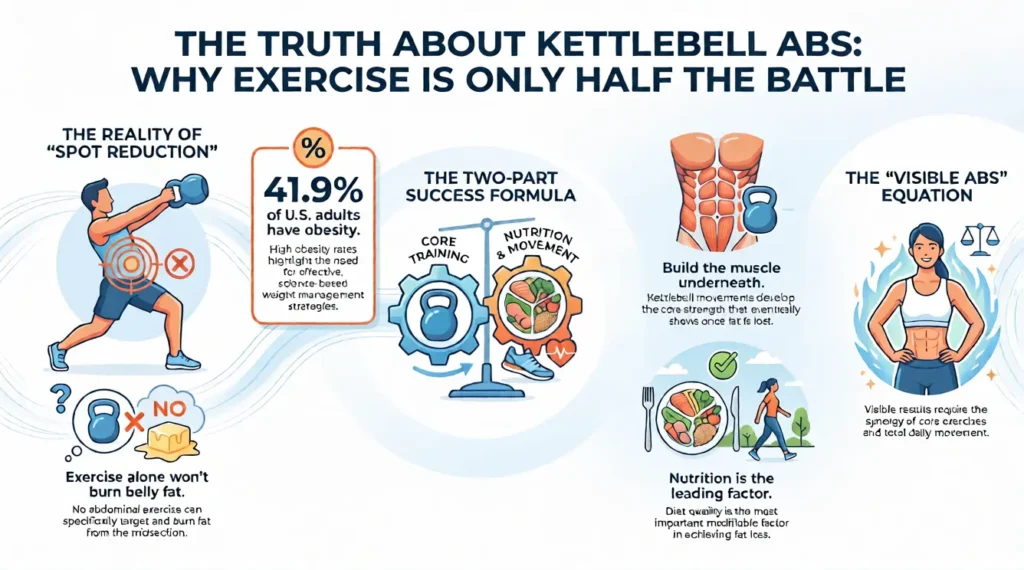
According to the CDC, roughly 41.9% of U.S. adults are classified as having obesity, and diet quality remains the leading modifiable factor in fat loss, not exercise type. This means your kettlebell workout for abs and belly fat needs a nutrition partner to actually show results.
Simple swaps help more than people expect. Try a protein forward Healthy Lunch, rotate in Soba Noodles instead of refined pasta, add Kidney Beans for fiber and plant protein, or keep Steak Healthy portions lean and grilled instead of fried.
What Equipment Do You Need for a Kettlebell Core Workout Without a Bench?
You need exactly one thing: a kettlebell. That’s the entire appeal of a kettlebell core workout without bench, every exercise in this guide (dead bug, plank, sit ups, leg raises, Russian twists) is done on the floor, which makes it ideal for home workouts, hotel rooms, or small apartments.
For upper body variety on off days, you don’t need new equipment either, the same kettlebell works for a kettle chest press or a Bicep Workouts session, making it one of the most space efficient tools in strength training.
Other Advanced Kettlebell Core Movements Worth Knowing
Once the basics feel easy, these moves add rotation, shoulder stability, and full body coordination.
Kettlebell windmill trains obliques and shoulder stability simultaneously; go slow, this one punishes bad form. Kettlebell Turkish get up is often called the single best full body core exercise by strength coaches, because it forces you to stabilize a weight through seven distinct positions. Kettlebell around the world circles the kettlebell around your torso, building grip and rotational core endurance. Kettlebell goblet squat core isn’t just a leg move; holding the kettlebell at chest height forces your core to stay upright under load, which crosses over nicely with a general leg workout day. Upper abs kettlebell exercises like weighted sit ups and kettlebell crunches round out the routine for people chasing visible upper ab definition.
If you’re managing PCOS, low impact rotational core work like the dead bug and windmill, done with lighter loads, is often better tolerated than high intensity interval training, worth discussing with a trainer familiar with a PCOS Workout approach to protect your joints long term.
FAQs:
How often should I do a kettlebell ab workout?
2 to 4 times per week is enough for most people. Your core recovers faster than large muscle groups, but it still needs at least one rest day between sessions for the best results. If you’re combining it with a Lower Body split, schedule core days on your lighter training days.
What’s the best kettlebell weight for ab exercises for beginners?
Most beginners do well starting with an 8 to 12 kg kettlebell. You can always size up once your form is consistent and controlled, especially once you’ve built a base through a kettle beginner program.
Can I build a full six pack using only kettlebell exercises for core strength?
You can build the muscle with kettlebells alone, but visibility also depends on body fat percentage, which comes down to diet and total activity, not just ab training. A Healthy Lunch habit matters as much as your training plan here.
Is a full body kettlebell workout for core strength better than isolated ab days?
Generally yes. A full body kettlebell workout for core strength, combining swings, squats, and get ups, trains your core indirectly through compound movement, which research consistently shows builds more functional strength than isolated ab only sessions.
How soon will I see results from a kettlebell ab workout?
Strength gains usually show up within 3 to 4 weeks of consistent training, while visible definition depends on your starting body fat and diet, and can take 8 to 12 weeks or longer. Patience plus consistency beats intensity here.
Can beginners do a kettlebell ab workout every day?
It’s not recommended. Daily core loading doesn’t allow enough recovery time for the muscle to actually get stronger, so 2 to 4 sessions a week with rest days in between will get you better results than training daily.
Do I need a heavy kettlebell to see results, or is a light one enough?
A light kettlebell (8 to 12 kg) is enough for most beginners to build real core strength, since these exercises rely more on control and time under tension than raw weight. You can size up gradually once your form is solid, similar to progressions in a kettle beginner plan.
Final Word
A good kettlebell ab workout isn’t about chasing a burn, it’s about training your core the way it’s actually used: bracing, rotating, and resisting force under load. Start light, nail your form on the dead bug, plank, and sit up, then build toward Russian twists, windmills, and the Turkish get up. Pair it with real nutrition, and the results follow.
Sources & References
Centers for Disease Control and Prevention (CDC), Physical Activity Guidelines for Adults. Used to support the recommendation of at least two days of muscle-strengthening activity per week. CDC, Adult Obesity Facts . Used for the U.S. adult obesity prevalence figure and its link to diet quality over exercise type. American Council on Exercise (ACE Fitness). Used for research on core muscle activation in loaded/instability exercises and calorie-burn data from kettlebell training studies. Harvard T.H. Chan School of Public Health, The Nutrition Source. Used to confirm that spot-reduction of fat is not physiologically supported by current evidence. American College of Sports Medicine (ACSM). Used for general strength-training frequency and recovery guidance for different experience levels. National Academy of Sports Medicine (NASM). Referenced for core-training progression principles (stability before load, anti-rotation before rotation). National Institutes of Health, PubMed / National Library of Medicine. General reference point for peer-reviewed exercise science research on functional core training. Mayo Clinic,. Referenced for general strength-training safety and beginner progression advice.

Hi, I’m Salem Nasir, founder of Fiturely. I research and write evidence-based articles on fitness, nutrition, weight loss, and healthy living. My mission is to make reliable health information simple, practical, and easy to understand so readers can build healthier habits with confidence
Pingback: 11 Best Kettlebell Core Exercises to Build a Stronger, More Stable Core - fiturely.com