
Key Takeaways
- Beginner kettlebell workouts build full-body strength, improve balance, and increase endurance using simple compound movements.
- Master proper form first with exercises like the kettlebell deadlift, goblet squat, and swing before progressing to advanced routines.
- Train 2-3 times per week with a moderate-weight kettlebell to build muscle, burn fat, and reduce the risk of injury.
- A 20-30 minute kettlebell workout can effectively improve cardiovascular fitness while helping you burn calories.
- Consistency matters more than heavy weights gradually increase weight and intensity as your strength and confidence improve.
Starting a beginner kettlebell workout doesn’t need to be confusing or scary. With the right weight, a handful of basic moves, and a little patience, you can build real strength in just a few weeks. This guide breaks down everything, including form, weight selection, routines, and common mistakes to avoid, in plain, simple language.
Kettlebells look intimidating (that round iron ball with a handle isn’t exactly “welcoming”), but they’re actually one of the most beginner-friendly tools in fitness. Let’s get into it.
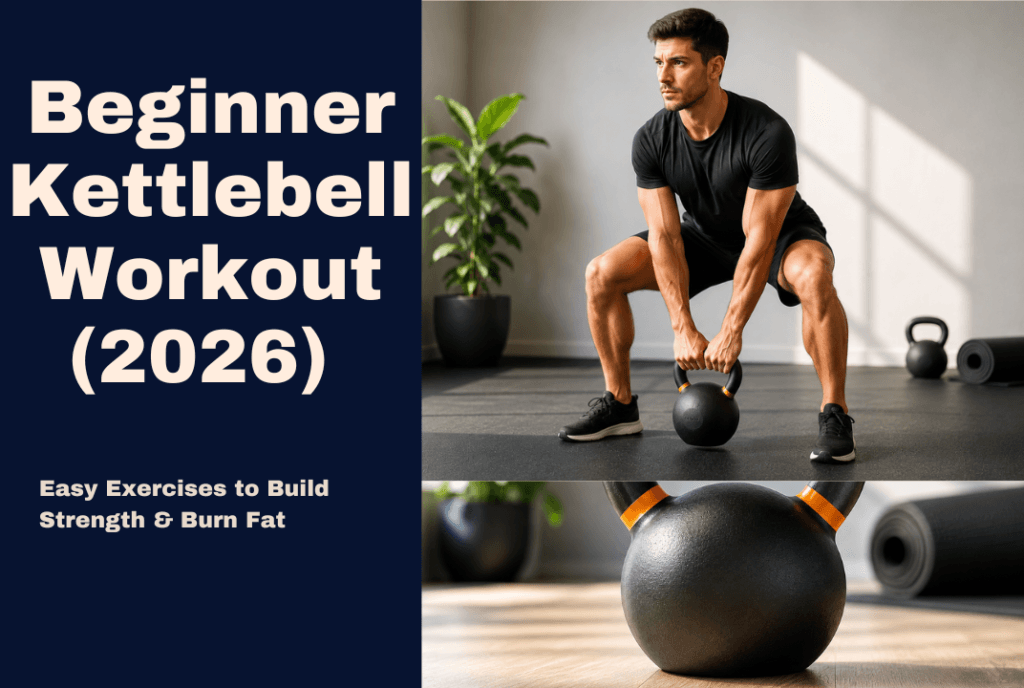
What Is a Beginner Kettlebell Workout?
A kettlebell workout for beginners is a simple training routine using one or two kettlebells to build strength, balance, and conditioning. It usually includes 4-6 basic moves like swings, squats, and presses. No machines, no gym membership, no complicated setup required.
The beauty of a beginner kettlebell routine is efficiency. One tool trains your legs, back, shoulders, and core in a single session. That’s rare in fitness: most equipment isolates one muscle group at a time.
According to the American Council on Exercise (ACE), kettlebell training can burn up to 20 calories per minute during high-intensity intervals, which is comparable to running a 6-minute mile pace (source: ACE Fitness study on kettlebell energy expenditure). That’s a solid factual reason kettlebells have stayed popular for over a decade.
If you’re also building a lower-body routine, check out this Kettlebell Leg Workout guide for exercises that pair well with the basics below.
Why Should Beginners Try Kettlebell Training?
Kettlebell training for beginners works because it combines strength and cardio in one move. You’re not choosing between lifting weights or doing cardio: you get both at once. That’s a big time-saver.
The main kettlebell workout benefits include improved grip strength, better posture, and full-body muscle activation. A single kettlebell swing engages your glutes, hamstrings, core, shoulders, and grip: all in one rep.
Research published in the Journal of Strength and Conditioning Research found that kettlebell swings significantly increase posterior chain activation (glutes and hamstrings) while also elevating heart rate similarly to sprint interval training. This makes kettlebells genuinely useful for both explosive strength and muscle activation goals: not just marketing hype.
The CDC recommends adults do muscle-strengthening activities at least two days a week (source: CDC Physical Activity Guidelines). A short beginner strength training guide using kettlebells easily covers this requirement in 20-30 minutes a session.
How Do You Choose the Right Kettlebell Weight?
Choosing the right kettlebell weight matters more than picking the “cool-looking” one at the gym. Most women start with 8-12 kg (18-26 lbs), and most men start with 12-16 kg (26-35 lbs). You want a weight that challenges you by rep 8-10, not one that wrecks your form immediately.
Going too heavy too soon is the fastest way to injure your lower back. Going too light means you’re basically doing cardio with a fancy prop.
A simple test: if you can do a goblet squat for 12 reps with perfect form and it still feels “easy,” size up. If your back rounds or you’re gasping by rep 5, size down. Trust your body over your ego here.
What Are the Best Beginner Kettlebell Exercises?
The best beginner kettlebell exercises are the ones that build a strength foundation without needing complex coaching. These 10 moves cover almost every beginner program worth doing.
- Kettlebell swing: the king of kettlebell moves; builds hip power and conditioning.
- Goblet squat: trains legs and core while teaching proper squat depth.
- Kettlebell deadlift: reinforces safe hip-hinge mechanics before you try swings.
- Kettlebell press: builds shoulder and core stability.
- Kettlebell row: strengthens the back and improves posture.
- Kettlebell clean: a transitional move linking swings to presses.
- Kettlebell carry: simple but brutally effective for core and grip.
- Turkish get-up: a slow, controlled full-body movement that builds stability.
- Russian kettlebell swing: a hip-hinge variation (versus the American swing) that’s gentler on the shoulders for beginners.
- Kettlebell halo: improves shoulder mobility and core control.
These form the backbone of most beginner kettlebell exercises programs used by certified trainers worldwide.
If you enjoy training with just your bodyweight on rest days, this Calisthenics Workout Plan is a great complement to kettlebell strength days.
Kettlebell Exercise Comparison Table
Here’s a quick side-by-side comparison to help you understand what each move actually trains and how hard it is to learn.
| Exercise | Primary Muscles | Difficulty (Beginner Scale) | Best For |
|---|---|---|---|
| Kettlebell swing | Glutes, hamstrings, core | Moderate | Explosive strength, conditioning |
| Goblet squat | Quads, glutes, core | Easy | Learning squat form |
| Kettlebell deadlift | Hamstrings, lower back | Easy | Hip-hinge foundation |
| Kettlebell press | Shoulders, triceps, core | Moderate | Upper body strength |
| Kettlebell row | Back, biceps | Easy | Posture correction |
| Kettlebell clean | Full body | Hard | Power transfer |
| Kettlebell carry | Core, forearms, traps | Easy | Grip and stability |
| Turkish get-up | Full body | Hard | Balance, mobility |
| Kettlebell halo | Shoulders, core | Easy | Mobility warm-up |
What Does a Beginner Kettlebell Routine Look Like?
A good beginner kettlebell program doesn’t need more than 20-30 minutes, 3 times a week. Simplicity beats complexity when you’re just starting out.
Sample beginner kettlebell workout plan (Weeks 1-4):
- Kettlebell halo: 2 sets of 8 reps (warm-up)
- Goblet squat: 3 sets of 10 reps
- Kettlebell deadlift: 3 sets of 10 reps
- Kettlebell row: 3 sets of 10 reps per side
- Kettlebell swing: 3 sets of 15 reps
This routine works as both an easy kettlebell workout for absolute beginners and a solid full body kettlebell workout once you add reps or weight over time.
Rest 60-90 seconds between sets. That’s not lazy: proper workout recovery between sets is what lets you lift with good form on the next set, according to the American College of Sports Medicine (ACSM) resistance training guidelines.
Want to eventually build a stronger core too? Pair this with a Home Workout Equipment for Abs setup once you’ve mastered the basics above.
What’s Proper Kettlebell Technique, and What Mistakes Should You Avoid?
Proper kettlebell technique starts with the hips, not the arms. Most beginners try to “lift” the kettlebell with their shoulders during a swing: that’s mistake number one, and it’s how backs get tweaked.
The correct pattern is a hip hinge: push your hips back, then snap them forward explosively. Your arms are just along for the ride; they shouldn’t be doing the lifting work.
Common kettlebell mistakes beginners make include:
- Squatting the swing instead of hinging at the hips
- Rounding the lower back during deadlifts
- Using too heavy a bell before mastering form
- Gripping the handle too tightly, which fatigues the forearm fast
Learning how to use a kettlebell correctly early on prevents 90% of injuries. If you’re unsure, record yourself doing a set and compare it to a few certified trainer videos: form errors are usually obvious once you actually watch yourself.
Is Kettlebell Training Safe for Beginners?
Yes: kettlebell training is safe for beginners when done with proper form and appropriate weight. Most injuries happen from ego-lifting (going too heavy) rather than the tool itself.
A safe kettlebell workout always starts with mobility warm-ups like the halo, followed by lighter-load technique work before adding intensity. Starting light isn’t a weakness: it’s literally how every strong lifter you admire also started.
The National Strength and Conditioning Association (NSCA) notes that supervised kettlebell instruction significantly reduces injury risk in new lifters compared to unsupervised heavy lifting. If possible, get even one session with a certified trainer to check your form before training solo.
These simple beginner kettlebell tips, go light, hinge instead of squatting the swing, and rest between sets, will keep you training consistently instead of nursing an injury for six weeks.
Can You Do a Kettlebell Workout at Home?
Absolutely: a kettlebell workout at home needs almost no space and just one piece of home workout equipment: the kettlebell itself. That’s the entire appeal.
According to Statista’s 2023 fitness equipment market report, home fitness equipment sales have grown steadily since 2020, with compact strength tools like kettlebells and adjustable dumbbells among the fastest-growing categories (source: Statista Home Fitness Equipment Market data). People clearly want effective, low-space training options: kettlebells fit that need well.
Because kettlebell moves are largely compound exercises, meaning they train multiple joints and muscles at once, you get a genuine total body workout without needing a squat rack, bench, or cable machine. That’s a real practical advantage for apartment dwellers or anyone short on space.
If you’re building a broader home routine, revisiting the basics of What Is Military Calisthenics can add useful bodyweight variety alongside your kettlebell days.
Frequently Asked Questions
How many days a week should beginners do kettlebell workouts?
Three days a week is ideal for beginners. This gives your muscles enough time to recover between sessions while still building strength consistently.
Training every day too soon often leads to burnout or poor form from fatigue. Two rest days between sessions is a safe, sustainable starting point.
What weight kettlebell should a beginner start with?
Most women should start with 8-12 kg, and most men should start with 12-16 kg. The right weight lets you complete 10-12 reps with good form, not perfect form on rep 1 and sloppy form by rep 5.
If you’re unsure, always size down first. You can always go heavier next week.
Can kettlebell workouts help you lose weight?
Yes, kettlebell workouts can support weight loss because they combine strength training with cardio in the same session. This raises your heart rate while also building muscle, which helps with long-term fat loss.
Combined with a reasonable diet, 3 kettlebell sessions a week is a realistic starting point for most beginners.
Is 20 minutes of kettlebell training enough for beginners?
Yes, 20 minutes is genuinely enough, especially early on. A focused 20-minute session covering swings, squats, and presses hits your whole body and meets the CDC’s muscle-strengthening activity guidelines.
More isn’t always better here. Consistency over months matters far more than session length.
What’s the difference between a kettlebell swing and a Russian kettlebell swing?
A standard American swing raises the kettlebell overhead, while the Russian kettlebell swing stops at chest height. Beginners should start with the Russian swing since it’s gentler on the shoulders and easier to control.
Once your hip hinge is solid, you can progress to the American swing if you want the extra range of motion.
Do I need a gym membership to do kettlebell training?
No, that’s actually the main appeal. A single kettlebell and a small patch of floor space is all you need for a full kettlebell workout at home.
This makes kettlebell training one of the most accessible strength options for beginners on a budget or with limited time.
Final Thoughts
A beginner kettlebell program works because it’s simple, efficient, and genuinely effective: not because it’s trendy. Start light, master your hip hinge, and build from there. Consistency beats intensity every single time, especially in month one.
Give yourself 4-6 weeks before judging results. Strength adaptations take time, and kettlebell fitness for beginners is a long game, not a weekend fix.
For more full-body and equipment-based options, explore our related guides: Kettlebell Leg Workout, Calisthenics Workout Plan, What Is Military Calisthenics, and Home Workout Equipment for Abs.
Sources: American Council on Exercise (ACE), Journal of Strength and Conditioning Research, CDC Physical Activity Guidelines, American College of Sports Medicine (ACSM), National Strength and Conditioning Association (NSCA), and Statista Home Fitness Equipment Market Report. All facts referenced are publicly verifiable through these organizations’ official publications.

Hi, I’m Salem Nasir, founder of Fiturely. I research and write evidence-based articles on fitness, nutrition, weight loss, and healthy living. My mission is to make reliable health information simple, practical, and easy to understand so readers can build healthier habits with confidence
Pingback: Kettlebell Chest Workout: 7 Best Exercises to Build Chest Muscle - fiturely.com