
Key Takeaways:
- Start gently: Focus on breathing and deep-core activation before harder exercises.
- Strengthen your core safely: Diaphragmatic breathing, heel slides, pelvic tilts, and modified dead bugs can support core control.
- Avoid excessive pressure: Stop exercises that cause abdominal doming, bulging, pain, or discomfort.
- Consistency matters: Regular, controlled practice can help improve core stability and movement.
- Progress gradually: As your strength improves, slowly advance to more challenging core exercises.
The safest diastasis recti exercises start with deep core activation, not crunches. Diaphragmatic breathing, heel slides, pelvic tilts, modified dead bugs, and bird dogs rebuild the deep core (transverse abdominis) and pelvic floor gradually. Most people see noticeable improvement in 8 to 12 weeks with daily, consistent practice. Avoid sit-ups, crunches, and standard planks until your core is stable enough to handle them.
If you’re reading this, you’ve probably heard the term “diastasis recti” from a doctor, a physical therapist, or a friend who noticed a strange bulge along your midline after a workout. You are not broken. You are not alone. And yes, diastasis recti exercises can genuinely help, the same way a smart Fitness plan helps with almost any recovery.
This guide walks you through what diastasis recti actually is, which movements help, which ones to skip, and how to build a safe, effective routine, whether you’re six weeks postpartum or six years past it. For a related look at how bodies adapt through hormonal changes and recovery, our PCOS Workout guide covers similar ground.

What Is Diastasis Recti, Really?
Diastasis recti is the separation of the left and right sides of the rectus abdominis muscle, the “six-pack” muscle that runs down the front of your stomach. During pregnancy, the connective tissue between these muscles (called the linea alba) stretches to accommodate a growing baby. Sometimes it doesn’t fully snap back afterward, the way a resistance band loses its snap after being stretched too far too fast, which is part of why smart Mobility Exercises matter for connective tissue health.
This is why you’ll often hear it described as postpartum abdominal separation or, more simply, abdominal muscle separation. Some women notice a visible ridge or doming down the middle of their belly, especially when they sit up from lying down. Others only find out during a checkup, when a doctor gently checks for separated abdominal muscles by pressing along the midline, a check as routine as any senior Fitness assessment for joint or muscle changes over time.
Here’s the part that surprises people: diastasis recti isn’t limited to postpartum bodies. Men get it. Non-postpartum women get it too, often from heavy lifting with poor form or rapid weight gain and loss. So while this article leans heavily on postpartum recovery, the exercises below work for almost anyone dealing with core separation, including people who came here after a heavy Kettlebell Workout session gone wrong.
How to Check for Diastasis Recti at Home (A Simple Self-Test)
Curious whether you actually have it before diving into a routine? Here’s a quick, low-tech way to check.
How to do it:
- Lie on your back with knees bent, feet flat on the floor.
- Place your fingertips just above your belly button, pressing gently into your abdomen.
- Lift your head and shoulders slightly off the floor, like the very start of a crunch, while keeping your fingers in place.
- Feel for a gap between the two sides of your abdominal muscles. Note how many finger-widths fit into the gap, and whether you notice any doming or bulging.
- Repeat the check just below and just above your belly button, since the gap can vary along the length of your midline.
A gap of one to two finger-widths is common and often considered within a normal range. A gap of two and a half finger-widths or more, especially with visible doming, is a stronger signal to work with a pelvic floor physical therapist alongside the diastasis recti exercises in this guide. This isn’t a formal diagnosis (think of it as a helpful heads-up, not a verdict), and it pairs well with the same body-awareness habits used in Pilates and other deep core exercises.
Can Exercise Fix Diastasis Recti?
Short answer: often, yes. Long answer: it depends on the severity, how consistent you are, and whether you’re doing the right movements, not unlike how progress in Lower Body training depends on form before load.
Research from physical therapy literature and organizations like the American College of Obstetricians and Gynecologists (ACOG) supports gentle postpartum exercises as a first-line approach for mild to moderate separation. The goal isn’t to “crunch” the gap closed. It’s to rebuild tension and coordination in your deep core so the connective tissue can knit back together naturally.
If you’re wondering how to heal diastasis recti naturally, the honest answer is patience plus the right pattern of movement, repeated often. Most people see meaningful improvement within 8 to 12 weeks of consistent practice, though timelines vary a lot from person to person. Severe cases sometimes need guidance from a pelvic floor physical therapist, and that’s not a failure. That’s just smart healthcare.
For a broader look at building strength safely after having a baby, our guide to Women Fitness covers how your body’s needs shift across different life stages, and why “bouncing back” is honestly a terrible phrase we’d like to retire.
Exercises to Avoid With Diastasis Recti
Before we get to the good stuff, let’s talk about what NOT to do. This matters just as much as the exercises themselves, whether you’re new to training or you’ve done years of Military Calisthenics and assume your core can handle anything.
Traditional crunches, sit-ups, and full sit-ups put direct outward pressure on an already-weakened linea alba. So can you do planks with diastasis recti? Standard front planks are often too advanced early on, because they demand a lot from a core that isn’t stable yet. Can sit-ups fix diastasis recti? No. In most cases, they make the doming worse, not better.
Also avoid:
- Heavy twisting movements (Russian twists, weighted rotations)
- Front-loaded ab machines at the gym
- Any exercise that causes visible doming or bulging along your midline
If you notice doming during any movement, that’s your body’s way of waving a little red flag. Stop, reset, and scale back the intensity, the same way you would ease off a Low Impact session if your joints started protesting.
Safe and Effective Diastasis Recti Exercises for Beginners
Now for the encouraging part. These diastasis recti exercises for beginners focus on rebuilding coordination between your deep core and pelvic floor before adding load, similar to how any Core Exercises program should start slow before progressing.
1. Diaphragmatic Breathing

This sounds too simple to matter, but trust us, it’s the foundation of everything else. Skip it and every other exercise on this list will feel harder than it needs to be.
How to do it:
- Lie on your back with your knees bent and feet flat on the floor, hip-width apart.
- Rest one hand on your chest and the other on your belly, so you can actually feel what’s happening.
- Inhale slowly through your nose. Let your belly rise like a balloon filling up. Your chest hand should barely move.
- Exhale slowly through your mouth, gently drawing your navel down toward your spine, like you’re softly hugging a low, wide waistband.
- Repeat for 8 to 10 breaths, twice a day.
Go slow here. There’s no prize for rushing a breath. This is one of the most underrated transverse abdominis exercises because it teaches your deepest core muscle to actually switch on before you ask it to do harder work later. A lot of people skip straight to “real” exercises and wonder why nothing improves. This is the “real” exercise, it’s just quiet about it.
2. Heel Slides
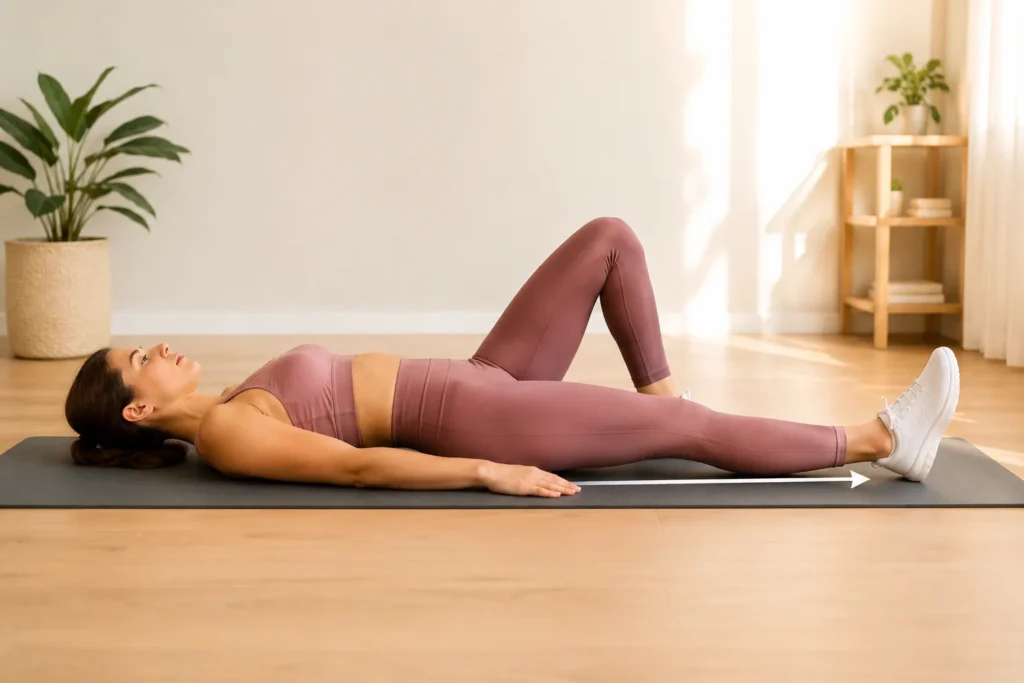
Once your breathing feels natural, heel slides add a small challenge: keeping your core steady while a leg moves. It’s a bit like patting your head and rubbing your belly, except useful.
How to do it:
- Lie on your back, knees bent, feet flat on the floor.
- Take a breath in to prepare, then exhale and gently engage your deep core the way you practiced with diaphragmatic breathing.
- Slowly slide one heel away from you along the floor, straightening that leg, while keeping your low back neutral (not arching or pressing flat by force).
- Inhale as you slide the heel back to the starting position.
- Do 8 to 10 slides per side, alternating legs, for 2 to 3 rounds.
The trick is keeping your low back and pelvis completely still while the leg does all the moving. If your back arches or your belly domes upward, that’s the cue to slide the heel a little less far. This gentle movement is one of the most reliable pelvic floor and core exercises, connecting your breath, pelvic floor, and deep abdominals in one smooth pattern, much like the controlled, unhurried breathing you’d practice in Tai Chi.
3. Pelvic Tilts
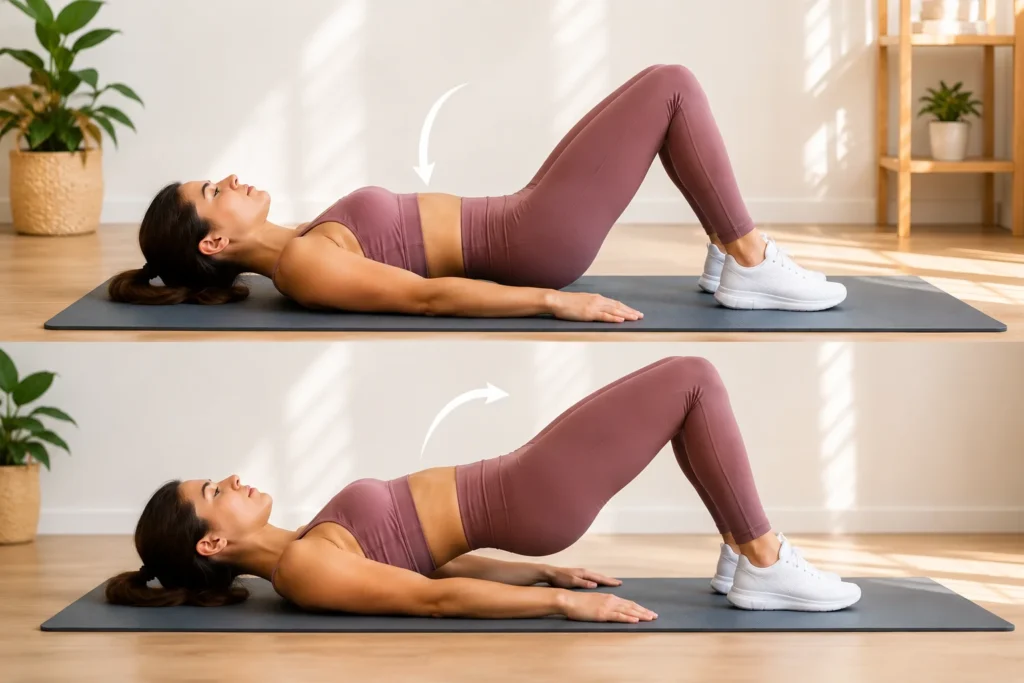
This one barely looks like exercise, which is exactly why people underestimate it. Don’t.
How to do it:
- Lie on your back, knees bent, feet flat on the floor, arms resting by your sides.
- Exhale gently and tilt your pelvis so your low back presses lightly into the floor, tucking your tailbone slightly upward.
- Hold for 2 to 3 seconds, feeling your deep abs and pelvic floor gently switch on together.
- Inhale and release back to a neutral, relaxed low back curve.
- Repeat for 10 to 12 reps.
Keep the movement small and controlled. This isn’t about grinding your back into the floor with force. It’s a tiny tilt, done with intention. Small movement, genuinely big payoff for reconnecting the deep core and teaching your pelvis and spine to move together instead of fighting each other.
Once these feel easy, you’re ready to progress. For a structural overview of movement patterns that support the entire midsection, our Core Exercises guide breaks down how the deep core, obliques, and pelvic floor work as a team rather than solo acts.
4. Modified Dead Bug
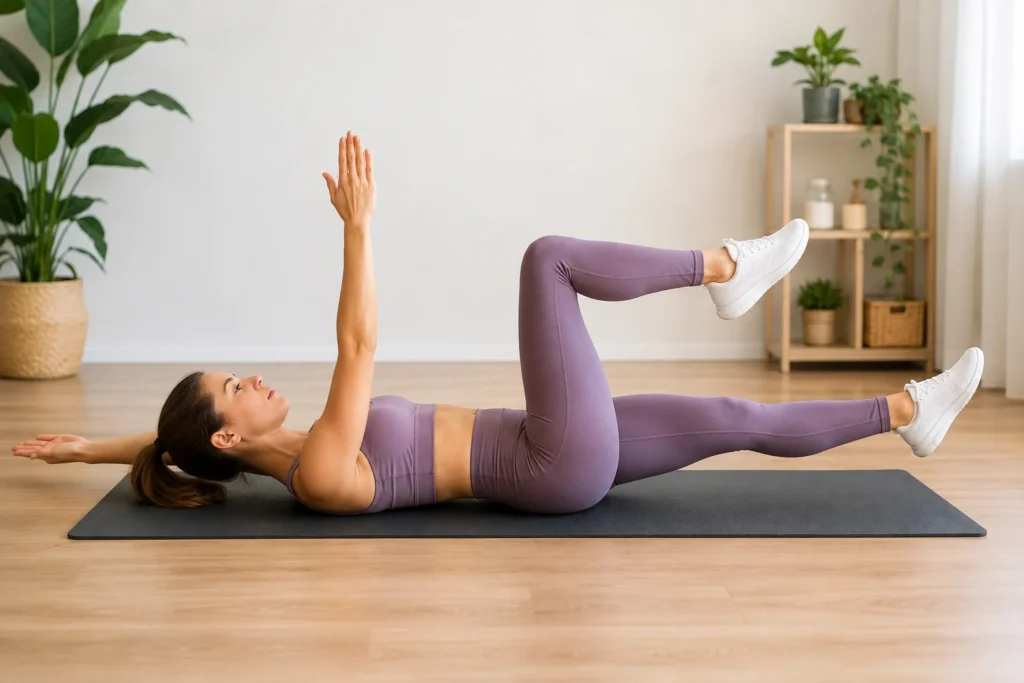
Don’t let the slightly awkward name put you off. This is one of the most effective moves on this entire list, and it looks a lot less silly than it sounds.
How to do it:
- Lie on your back, arms reaching straight up toward the ceiling, knees bent at 90 degrees so your shins are parallel to the floor.
- Exhale and gently engage your core, keeping your low back lightly pressed into the mat.
- Slowly lower one arm overhead and extend the opposite leg out, hovering both just above the floor, without letting your back arch.
- Inhale as you bring the arm and leg back to the starting position.
- Switch sides and repeat, aiming for 6 to 8 reps per side.
Move slowly and stop the range of motion the moment your low back starts to arch off the floor. That’s your body telling you it’s found the edge of what it can control right now, and that’s completely fine. This builds the kind of coordinated strength that a postpartum belly workout actually needs, not six-pack lines, but a core that supports your spine through everyday chaos like bending, lifting, and carrying a car seat that somehow weighs as much as a small refrigerator.
5. Bird Dog
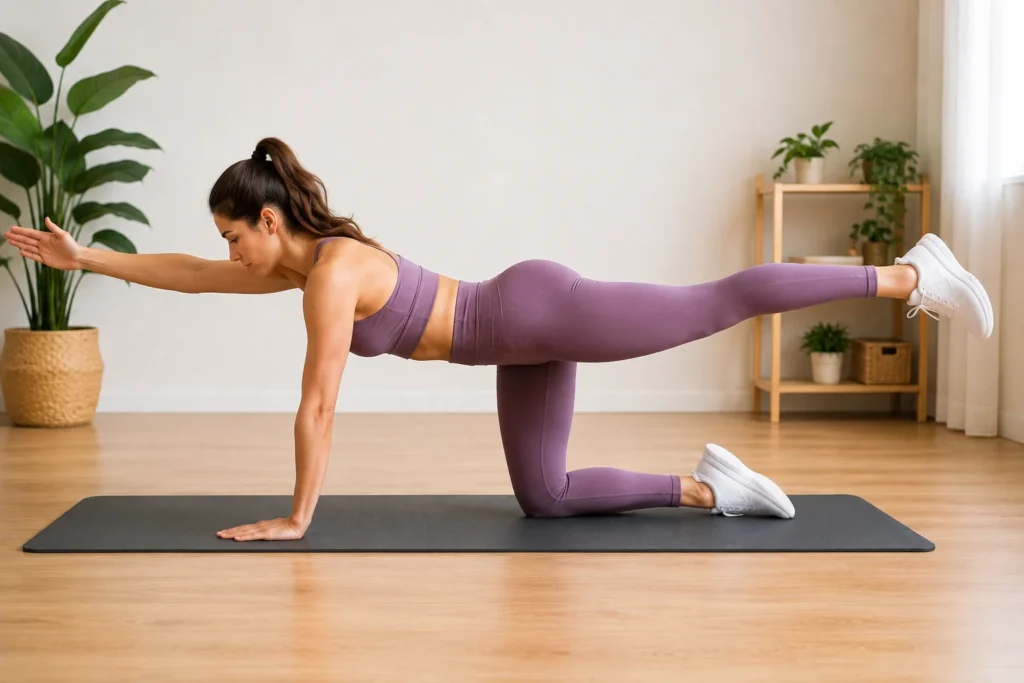
This is the exercise that quietly does more than it gets credit for. It looks calm on the surface, but your whole core is working hard underneath.
How to do it:
- Start on hands and knees, hands under your shoulders and knees under your hips, spine in a neutral, relaxed position (not sagging, not arched).
- Engage your core gently and extend one arm straight forward while extending the opposite leg straight back, both reaching to about hip and shoulder height.
- Keep your hips level, imagine balancing a cup of tea on your lower back without spilling it.
- Hold for 2 to 3 seconds, then return to the starting position with control.
- Switch sides and repeat for 6 to 8 reps per side.
If balancing on the opposite hand and knee feels wobbly at first, that’s completely normal. Just move the arm or the leg alone until it feels steadier, then combine them. This is a staple of postpartum abdominal rehabilitation programs because it trains stability without any spinal flexion, and it doubles as a great warm-up if you’re also working on Stronger Glutes, since your hips have to stay level the whole time.
6. Standing Core Braces
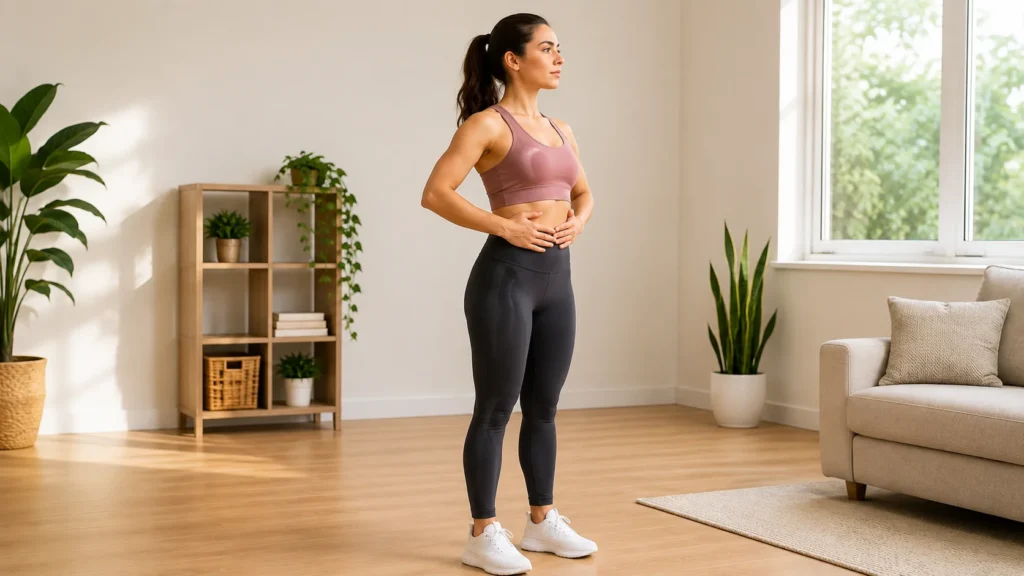
Here’s the one exercise on this list you can genuinely do anywhere, anytime, without anyone noticing you’re doing it.
How to do it:
- Stand tall, feet hip-width apart, shoulders relaxed away from your ears.
- Take a breath in, then exhale and gently draw your navel in and up, as if bracing lightly for a playful tap to the stomach, not sucking in hard, just a firm, gentle hug from the inside.
- Hold that gentle brace for 5 to 8 seconds while breathing normally (don’t hold your breath).
- Release fully, then repeat 8 to 10 times.
Do this while brushing your teeth, waiting for coffee to brew, standing in a grocery line, or rocking a baby to sleep. Nobody will know, and that’s the whole point. Core strengthening after pregnancy doesn’t have to happen on a mat with dedicated workout time you probably don’t have.
If your schedule barely has room for a shower, let alone a workout, our Home Work guide is built for exactly this: short, effective sessions that don’t require leaving the living room.
Diastasis Recti Exercises You Can Do at Home, No Equipment Needed
You don’t need a gym membership or a single dumbbell for this. These diastasis recti exercises without equipment rely entirely on bodyweight and breath control, borrowing the same no-frills approach as Military Calisthenics, just gentler.
Standing pelvic floor lifts:
Stand tall, exhale, and gently lift and squeeze your pelvic floor muscles (the ones you’d use to stop a stream of urine), hold for 3 to 5 seconds, then release fully. Do 10 reps. This quietly strengthens the base of your core, which works hand in hand with the muscles you’re rebuilding up top.
Wall sits with core bracing:
Lean your back against a wall, slide down until your knees are bent at about 45 to 60 degrees (no need to go all the way to a full 90-degree sit), and hold while gently bracing your core and breathing steadily. Start with 15 to 20 seconds and build up gradually. Your legs will complain before your core does, which is normal.
Seated marching:
Sit tall on a sturdy chair, hands resting lightly on the seat or your knees. Exhale, engage your core, and lift one knee a few inches off the floor, then lower it with control and switch legs. Do 8 to 10 lifts per side. Keep your torso upright the whole time instead of leaning back to compensate.
Side-lying leg lifts with a gentle core brace:
Lie on your side, legs stacked and slightly bent, head resting on your arm. Brace your core gently, then lift your top leg a few inches, hold briefly, and lower with control. Do 10 to 12 reps per side. This one sneaks in some hip strength alongside the core work, which is never a bad trade.
Do three to four of these, five days a week, for about 10 to 15 minutes total. Daily diastasis recti exercises, done consistently in small doses, tend to outperform occasional long, intense sessions. Consistency beats intensity here, every single time.
Looking to round this out with gentle full-body movement? Low Impact training pairs beautifully with core rehab because it keeps your heart rate up without straining a healing midline.
Diastasis Recti Exercises for Women Over 40
Hormonal shifts, previous pregnancies, and natural changes in connective tissue elasticity mean diastasis recti exercises for women over 40 sometimes need a slightly slower, more deliberate approach, an idea that also shows up throughout our senior Fitness content. Tissue takes a bit longer to respond, and that’s completely normal, not a sign you’re doing anything wrong.
Focus on the same foundational movements above, but add extra emphasis on breath timing and hold each position a beat longer. Pairing this with balance-focused work, like Tai Chi or gentle Mobility Exercises, supports the connective tissue and joints surrounding your core, which matters more as we get older.
Diastasis Recti Rehab and Physical Therapy Exercises
For moderate to severe separation (generally more than two to three finger-widths), a licensed pelvic floor physical therapist can assess your specific gap and design targeted diastasis recti physical therapy exercises. This isn’t a plug for extra appointments. It’s genuinely the fastest, safest route for more significant cases.
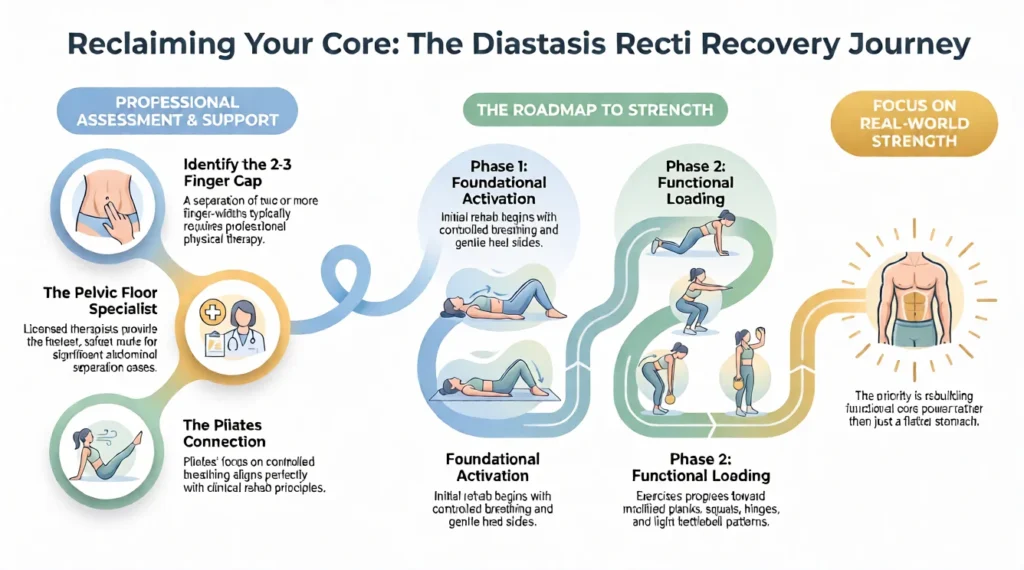
A typical diastasis recti rehab exercises plan might progress from breathing and heel slides toward loaded carries, modified planks on the knees, and eventually functional movements like squats, hip hinges, and light Kettlebell Workout patterns. These diastasis recti recovery exercises rebuild real-world strength, not just a flatter-looking stomach.
If you enjoy structured, low-impact movement systems, Pilates is often recommended alongside physical therapy because its emphasis on controlled breathing and core engagement lines up almost perfectly with diastasis recti rehab principles.
Can Walking Help Diastasis Recti?
Yes, and it’s wonderfully low-key. Walking doesn’t directly close the gap, but it improves circulation, supports gentle core engagement with every step, and keeps your whole body moving without straining the linea alba, similar to how Low Impact cardio supports recovery without adding strain. So can walking help diastasis recti recovery overall? Absolutely, especially paired with the targeted exercises above.
Diastasis Recti Exercises to Close the Gap and Flatten Your Stomach
Let’s be honest about something: nobody exercises purely for fun (okay, some people do, but stay with me). Most people also want visible results. Diastasis recti exercises to close the gap work by rebuilding tension in the connective tissue over time, and as your deep core strengthens, your midsection often looks flatter too, a natural side effect, not a magic trick, the same slow-and-steady logic behind progress in Lower Body strength work.
For diastasis recti exercises for belly fat, remember that spot reduction isn’t real, no matter what an ad promises. Overall movement, reasonable nutrition, and consistent core work together support a leaner-looking midsection. An abdominal separation workout paired with regular walks or Low Impact cardio is a realistic, sustainable combination.
A Simple Weekly Diastasis Recti Core Workout Plan
Not sure how to string all these moves together? Here’s a beginner-friendly diastasis recti core workout for beginners that turns everything above into an actual weekly routine, without needing a spreadsheet or a personal trainer.
- Monday: Diaphragmatic breathing (10 breaths) + Pelvic tilts (12 reps) + Standing core braces (10 reps)
- Tuesday: Rest, or a gentle walk
- Wednesday: Heel slides (10 per side) + Bird dog (8 per side) + Standing pelvic floor lifts (10 reps)
- Thursday: Rest, or light Mobility Exercises
- Friday: Modified dead bug (8 per side) + Wall sits with core bracing (3 rounds) + Seated marching (10 per side)
- Saturday: Full circuit: one round of every exercise above, done gently
- Sunday: Rest and recovery
This is genuinely one of the best exercises for diastasis recti routines to start with because it never overloads your core two days in a row, which matters just as much for diastasis recti exercises for postpartum women as it does for anyone returning to movement after a break. Whether you’re doing this as diastasis recti exercises after pregnancy or simply as a general diastasis recti workout for diastasis recti exercises for women, the same weekly rhythm applies: gentle, consistent, and never rushed. Think of it as a postpartum diastasis recti workout you can actually stick to, not one you dread.
FAQs:
What exercises are good for diastasis recti?
Diaphragmatic breathing, heel slides, pelvic tilts, modified dead bugs, and bird dogs top the list. They rebuild deep core coordination without putting outward pressure on the midline.
Can exercise fix diastasis recti?
Often, yes, especially for mild to moderate separation. The right exercises rebuild tension in the connective tissue and reconnect the deep core, though more severe cases may also need guidance from a pelvic floor physical therapist.
How do I exercise safely with diastasis recti?
Move slowly, breathe out on exertion, keep your core gently engaged, and stop immediately if you notice doming or bulging along your midline. Build up gradually instead of jumping straight to advanced moves.
What exercises should you avoid with diastasis recti?
Sit-ups, crunches, standard front planks, and heavy twisting movements top the avoid list until your deep core is strong enough to support them without doming.
How long does diastasis recti take to heal?
Many people see solid improvement in 8 to 12 weeks with consistent daily practice, though full closure varies by individual, severity, and how consistently the exercises are done.
Can you do planks or sit-ups with diastasis recti?
Standard planks and sit-ups are usually too advanced early on and can worsen doming. Modified, knee-supported planks are sometimes appropriate later, once your deep core has rebuilt enough stability, ideally with guidance from a physical therapist.
Can walking help diastasis recti?
Yes. Walking won’t close the gap on its own, but it supports circulation, gentle core engagement, and overall recovery, making it a solid companion to targeted exercises rather than a replacement for them.
Bringing It All Together
Healing from diastasis recti isn’t about punishing your body for what it just accomplished. It’s about rebuilding trust between your brain, your breath, and your deep core, one gentle rep at a time. Start with the basics, stay consistent, skip the exercises that cause doming, and don’t hesitate to loop in a pelvic floor physical therapist if progress feels slow. And once your core feels steady again, there’s no reason to stop there. Plenty of people move on to balanced upper-body work like Bicep Workouts or Traps at Home once their midline has healed.
For more ways to build strength safely at every stage, explore our guides on Fitness and Workout Equipment for Abs, because a strong core deserves the right tools and the right timeline.
Sources :
This guide draws on general clinical guidance from recognized health organizations, including the American College of Obstetricians and Gynecologists (ACOG), which supports gradual, core-focused exercise as a first-line approach to postpartum recovery, and the American Physical Therapy Association (APTA), whose pelvic health resources shape much of the standard rehab approach to diastasis recti. Patient education material from institutions like the Mayo Clinic and the National Institutes of Health (NIH) also informed the general recovery timelines mentioned here.
This article is for general educational purposes and isn’t a substitute for personalized medical advice. Please consult your doctor or a pelvic floor physical therapist before starting any postpartum exercise program.

Hi, I’m Salem Nasir, founder of Fiturely. I research and write evidence-based articles on fitness, nutrition, weight loss, and healthy living. My mission is to make reliable health information simple, practical, and easy to understand so readers can build healthier habits with confidence