
Key Takeaways
- Just 5 lower body dumbbell exercises can help build stronger legs, glutes, and overall lower-body strength at home.
- Compound movements like Goblet Squats and Romanian Deadlifts target multiple muscle groups for better results.
- Training your lower body regularly can improve balance, stability, posture, and everyday movement.
- You don’t need a gym a pair of dumbbells and proper form are enough for an effective workout.
- Stay consistent and gradually increase the weight or repetitions to keep building strength and muscle over time.
A lower body dumbbell workout at home helps build stronger legs, glutes, hamstrings, and calves using minimal equipment. With the right exercise selection and progressive overload, you can improve strength, muscle tone, balance, and calorie burn without needing a gym. Beginners can start with light dumbbells and gradually increase the challenge over time.
You don’t need a fancy machine or a gym membership to build strong legs. A pair of dumbbells and a bit of floor space is genuinely enough. If you’re also working on your upper body at home, this guide pairs well with our bicep workouts at home for a balanced routine.
 Why Train Your Lower Body at Home with Dumbbells?
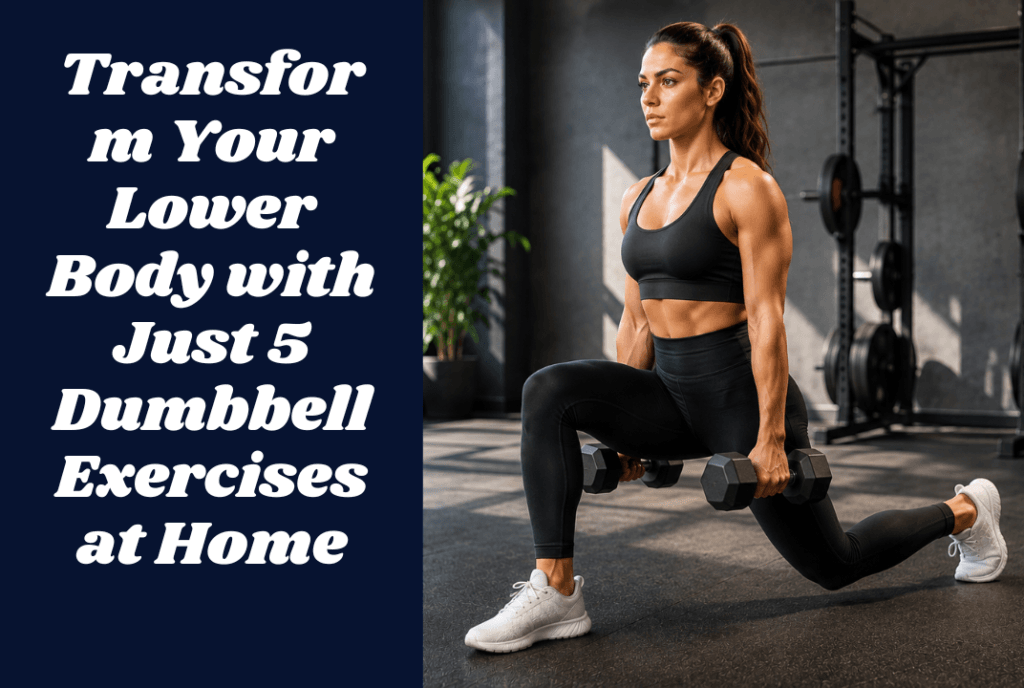 Why Train Your Lower Body at Home with Dumbbells?
Your legs contain the biggest muscle groups in your body, so training them burns more calories than almost any other muscle group. Dumbbells let you load these muscles safely, from any room in your house. This makes lower body dumbbell workout at home routines one of the most efficient ways to build strength without gym equipment.
Benefits of Dumbbell Training
Dumbbells are affordable, space-saving, and joint-friendly compared to barbells. They also force each leg to work independently, which fixes muscle imbalances that machines often hide. According to the American Council on Exercise (ACE), unilateral resistance training improves balance and functional strength more than bilateral movements alone (acefitness.org).
- Builds real-world functional strength
- Improves joint stability and balance
- Cheap, compact, and beginner-friendly
- Works well for home strength workout routines
- Suitable for all fitness levels
Muscles Worked
A proper dumbbell leg workout hits nearly every muscle from your hips to your ankles. This is what makes lower body training so time-efficient. If you prefer a more joint-friendly training style, Low Impact Exercises for Women can help you build strength, improve mobility, and stay active while reducing stress on your knees and hips
- Glutes
- Quads
- Hamstrings
- Calves
- Hip Stabilizers
1. Goblet Squat
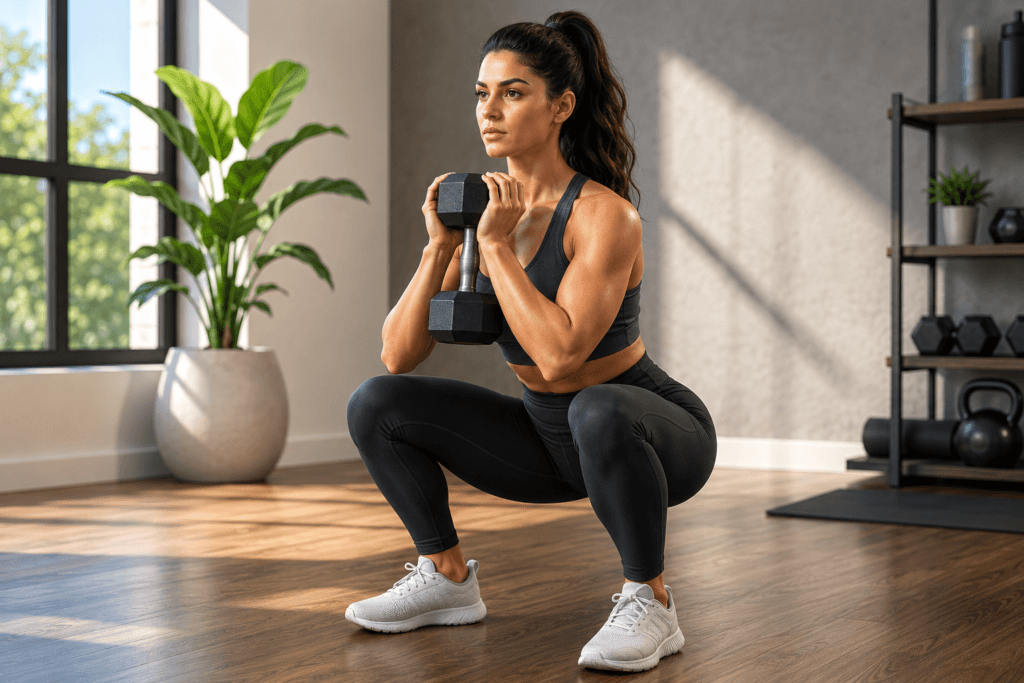
The goblet squat is usually the first exercise trainers teach beginners, and for good reason. Holding the dumbbell at chest height naturally keeps your torso upright, so it’s almost impossible to round your back. It’s simple, safe, and builds the foundation for every other squat variation you’ll do later.
Muscles Worked: Quads, glutes, core, adductors
How to Perform It:
- Hold one dumbbell vertically against your chest, close to your body
- Stand with feet shoulder-width apart, toes slightly turned out
- Sit your hips back and squat down until your thighs are near parallel to the floor
- Keep your chest up and elbows pointing down through the movement
- Push through your heels to drive back up to standing
Benefits:
- Beginner-friendly
- Teaches squat depth
- Improves posture
- Builds quads and glutes
- Joint-friendly
Common Mistakes: Letting knees cave inward, rising onto toes, and rushing the descent instead of controlling it
2. Romanian Deadlift (RDL)
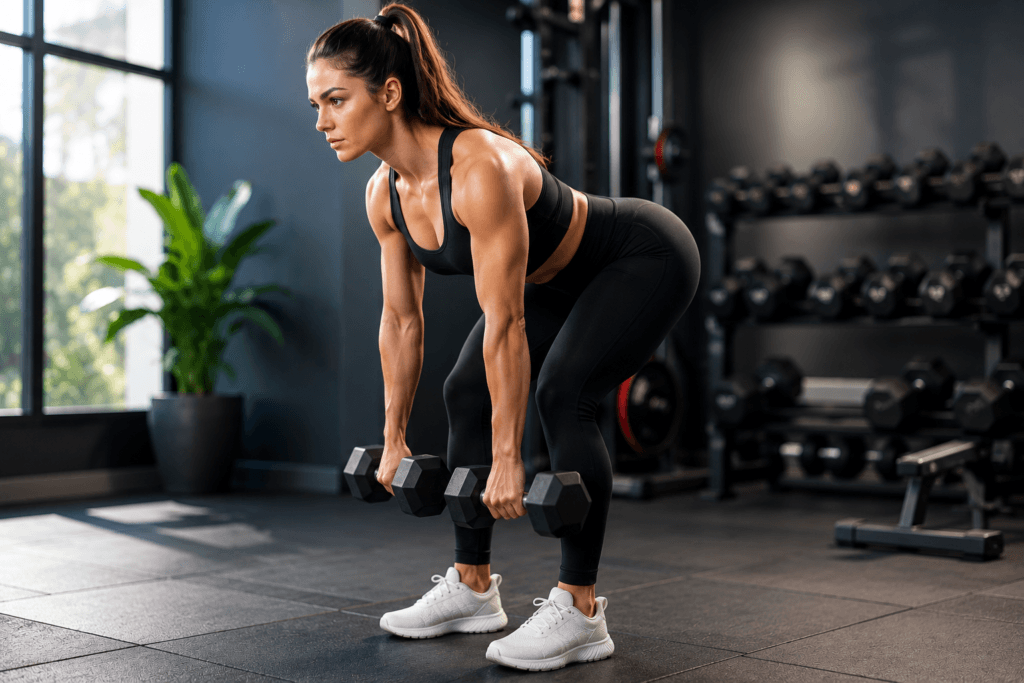
The RDL is a hip-hinge movement, not a squat, and that distinction matters. It targets your hamstrings and glutes through a deep stretch rather than a deep bend, which is exactly why it’s so good for building a strong, injury-resistant posterior chain. Most people feel this one working within the first few reps.
Muscles Worked: Hamstrings, glutes, lower back
How to Perform It:
- Hold a dumbbell in each hand in front of your thighs
- Keep a slight bend in your knees, and lock it in place through the movement
- Hinge forward at your hips, pushing them back as your torso lowers
- Lower the weights along your legs until you feel a stretch in your hamstrings
- Squeeze your glutes and drive your hips forward to return to standing
Benefits:
- Strengthens hamstrings
- Improves posture
- Builds hip-hinge form
- Protects lower back
- Boosts flexibility
Common Mistakes: Rounding the back, bending knees too much (turning it into a squat), and going lower than your flexibility allows.
3. Bulgarian Split Squat
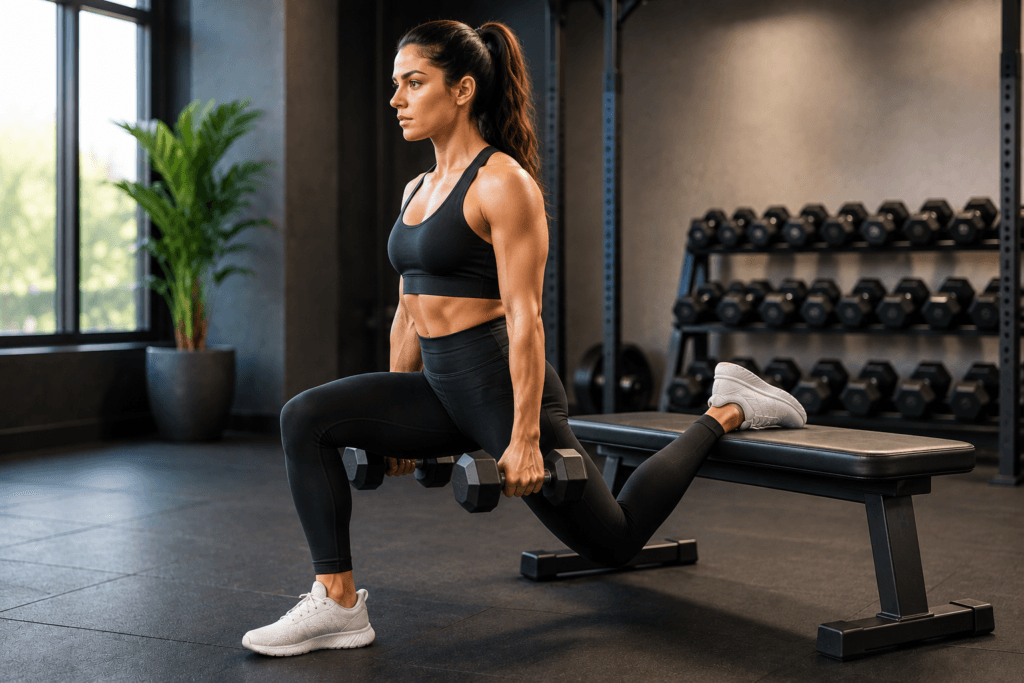
Don’t let the name scare you, this one is tougher than it looks but delivers results fast. Because your back foot is elevated, almost all the load shifts onto your front leg, forcing it to work harder than a regular squat ever could. It’s a favorite among trainers for building single-leg strength quickly.
Muscles Worked: Quads, glutes, hamstrings, stabilizers
How to Perform It:
- Stand a couple of feet in front of a bench or sturdy step
- Place the top of your back foot on the bench behind you
- Hold a dumbbell in each hand, arms relaxed at your sides
- Lower your back knee toward the floor, keeping your front knee tracking over your foot
- Push through your front heel to return to the starting position
Benefits:
- Fixes muscle imbalances
- Builds glute strength
- Improves balance
- Strengthens core
- Boosts athletic performance
Common Mistakes: Placing the front foot too close to the bench, leaning too far forward, and not going deep enough to fully engage the glutes
4. Dumbbell Walking Lunges
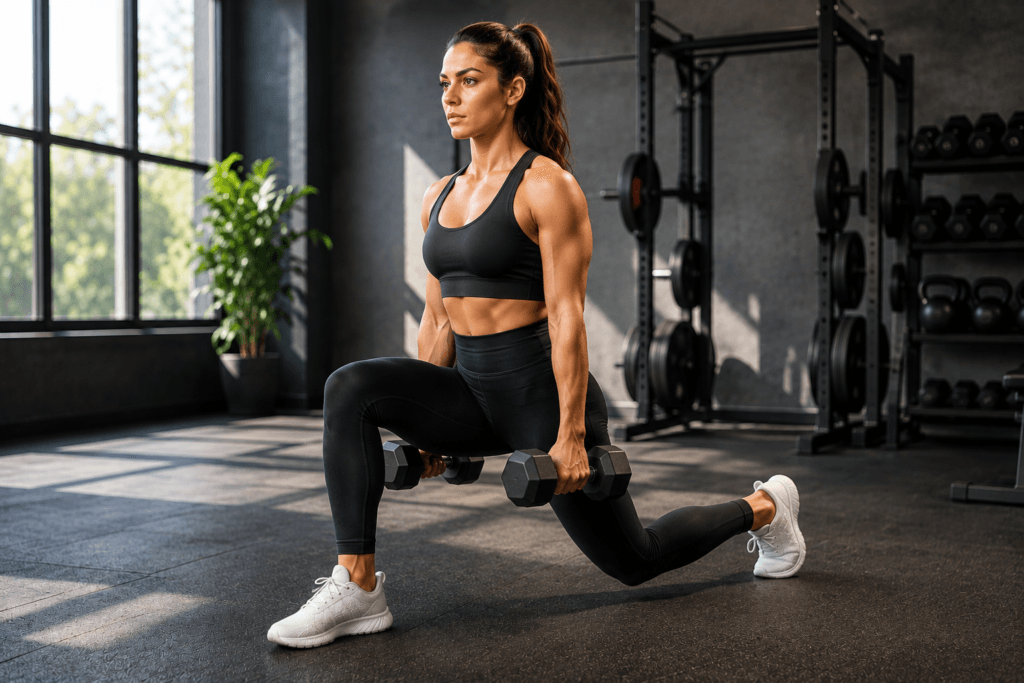
Walking lunges add a dynamic, athletic element that static exercises don’t offer. Every step forces your body to stabilize, balance, and drive forward at the same time, which mimics real movement patterns far better than a machine ever could. They’re also easy to scale up or down depending on your fitness level.
Muscles Worked: Quads, glutes, hamstrings, calves
How to Perform It:
- Hold a dumbbell in each hand, arms at your sides
- Step forward into a controlled lunge, keeping your torso upright
- Lower your back knee close to the floor without letting it touch
- Push off through your front foot to stand and bring your back leg forward
- Continue alternating legs as you walk forward
Benefits:
- Improves balance
- Builds coordination
- Strengthens single-leg power
- Mimics natural movement
- Easy to scale
Common Mistakes: Taking steps too short, letting the front knee shoot past the toes, and losing balance from going too fast.
5. Dumbbell Hip Thrust
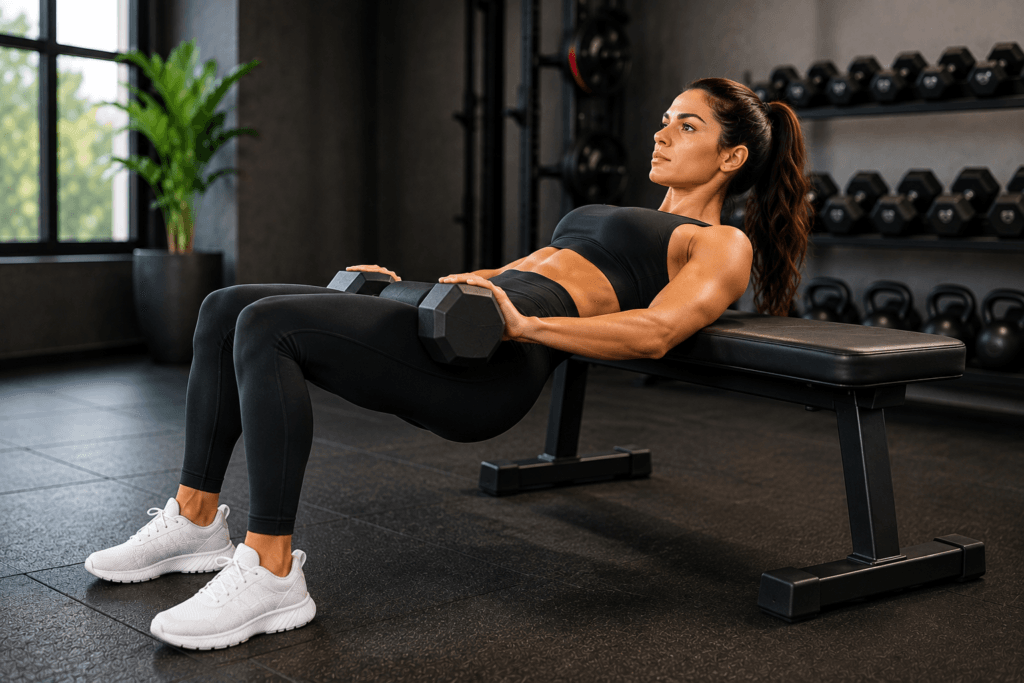
If glutes are your main focus, this exercise deserves the top spot in your routine. Unlike squats or lunges, the hip thrust isolates the glutes almost entirely, with minimal involvement from your quads or lower back. It looks a little awkward the first time you try it, but the results speak for themselves.
Muscles Worked: Glutes primarily, hamstrings secondarily
How to Perform It:
- Sit on the floor with your upper back resting against a bench
- Place a dumbbell across your hips, holding it steady with both hands
- Plant your feet flat on the floor, hip-width apart
- Drive through your heels to lift your hips until your body forms a straight line from shoulders to knees
- Squeeze your glutes at the top, then lower slowly back down
Benefits:
- Best glute isolation
- Shapes and lifts glutes
- Boosts hip power
- Knee-friendly
- Improves athletic speed
Common Mistakes: Overextending the lower back at the top, placing feet too far from the body, and using momentum instead of muscle control.
If you’re combining this with a full-body plan, check our guide on glute exercises for women for extra targeted variations
Beginner Lower Body Dumbbell Workout Plan
This beginner lower body dumbbell workout focuses on form and consistency over heavy loading.
| Exercise | Sets | Reps | Rest |
|---|---|---|---|
| Goblet Squat | 3 | 10-12 | 60 sec |
| Romanian Deadlift | 3 | 10 | 60 sec |
| Walking Lunges | 2 | 10 per leg | 45 sec |
| Dumbbell Hip Thrust | 3 | 12 | 45 sec |
Train this routine two to three times per week with at least one rest day between sessions.
Intermediate Workout Plan
Once squats and lunges feel comfortable, this intermediate plan adds volume and unilateral demand for further lower body muscle building.
| Exercise | Sets | Reps | Rest |
|---|---|---|---|
| Bulgarian Split Squat | 4 | 10 per leg | 60 sec |
| Romanian Deadlift | 4 | 10 | 60 sec |
| Goblet Squat | 3 | 15 | 45 sec |
| Walking Lunges | 3 | 12 per leg | 45 sec |
| Dumbbell Hip Thrust | 4 | 12 | 45 sec |
Advanced Home Leg Workout (Circuit)
For advanced trainees, circuit-style training with minimal rest boosts both strength and conditioning.
Complete all five exercises back-to-back with 15 seconds rest between moves, then rest 2 minutes and repeat the circuit 3-4 times:
- Goblet Squat – 15 reps
- Bulgarian Split Squat – 10 reps per leg
- Romanian Deadlift – 12 reps
- Walking Lunges – 12 reps per leg
- Dumbbell Hip Thrust – 15 reps
This format works well alongside a broader home fitness routine that includes cardio and mobility days.
Which Dumbbell Weight Should Beginners Use?
Choosing the right weight matters more than people think: too light and you won’t progress; too heavy and your form breaks down.
| Level | Women | Men |
|---|---|---|
| Beginners | 5-10 lbs | 10-15 lbs |
| Intermediate | 10-20 lbs | 15-30 lbs |
| Advanced | 20-35 lbs+ | 30-50 lbs+ |
These are general starting ranges, not fixed rules. A good gauge from the CDC’s physical activity guidelines is that the last 2 reps of a set should feel genuinely challenging but still controlled (cdc.gov).
Lower Body Workout for Different Goals
Your rep range and rest periods should shift depending on what you’re actually training for.
Fat Loss
Higher reps (15-20), shorter rest (30-45 sec), and circuit-style training to keep your heart rate elevated throughout the session.
Muscle Growth
Moderate reps (8-12), moderate rest (60-90 sec), and consistent progressive overload week over week.
Strength
Lower reps (4-6), longer rest (2-3 minutes), and heavier dumbbells relative to your capacity.
Athletic Performance
Explosive movements like jump lunges combined with unilateral leg exercises to build power and balance together.
Glute Growth
Prioritize hip thrusts and Bulgarian split squats, since these create the greatest glute activation according to EMG studies published in the Strength and Conditioning Journal.
For those managing joint issues while chasing any of these goals, our article on low impact exercises offers useful modifications.
Lower Body Dumbbell Workout vs Bodyweight Workout
| Compare | Dumbbell Workout | Bodyweight Workout |
|---|---|---|
| Muscle Growth | Higher, due to added resistance | Limited past a certain point |
| Calories Burned | Higher with heavier loads | Moderate, depends on intensity |
| Progressive Overload | Easy to add weight | Harder without added resistance |
| Equipment | Requires dumbbells | None needed |
| Beginners | Great with light weights | Great starting point, zero cost |
Bodyweight training is a solid starting point, but a dumbbell leg workout for weight loss and muscle building tends to outperform it once your body adapts to basic movement patterns. If you’re just starting your fitness journey, our calisthenics workout plan for beginners is a good complementary resource.
Common Mistakes During Lower Body Dumbbell Training
Even a well-designed home lower body workout with dumbbells can stall if these habits creep in.
- Poor squat depth, which limits glute and quad activation
- Rounded back during deadlifts and hip thinges, risking lower back strain
- Knees collapsing inward, a common sign of weak hip stabilizers
- Using heavy weights too early, before form is solid
- Skipping warm-up, which increases injury risk
- No progressive overload, so muscles stop adapting
- Poor recovery between sessions, leading to fatigue and plateaus
If you experience nagging discomfort in your lower back after training, our guide on lower left back pain in women explains possible causes and when to see a doctor.
Warm-Up Before Leg Day at Home
A rushed warm-up is one of the fastest ways to get injured. Spend five minutes preparing your joints and muscles before any leg day at home.
5-Minute Routine:
- Bodyweight squats – 1 minute
- Hip circles – 1 minute
- Walking knee hugs – 1 minute
- Glute bridges – 1 minute
- Ankle rotations and light lunges – 1 minute
This primes your hips, knees, and ankles for heavier loading. Older adults or those easing back into training may also benefit from our mobility exercises for seniors before starting resistance work.
Nutrition Tips for Muscle Recovery
Training builds the stimulus, but nutrition and recovery build the actual muscle. This part gets ignored far too often.
Protein: Aim for roughly 1.6-2.2 grams of protein per kilogram of bodyweight daily, a range supported by research in the International Society of Sports Nutrition journal.
Carbs: Carbohydrates refill muscle glycogen, which fuels your next lower body resistance training session.
Hydration: Even mild dehydration reduces strength output and increases perceived effort during workouts.
Sleep: Growth hormone release peaks during deep sleep, making 7-9 hours a non-negotiable part of muscle building, according to the National Sleep Foundation.
Frequently Asked Questions
Can I build muscle with only dumbbells?
Yes. As long as you apply progressive overload and train with proper form, dumbbells alone can build noticeable muscle over time.
Is a 20-minute lower body workout enough?
For most beginners and intermediates, 20 focused minutes with compound lower body exercises is enough to see steady progress.
How many times should I train legs?
Two to three times per week works well for most people, allowing 48 hours of recovery between sessions.
What dumbbell weight is best for beginners?
Start with 5-15 lbs depending on your gender and strength level, then increase gradually as exercises feel easier.
Can dumbbells grow glutes?
Yes. Exercises like the dumbbell hip thrust and Bulgarian split squat are highly effective for a home glute workout.
Can I lose weight with lower body workouts?
Yes. Leg training burns significant calories due to the size of the muscles involved, supporting a dumbbell leg workout for weight loss.
Are home workouts as effective as gym workouts?
For most fitness goals, yes, consistency and progressive overload matter more than the specific location you train in.
Should beginners train legs every day?
No. Muscles need recovery time to repair and grow, so daily leg training is not recommended for beginners.
Final Thoughts
A lower body dumbbell workout at home is one of the simplest, most affordable ways to build real strength, tone your legs and glutes, and burn calories without stepping into a gym. Start light, focus on form, and let progressive overload do the heavy lifting over time.
Consistency, not intensity, is what actually transforms your legs. Pick two or three sessions a week, follow the plans above, and give your body the recovery and nutrition it needs to adapt. For a well-rounded routine, you might also explore our core exercises for seniors or military calisthenics guides to round out your training week.
Note: This article is for general fitness information. It is not a substitute for professional medical or training advice. Please consult a certified trainer or physician before starting any new exercise program, especially if you have existing injuries or health conditions.
Sources & References
- American Council on Exercise (ACE), Unilateral Training and Functional Strength: https://www.acefitness.org
- Centers for Disease Control and Prevention (CDC), Physical Activity Guidelines for Adults: https://www.cdc.gov/physicalactivity/basics/adults/index.htm
- International Society of Sports Nutrition (ISSN), Position Stand on Protein and Exercise: https://jissn.biomedcentral.com
- National Sleep Foundation, Sleep and Muscle Recovery: https://www.sleepfoundation.org
- National Strength and Conditioning Association (NSCA), Journal of Strength and Conditioning Research: https://journals.lww.com/nsca-jscr
- Statista, Home Fitness and Strength Training Trends: https://www.statista.com
- Mayo Clinic, Strength Training: Get Stronger, Leaner, Healthier: https://www.mayoclinic.org/healthy-lifestyle/fitness/in-depth/strength-training/art-20046670

Hi, I’m Salem Nasir, founder of Fiturely. I research and write evidence-based articles on fitness, nutrition, weight loss, and healthy living. My mission is to make reliable health information simple, practical, and easy to understand so readers can build healthier habits with confidence