
Key Takeaways
- Saltines are low in calories but relatively high in sodium.
- Most of their calories come from carbohydrates.
- Saltines provide very little protein and fiber.
- Portion size matters when adding them to your daily diet.
- Pairing saltines with protein can make a more balanced snack.
Saltines look boring. Plain, square, a little salty, the cracker equivalent of a beige waiting room. But that plainness is exactly why they show up in hospital trays, diet plans, and pantry staples across the country. This guide breaks down saltine crackers nutrition in full: calories, carbs, protein, fat, sodium, fiber, and how they stack up against other everyday foods.
We’re using real data from USDA FoodData Central and public health guidelines, no invented numbers, no filler stats.
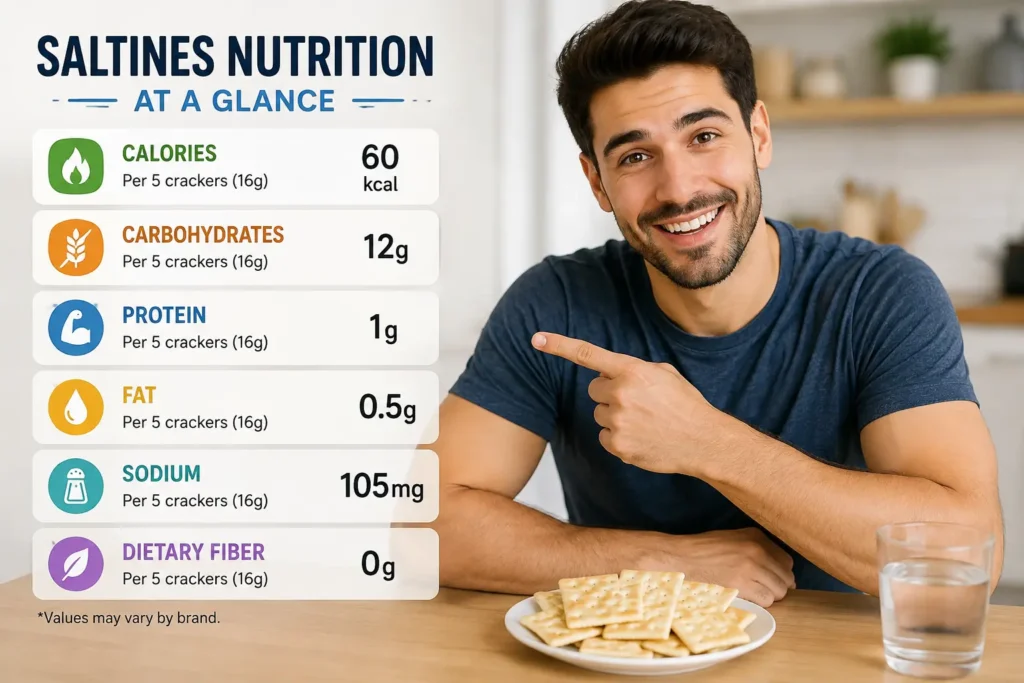
Saltines Nutrition at a Glance:
Short on time? Here’s saltines nutritional value in one glance, the numbers people usually search for first:
- Calories in saltine crackers: 70 per 5-cracker serving (16g)
- Carbs in saltine crackers: 12g per serving, mostly refined flour
- Protein in saltines: 1g per serving, very low
- Fat in saltines: 2g per serving, mostly from vegetable oil
- Sodium in crackers: 180mg per serving, about 8% of the daily limit
- Fiber: under 1g, negligible
- Verdict: A low-calorie, low-fat snack that’s easy on digestion, but low in protein and fiber, best eaten in moderation, not as a nutritional staple.
Keep scrolling for the full breakdown, comparisons with other foods, and answers to the most-asked questions about saltine crackers nutrition.
What Is the Nutritional Value of Saltine Crackers?
A standard serving of saltines (5 crackers, about 16g) contains roughly 70 calories, 12g carbs, 1g protein, 2g fat, and 180mg sodium. Fiber is minimal, usually under 1g per serving. This makes saltines nutrition facts fairly simple: they’re a low-calorie, carb-heavy, low-protein snack.
They’re not a “superfood,” and they were never meant to be one. Saltines exist to be neutral, bland enough to pair with soup, cheese, or an upset stomach without adding much of their own flavor or nutrition profile.
Here’s the full breakdown in one table so you don’t have to hunt for numbers.
| Nutrient | Amount (per 5 crackers / 16g) | % Daily Value* |
|---|---|---|
| Calories | 70 kcal | 3.5% |
| Total Fat | 2g | 3% |
| Saturated Fat | 0.5g | 3% |
| Sodium | 180mg | 8% |
| Total Carbohydrates | 12g | 4% |
| Dietary Fiber | 1g | 2% |
| Total Sugars | 0g | , |
| Protein | 1g | 2% |
Based on a 2,000-calorie daily diet. Values are approximate label figures for Premium-style saltine crackers (USDA FoodData Central).
How Many Calories Are in Saltine Crackers?
Calories in saltine crackers run about 13-14 calories per single cracker, or roughly 70 calories per 5-cracker serving. A full sleeve (about 40 crackers) adds up to close to 560 calories.
That’s genuinely low compared to chips, cookies, or granola bars. The catch is that saltines don’t fill you up much, so it’s easy to eat far more than one serving without noticing, which is where the calorie count can quietly climb.
How Many Carbs Are in Saltine Crackers?
Carbs in saltine crackers sit around 12g per 5-cracker serving, almost entirely from refined wheat flour. There’s essentially no sugar and very little fiber in that carbohydrate count.
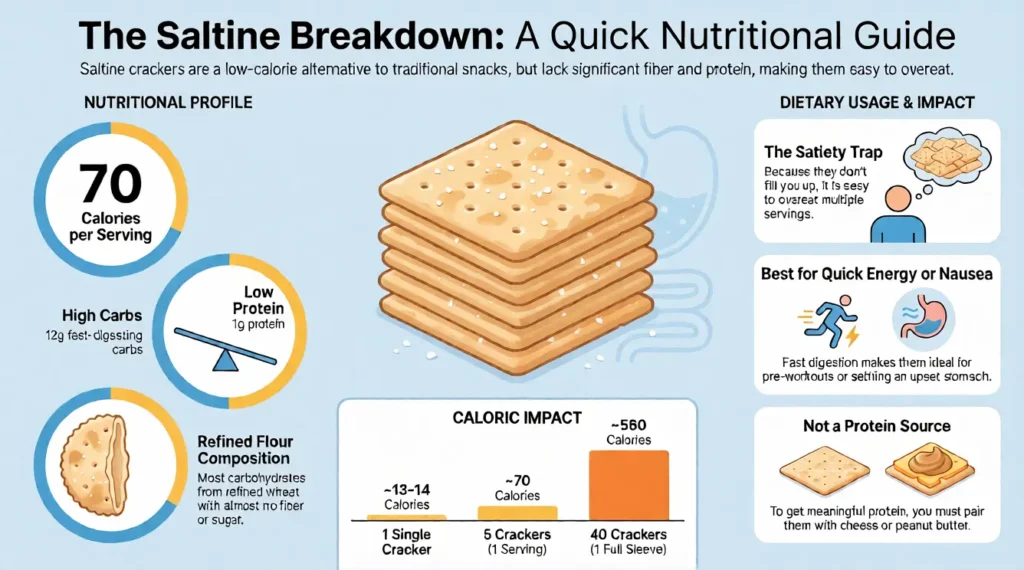
For someone tracking carbohydrate-rich snacks, saltines are a fast-digesting carb source. That’s useful in specific situations (like settling nausea or a quick pre-workout snack) but less ideal as a steady, everyday carb choice since they lack the fiber that slows digestion.
How Much Protein Do Saltines Have?
Protein in saltines is low, about 1g per 5-cracker serving, or roughly 8g per 100g of crackers. That’s not enough to call them a protein source in any meaningful way.
If you’re pairing saltines with something like peanut butter, cheese, or cottage cheese, you’re really getting your protein from the topping, not the cracker. On their own, saltine cracker protein content won’t move the needle on a high-protein diet.
How Much Fat Is in Saltine Crackers?
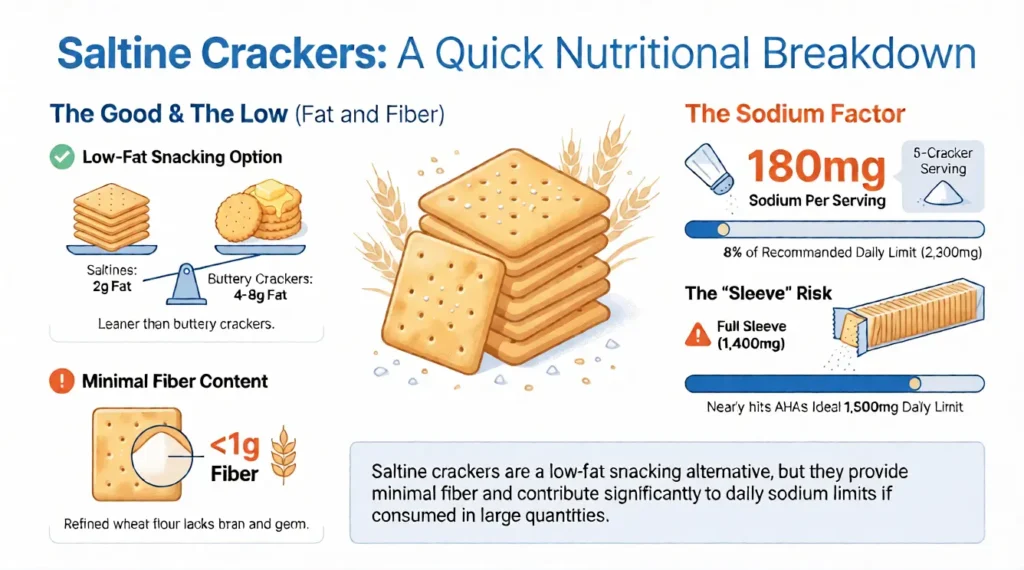
Fat in saltines is around 2g per serving, with roughly 0.5g being saturated fat. That places saltines in the low fat cracker options category compared to buttery or cheese-flavored crackers, which often carry 4-8g of fat per serving.
The fat mostly comes from the vegetable oil used in the dough, not from any added cream, cheese, or butter, which keeps the saltine cracker fat content relatively modest.
How Much Sodium Do Saltine Crackers Contain?
Sodium in crackers like saltines runs about 180mg per 5-cracker serving, roughly 8% of the recommended daily limit. Eat a full sleeve, and you’re looking at close to 1,400mg, more than half the CDC suggested daily sodium ceiling.
The Dietary Guidelines for Americans recommend adults keep sodium under 2,300mg a day, and the American Heart Association suggests an ideal limit closer to 1,500mg for most adults. That makes crackers and sodium intake worth paying attention to, especially if you’re managing blood pressure. Daily sodium intake adds up fast when crackers are a frequent snack.
Do Saltines Have Fiber?
Crackers and dietary fiber don’t mix well, saltines contain less than 1g of fiber per serving. That’s because they’re made from refined wheat flour, which strips out the bran and germ where fiber naturally lives.
The Dietary Guidelines for Americans recommend 25-38g of fiber daily depending on age and sex. A serving of saltines contributes almost nothing toward that goal, so saltine cracker fiber shouldn’t be counted on for digestive health.
What’s a Standard Saltine Cracker Serving Size?
The typical saltine cracker serving size is 5 crackers (about 16g), based on standard nutrition labels. That’s also the reference point most brands use for their printed calorie and sodium figures.
In practice, cracker portion size is easy to blow past, five crackers disappear in under a minute, and most people eat closer to 10-15 without really counting.
Are Saltines Made from Refined or Whole Grain Flour?
Saltines are classic refined grain crackers, made primarily from enriched wheat flour crackers dough, plus yeast, oil, and salt. The refining process removes most of the natural fiber and some micronutrients found in whole wheat.
That’s the core trade-off with plain crackers nutrition: refined flour gives saltines their light, crisp texture, but it also means less nutritional density compared to whole grain alternatives.
How Do Saltines Compare to Other Common Foods?
Numbers mean more with context. At 70 calories, 1g protein, 12g carbs, and 2g fat per serving, saltines sit on the lighter end of the calorie scale, but they don’t bring much else to the table nutritionally. Stack them against other everyday foods and the gaps show up fast.
Take vegetables first. Red onion (about 32 calories per half cup raw) and pickled beetroot (roughly 37 calories per half cup) both come in lighter than saltines while adding antioxidants and folate, nutrients saltines don’t offer at all. Fruit tells a similar story: a medium naval orange runs about 69 calories, close to a saltine serving, but delivers fiber and vitamin C instead of empty refined carbs.
Grains and noodles land closer to saltines in character since they’re also carb-forward. Pho noodles (rice noodles, about 190 calories per cooked cup) and soba noodle (around 113 calories per cooked cup) both carry more carbs than a saltine serving, but soba edges ahead with nearly 6g of protein and a bit of fiber, something plain refined-flour crackers can’t match.
Protein sources make the difference clearest. Chicken thigh (skinless, about 180 calories per 3oz) delivers 21g of protein, and cottage cheese (about 90 calories per half cup) packs in 12g, both dwarf the 1g of protein you get from saltines. Kidney beans (roughly 112 calories per half cup cooked) split the difference nicely, offering 7.6g of protein and solid fiber from a plant source.
Then there’s the sodium comparison, where saltines aren’t alone in the danger zone. Spam (about 174 calories per 2oz) and ham (around 92 calories per 2oz cooked) both carry sodium levels that rival or exceed a full sleeve of saltines, just packaged as meat instead of a cracker.
saltines are calorie-light but nutrient-light too. Foods like kidney beans, cottage cheese, and chicken thigh punch well above saltines in protein per calorie, while processed foods like spam and ham share saltines’ sodium problem from a different angle.
Are Saltines Good or Bad for Weight Management?
Saltines and weight management can go either way depending on portion control. At 70 calories per serving, they’re not calorie-dense, which is why some people use saltine crackers for dieting as a low-calorie filler between meals.
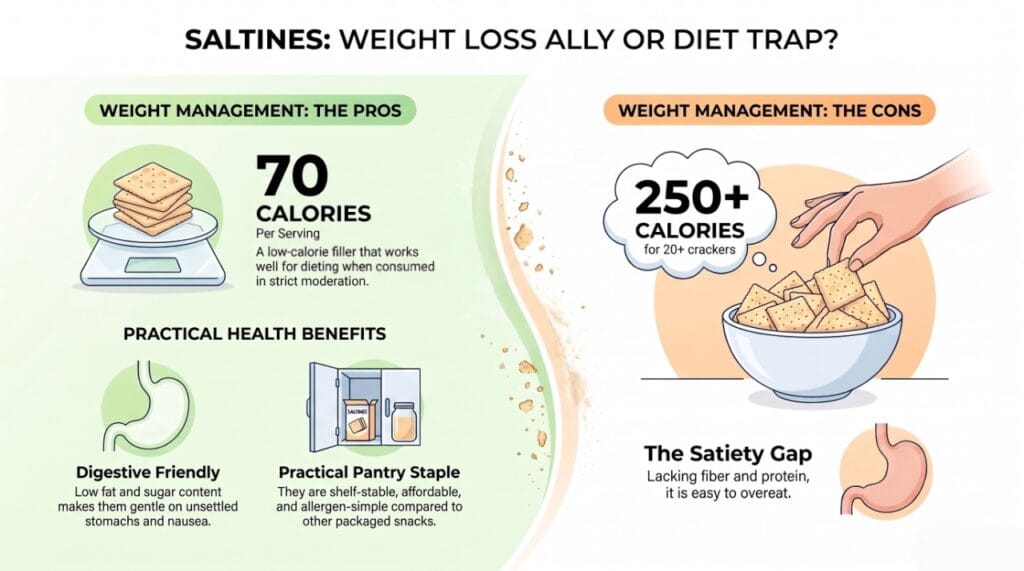
The problem is satiety. With almost no fiber or protein, saltines don’t keep you full for long, so it’s easy to eat 20+ crackers without feeling satisfied, quietly adding 250+ calories with little nutritional return. Are saltines good for weight loss? They can work in moderation, but they’re not a strategy on their own.
What Are the Health Benefits of Saltine Crackers?
Saltine crackers health benefits are modest but real, especially in specific situations. They’re low in fat, low in sugar, easy to digest, and gentle on an unsettled stomach, which is why hospitals and doctors often hand them out for nausea.
They’re also shelf-stable, cheap, and allergen-simple compared to many packaged snacks, making them a practical pantry staple rather than a nutrition powerhouse.
What Are the Drawbacks of Eating Saltine Crackers?
Saltine crackers drawbacks center on three things: high sodium relative to calories, almost no fiber, and very little protein. As one of many processed snack foods, they’re engineered for shelf life and texture, not nutrient density.
Eating them regularly in large amounts, especially a full sleeve at once, can push sodium intake higher than expected without much nutritional payoff in return.
What Are Healthier Cracker Alternatives?
Healthy cracker alternatives and whole grain cracker alternatives generally offer more fiber and protein per serving than saltines, while keeping a similar crunch factor.
- Whole wheat crackers (more fiber, similar calories)
- Seed-based crackers (flax, chia, added omega-3s and fiber)
- Rice cakes (lower sodium, though also low fiber)
- Chickpea or lentil crackers (added plant protein)
- Whole grain rye crisps (high fiber, low fat)
For a snack calorie comparison, most of these swap in around the same calorie range as saltines but deliver more staying power.
Best Crackers for a Balanced Diet
Best crackers for a balanced diet generally check three boxes: fiber above 2g per serving, sodium under 150mg, and at least 2-3g of protein. Whole grain and seed-based crackers tend to hit this mark more consistently than refined-flour options like saltines.
That said, nutrient content of crackers varies a lot by brand, so checking the label, not just the front-of-box marketing, is the only reliable way to compare packaged cracker nutrition and the general nutritional content of crackers on store shelves.
Saltine Crackers: Myth vs Fact
A lot of what people believe about saltines isn’t quite right. Here’s where the common claims actually stand against the data.
Myth: “Saltines are basically a health food because they’re low-calorie.” Fact: At 70 calories per serving, they’re light, but with only 1g protein and under 1g fiber, they don’t fill you up or add much nutritional value. Low-calorie doesn’t automatically mean nutritious.
Myth: “Whole wheat crackers are always healthier than saltines.” Fact: Usually true for fiber, but not guaranteed, some whole wheat crackers still carry high sodium or added oils. It’s worth checking the label instead of assuming.
Myth: “A sleeve of saltines is a harmless snack.” Fact: A full sleeve runs about 1,400mg of sodium, more than half the CDC‘s recommended daily limit, plus over 500 calories with almost no fiber or protein to show for it.
Myth: “Saltines settle your stomach because they have special digestive properties.” Fact: They help simply because they’re bland, low-fat, and easy to digest, not because of any unique ingredient. Any plain, low-fat food would have a similar calming effect.
Myth: “Saltines and bread have completely different nutrition profiles.” Fact: White bread and saltines are actually close cousins, both come from refined flour, with similar low fiber and moderate sodium levels per serving.
FAQs:
Are saltines healthy or unhealthy?
Neither extreme. They’re low in fat and sugar but also low in fiber and protein, with a notable sodium count relative to their calories. In moderation, they’re a neutral, low-risk snack, not a health food.
How many saltines should you eat?
Sticking to one or two labeled servings (5-10 crackers) keeps sodium and refined-carb intake reasonable. Beyond that, the nutritional trade-off starts to outweigh the convenience.
How many carbs do 10 saltine crackers have?
About 24g of carbs, based on roughly 12g per 5-cracker serving, almost entirely from refined wheat flour with very little fiber or sugar.
Are saltines better for you than bread?
It depends on the bread. Whole grain bread usually has more fiber and protein per calorie than saltines. White bread and saltines are closer in nutrient profile, since both come from refined flour.
Why do doctors recommend saltine crackers?
Their blandness and low fat content make them easy to digest, which is why they’re commonly suggested for nausea, morning sickness, or recovery from stomach upset, not for general nutrition.
What are the unhealthiest crackers?
Crackers high in saturated fat, added sugar, and sodium, like heavily flavored cheese crackers or butter crackers, generally rank as less healthy than plain options like saltines.
Can diabetics eat saltine crackers?
In small, controlled portions, yes. Saltines are a fast-digesting refined carb, so the American Diabetes Association recommends pairing them with protein or fat and factoring them into overall carb counting for the day.
Is it okay to eat a whole sleeve of saltines?
Occasionally, it’s not dangerous, but a full sleeve can add up to over 500 calories and 1,400mg of sodium, more than half the recommended daily sodium limit, so it’s not something to make a habit of.
Why do saltines settle your stomach?
They’re low in fat and fiber, bland in flavor, and easy on digestion, which reduces the workload on an already-irritated stomach compared to greasy or spicy foods.
References
USDA FoodData Central, Cracker nutrient data, Dietary Guidelines for Americans 2020-2025 (USDA/HHS), Sodium and fiber recommendations, American Heart Association, Sodium guidance, CDC, Sodium and health, Mayo Clinic, Dietary fiber essentials, American Diabetes Association, Carbohydrate counting.

Hi, I’m Salem Nasir, founder of Fiturely. I research and write evidence-based articles on fitness, nutrition, weight loss, and healthy living. My mission is to make reliable health information simple, practical, and easy to understand so readers can build healthier habits with confidence