
Your core does more than show up in mirror selfies. It holds your spine steady, transfers force between your upper and lower body, and keeps you from folding like a lawn chair every time you lift something heavy. If you want a training tool that trains all of that at once, kettlebell core exercises are hard to beat.
Kettlebells are not just “weird dumbbells.” Their off-center handle forces your midsection to work overtime just to keep the bell under control. That single design quirk is why so many coaches now build entire ab days around them instead of endless crunches.
This guide breaks down the best kettlebell exercises for core strength, shows you how to build a home routine, and clears up a few myths along the way. No fluff, no fake statistics, just practical training advice.
Why Kettlebells Are Different From Dumbbells for Core Training
A dumbbell keeps its weight centered in your hand. A kettlebell doesn’t. Its handle sits above the bell, so the load shifts as you move.
That shift is the whole point. Your body has to brace, rotate, and stabilize constantly, which is exactly what core strengthening kettlebell exercises are built to do. You’re not just working your rectus abdominis (the “six-pack” muscle). You’re training your obliques, deep spinal stabilizers, and hip muscles as a team.
This is one reason kettlebell training shows up so often in strength and conditioning programs used by physical therapists and certified trainers, according to organizations like the American Council on Exercise and the National Academy of Sports Medicine, both of which publish public guidance on kettlebell technique and safety.
11 Kettlebell Exercises for a Stronger Core
Once the basics feel natural, it’s time to expand your toolkit. Below are the kettlebell exercises for a stronger core that show up again and again in strength programs, ranked by movement type rather than difficulty, because your core needs variety, not just volume.
Kettlebell Russian Twists
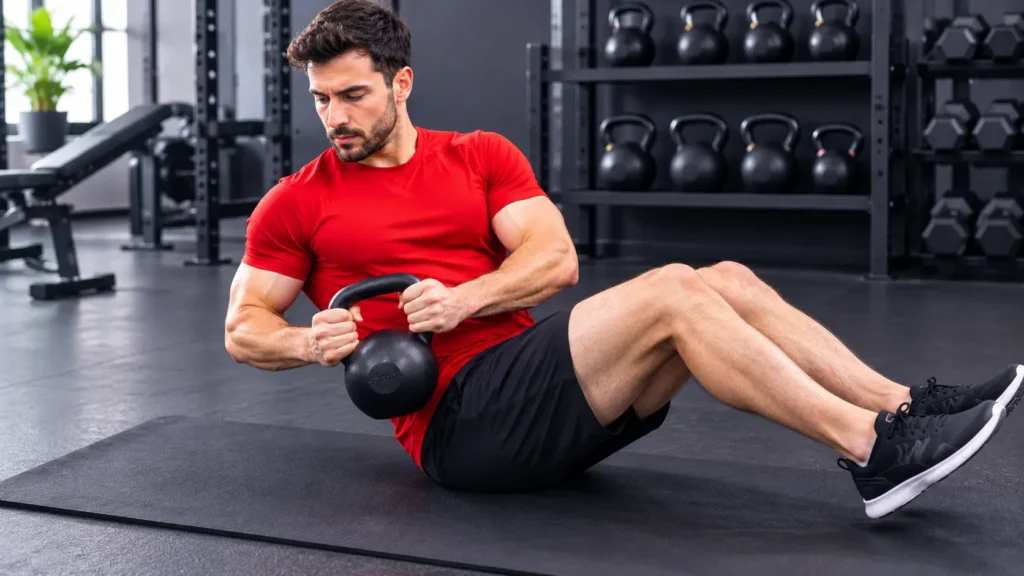
Sit with your knees bent and lean back slightly. Hold the kettlebell with both hands and rotate side to side, tapping the bell near the floor. This is one of the most direct effective kettlebell exercises for abs, targeting the obliques with every twist.
How to do it:
- Sit on the floor with your knees bent and heels either touching the ground or lifted slightly for extra difficulty.
- Hold the kettlebell close to your chest with both hands.
- Lean your torso back about 45 degrees while keeping your spine straight.
- Rotate your torso to one side and tap the kettlebell near the floor.
- Rotate to the other side and repeat, keeping your core braced the whole time.
- Move slowly. Speed here just means sloppy reps.
Kettlebell Plank Drag
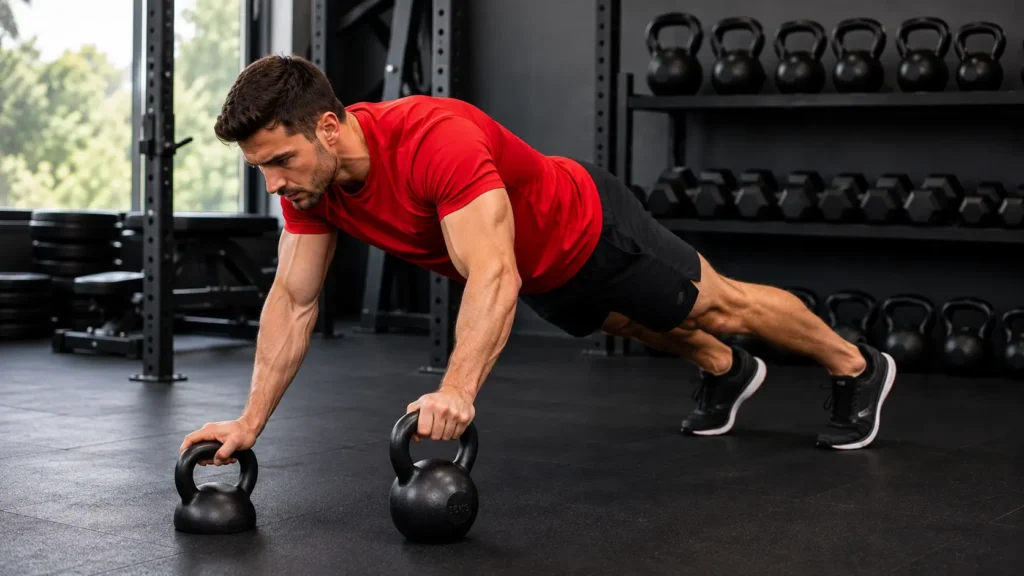
Set up in a plank position with the kettlebell to one side. Reach under your body and drag it to the other side without letting your hips rotate. It looks simple. It is not simple. Your core will disagree with you within the first ten seconds.
How to do it:
- Get into a high plank position with the kettlebell placed just outside one hand.
- Keep your feet slightly wider than hip-width for a stable base.
- Reach across your body with the opposite hand and drag the kettlebell underneath you to the other side.
- Fight the urge to let your hips twist or sag as you reach.
- Set the kettlebell down, reset your plank, and repeat on the other side.
- Keep your neck neutral and your eyes down instead of forward.
Kettlebell Dead Bug
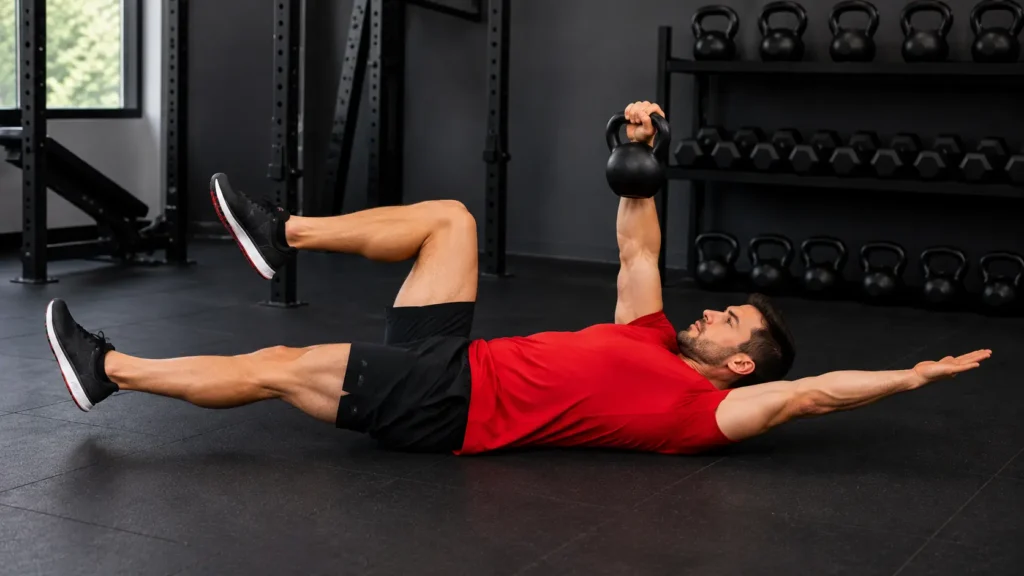
Already mentioned above, but worth repeating here because it’s genuinely one of the safest kettlebell abdominal exercises for anyone dealing with lower back sensitivity.
How to do it:
- Lie on your back and hold the kettlebell overhead with both hands, arms straight.
- Bring your knees up so your hips and knees form a 90-degree angle.
- Press your lower back firmly into the floor and keep it there for the entire set.
- Slowly lower one leg toward the floor while keeping the kettlebell steady overhead.
- Bring the leg back to the start and switch sides.
- If your lower back lifts off the floor at any point, shorten the range of motion.
Kettlebell Sit-Up
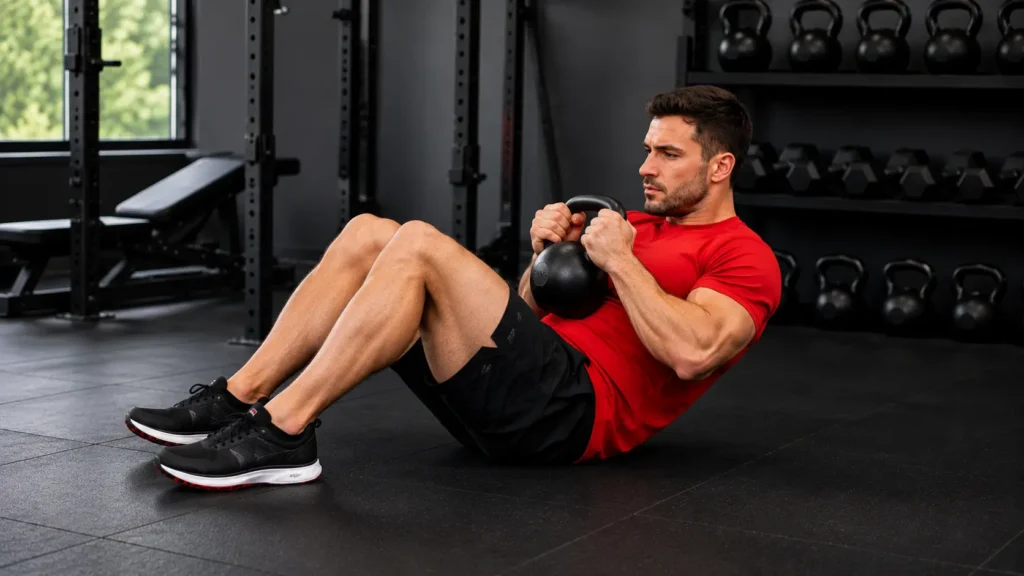
A loaded version of the classic move. Keep your feet anchored, chin tucked, and avoid yanking your neck forward. Quality beats speed every time with this one.
How to do it:
- Lie on your back with your knees bent and feet flat, anchored under something sturdy or held by a partner.
- Hold the kettlebell against your chest with both hands.
- Tuck your chin slightly and engage your core before you move.
- Curl your torso up smoothly until you’re sitting upright.
- Lower yourself back down with control instead of dropping.
- Avoid pulling on your neck. Let your abs do the lifting.
Kettlebell Windmill
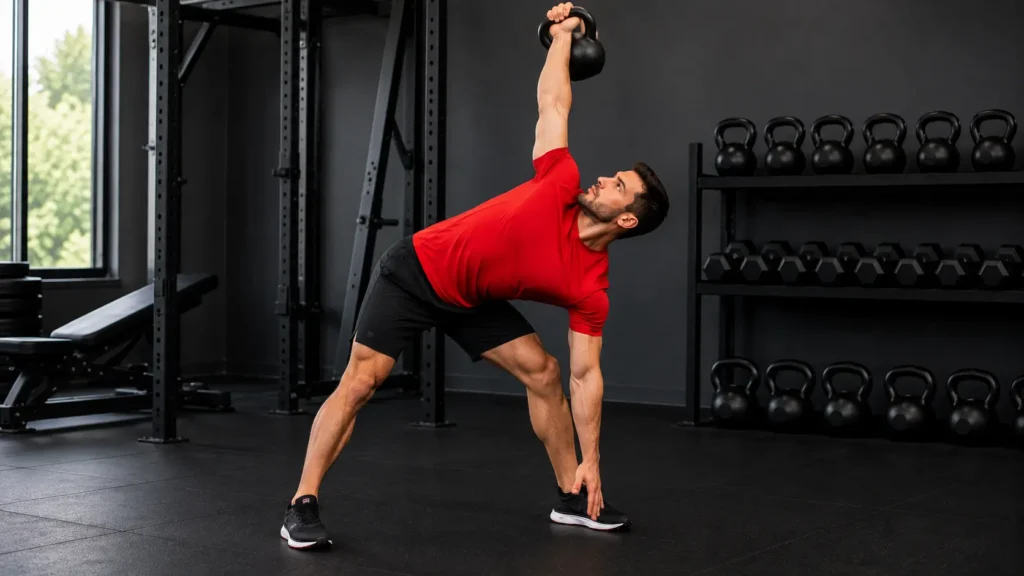
Press the kettlebell overhead, then hinge at the hips and reach toward the floor with your free hand while keeping your eyes on the bell. This move blends shoulder stability with rotational core control, and it deserves a spot in any list of kettlebell exercises for core stability.
How to do it:
- Press the kettlebell overhead with one arm and lock your elbow.
- Turn your feet slightly away from the working arm.
- Keeping your eyes on the kettlebell, hinge at the hips and reach your free hand down toward your shin.
- Push your hips back as you lower, rather than rounding your spine.
- Return to standing by driving through your hips, not your lower back.
- Keep the kettlebell locked out and steady throughout the entire movement.
Kettlebell Turkish Get-Up
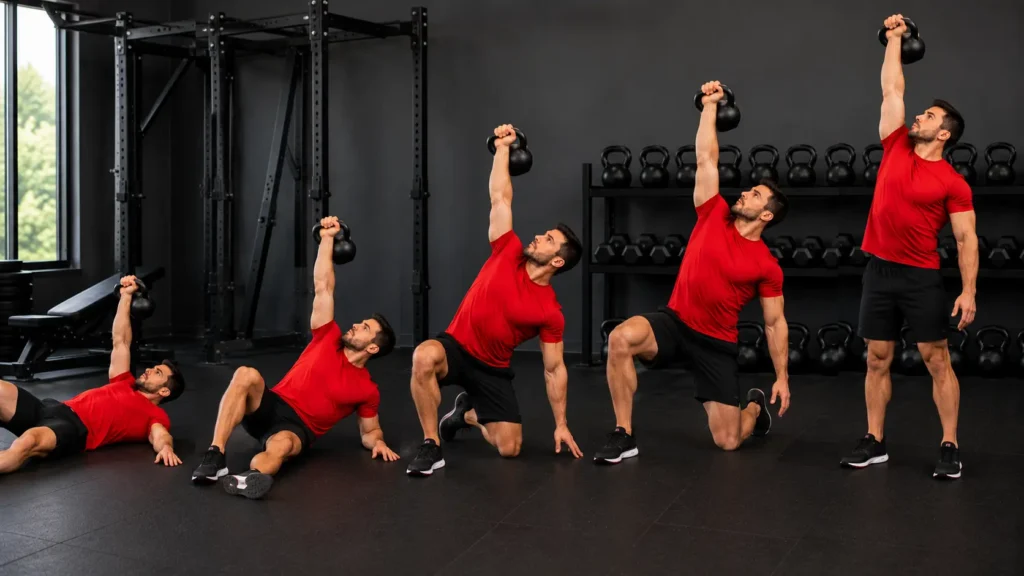
Often called the ultimate full-body test. You start lying down and stand up while holding the kettlebell locked overhead, moving through several distinct positions. It takes patience to learn but pays off with serious core and shoulder resilience.
How to do it:
- Lie on your back and press the kettlebell overhead with one arm, elbow locked.
- Bend the knee on the same side and plant that foot on the floor.
- Roll onto your opposite forearm, then push up onto your hand.
- Lift your hips off the ground and sweep your back leg underneath you into a kneeling position.
- Stand up from the kneeling position while keeping the kettlebell locked overhead.
- Reverse each step slowly to return to the floor, and repeat on the other side.
- Go light while learning this one. The technique matters far more than the weight.
Kettlebell Suitcase Carry
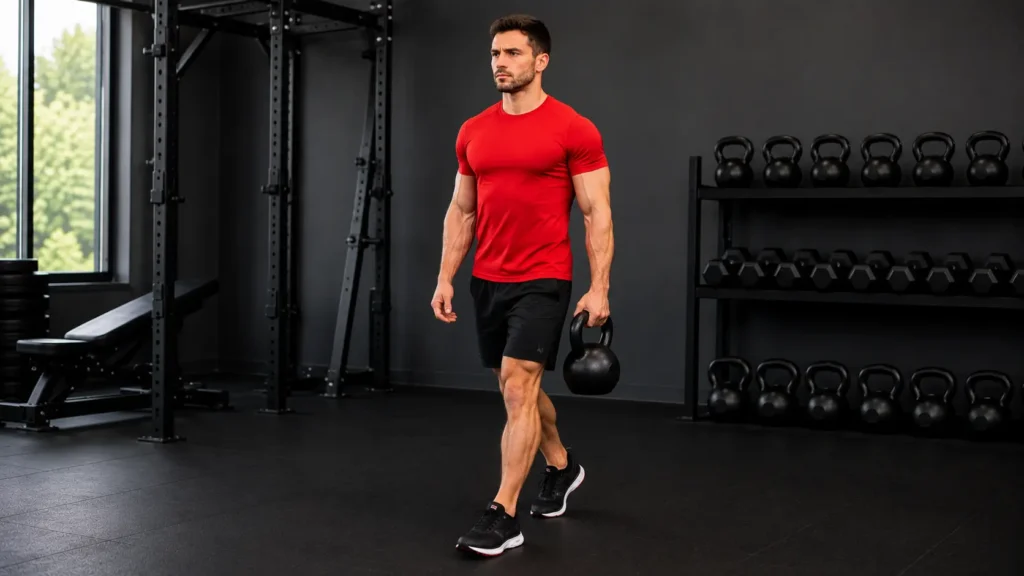
Simple, brutal, effective. Carrying uneven weight forces your core to fight rotation the entire time you walk.
How to do it:
- Stand tall and hold the kettlebell in one hand at your side, like you’re carrying a suitcase.
- Keep your shoulders level and resist the urge to lean toward the weighted side.
- Brace your core as if someone might poke you in the stomach.
- Walk in a straight line with normal, controlled steps.
- Switch the kettlebell to the other hand once you’ve covered the set distance or time.
- Keep your chin up and eyes forward instead of looking down at your feet.
Kettlebell Halo
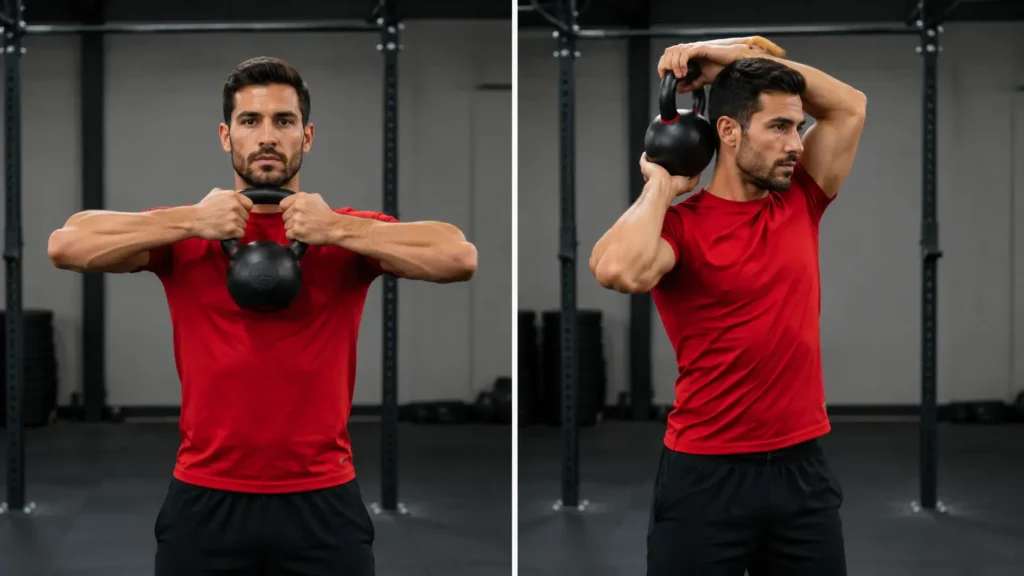
Circling the bell around your head trains rotational control and shoulder mobility together, and it barely takes any space, which makes it perfect for small home gyms.
How to do it:
- Hold the kettlebell upside down by the horns, close to your chest.
- Keep your core braced and your ribs pulled down.
- Circle the kettlebell around your head, passing it from hand to hand behind your neck.
- Move slowly and keep your torso still. Only your arms and the kettlebell should move.
- Complete the circle in one direction, then reverse and repeat.
- Keep your elbows slightly bent so the kettlebell doesn’t scrape too close to your skull.
Kettlebell Wood Chop
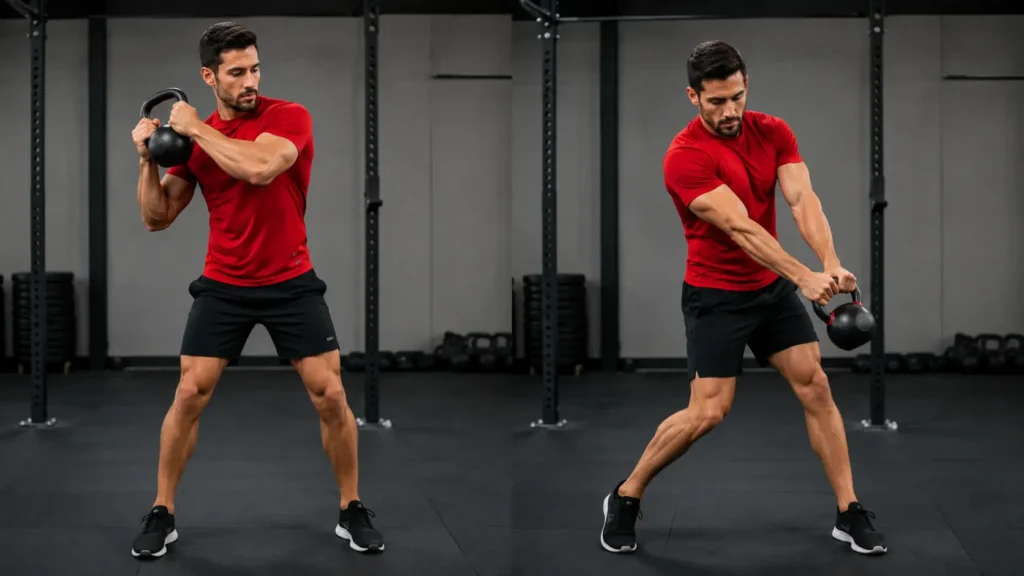
Hold the kettlebell with both hands and rotate diagonally from high to low, like you’re actually chopping wood. This mimics real-world rotational movement better than most machine exercises ever could.
How to do it:
- Stand with feet shoulder-width apart and hold the kettlebell with both hands near one shoulder.
- Rotate your torso and hips as you pull the kettlebell diagonally down toward the opposite hip.
- Let your back heel pivot naturally as you rotate, like you’re actually swinging an axe.
- Reverse the motion back to the starting position with control.
- Complete all reps on one side before switching to the other.
- Keep the movement smooth. Jerking the kettlebell defeats the purpose.
Kettlebell Side Bends
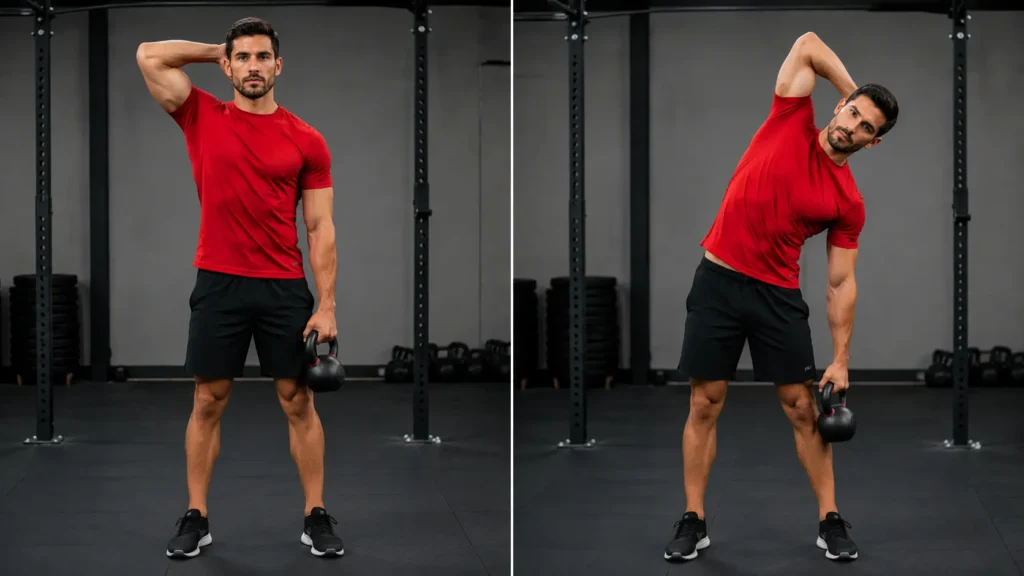
Stand tall, hold the bell in one hand, and bend sideways at the waist. This isolates the obliques directly and is a staple in many kettlebell abs workout for beginners routines.
How to do it:
- Stand tall with feet hip-width apart and hold the kettlebell in one hand at your side.
- Keep your other hand relaxed at your side or behind your head.
- Bend sideways at the waist, lowering the kettlebell down your leg without leaning forward or backward.
- Go only as far as your obliques allow, not as far as gravity wants to pull you.
- Return to standing by contracting your side muscles, not by swinging the weight.
- Finish all reps on one side, then switch the kettlebell to the other hand.
Kettlebell Overhead Carry
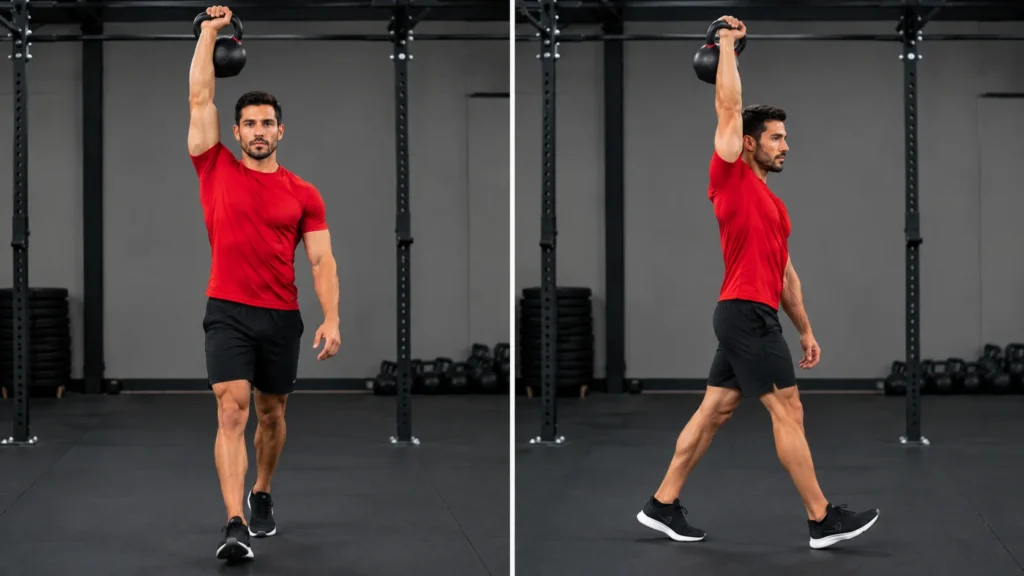
Press the kettlebell overhead and walk in a straight line while keeping your ribs down and core tight. Your shoulder stability and core endurance both get tested at the same time.
How to do it:
- Press the kettlebell overhead with one arm until your elbow is fully locked.
- Stack the kettlebell directly over your shoulder, not out in front or behind.
- Pull your ribs down and brace your core so your lower back doesn’t arch.
- Walk forward in a straight line with slow, controlled steps.
- Keep your eyes forward and avoid glancing up at the kettlebell.
- Switch arms once you’ve completed the set distance or time, and repeat.
Standing Kettlebell Core Exercises (No Floor Work Needed)
Not everyone loves lying on a gym floor that smells faintly of rubber and regret. Good news: several of the exercises above are standing kettlebell core exercises, including the suitcase carry, overhead carry, halo, windmill, and wood chop.
Standing core work carries a practical bonus. It trains your midsection in the same upright position you actually use in daily life, whether you’re carrying groceries or catching a toddler mid-jump.
Easy Kettlebell Core Workout at Home
You don’t need a full gym setup. One kettlebell and a few square feet of floor space is enough for an easy kettlebell core workout at home.
Try this simple routine, three times a week:
- Kettlebell Dead Bug: 3 sets of 8 reps per side
- Kettlebell Halo: 3 sets of 10 reps
- Kettlebell Russian Twists: 3 sets of 12 reps per side
- Kettlebell Suitcase Carry: 3 sets of 30 seconds per side
Rest 30 to 45 seconds between sets. This routine works as a standalone kettlebell core workout, or as a finisher after a strength session.
Kettlebell Exercises for Core Stability
Strength and stability are not the same thing. Strength is how much force you can produce. Stability is how well you resist unwanted movement, especially rotation and side-bending.
The dead bug, plank drag, and suitcase carry all fall firmly into this category. They’re less about how hard you can pull and more about how well you can resist a force trying to pull you off balance. That skill translates directly to injury prevention, which is exactly why physical therapists frequently recommend anti-rotation training as part of rehab and prehab programs.
Kettlebell Core Exercises for Women and Men: Does It Matter?
Short answer: not really. The muscles in your core don’t check your gender before deciding whether to contract.
Kettlebell core exercises for women and kettlebell core exercises for men use identical movement patterns. The real variables that matter are starting strength, prior training experience, and personal goals, not gender. A beginner of any gender should start with lighter bells and focus on form. An experienced lifter of any gender can push load and complexity further.
If you’ve seen “women’s kettlebell workouts” marketed differently, that’s usually a marketing choice rather than a physiological one.
Full Body Kettlebell Workout With Core Exercises
Your core rarely works in isolation outside the gym, so it makes sense to train it that way too. A full body kettlebell workout with core exercises blends compound lifts with targeted core work.
A sample structure:
- Kettlebell Swing: 4 sets of 12 reps
- Kettlebell Goblet Squat: 3 sets of 10 reps
- Kettlebell Turkish Get-Up: 3 sets of 3 reps per side
- Kettlebell Wood Chop: 3 sets of 10 reps per side
- Kettlebell Plank Drag: 3 sets of 30 seconds
This format hits your legs, hips, shoulders, and midsection in one session, which makes it efficient for anyone short on gym time.
Common Mistakes to Avoid
Even good exercises go wrong with bad execution. Watch out for these:
- Rushing the Turkish get-up. Speed ruins the point of this exercise. Slow down.
- Holding your breath. Bracing does not mean suffocating. Breathe out on exertion.
- Choosing a kettlebell that’s too heavy too soon. Your core will find a shortcut, usually your lower back, and it won’t thank you later.
- Skipping warm-ups. Cold hips and shoulders make windmills and get-ups riskier than they need to be.
Final Thoughts
Kettlebell core exercises offer something most ab-specific machines can’t: real-world stability, rotational strength, and full-body coordination, all from one piece of equipment. Whether you’re doing a quick kettlebell ab workout at home or building it into a full strength program, consistency matters more than intensity.
Start with the basics, respect your form, and let your core catch up to your ambition. It usually does, given enough honest reps.
Sources
- American Council on Exercise (ACE)
- National Academy of Sports Medicine (NASM)
- Mayo Clinic, Health & Fitness section
- Harvard Health Publishing
- National Strength and Conditioning Association (NSCA)

Hi, I’m Salem Nasir, founder of Fiturely. I research and write evidence-based articles on fitness, nutrition, weight loss, and healthy living. My mission is to make reliable health information simple, practical, and easy to understand so readers can build healthier habits with confidence
Pingback: Want to Train Like Joe Rogan? Try These Kettlebell Exercises - fiturely.com